

Throwball is a non-contact team sport played between two teams of seven players, with a net separating the two sides. The sport is similar to volleyball in its court setup, but instead of hitting or volleying the ball, players catch and throw it over the net.
The throwball court measurement, including the court size, net height and line markings, plays an important role in how the game is organised and played. The standard court measures 18.3 metres in length and 12.2 metres in width for Senior, Youth and Junior categories, while the dimensions and net height vary for younger age groups. This guide covers the standard throwball court measurements, court markings, zones, net height, and measurements in metres and feet.
The Standard Throwball Court Measurement
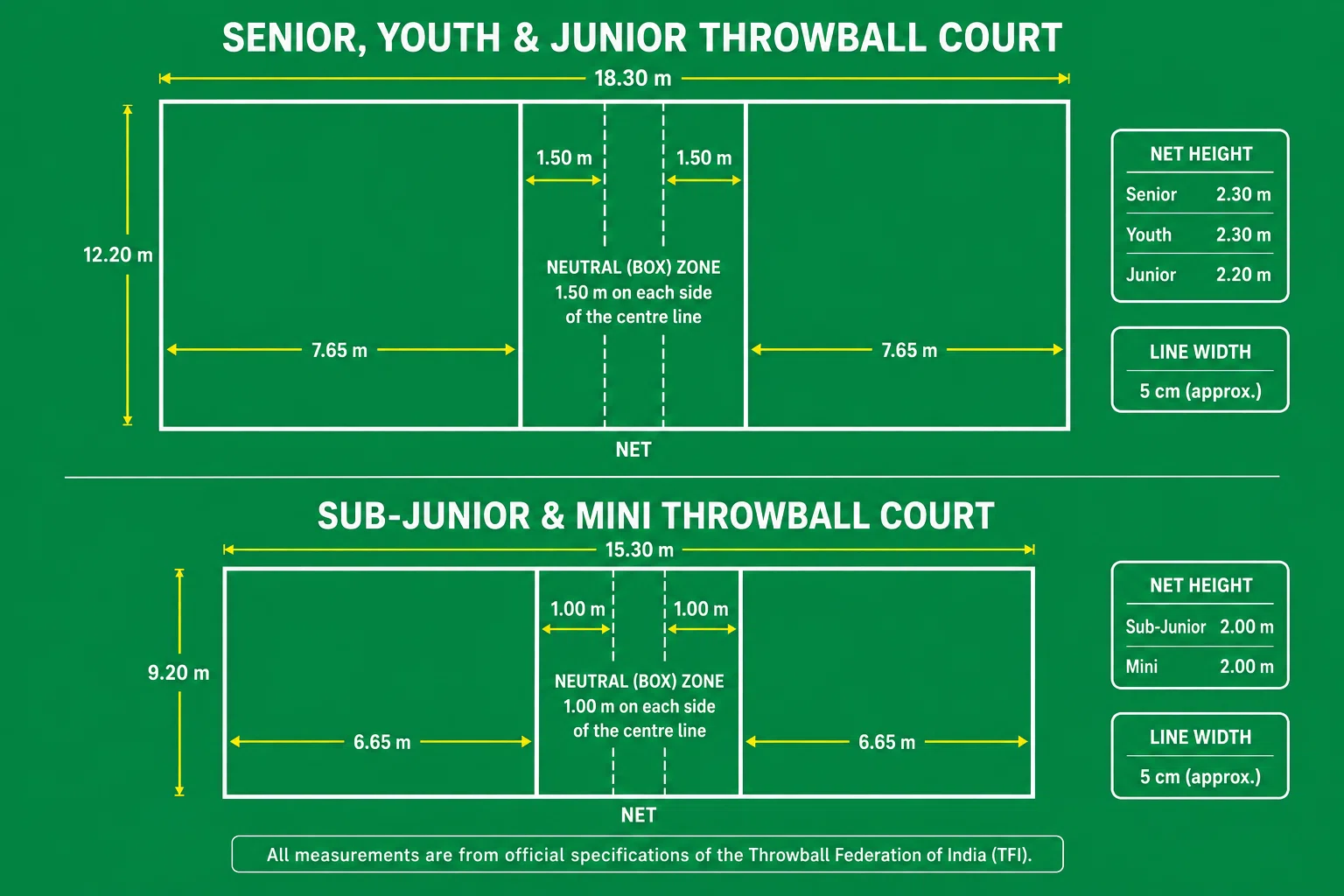
A standard throwball court measurement for Senior, Youth and Junior categories is 12.2 meters wide and 18.3 meters long. The court is divided into two equal halves by the centre line and net.
- Length: 18.3 meters
- Width: 12.2 meters
- Centre Line: Divides the court into two equal halves, each measuring 9.15 meters × 12.2 meters.
- Neutral/Box Zone: Extends 1.5 meters on either side of the centre line for Senior, Youth and Junior categories.
For Sub-Junior and Mini categories, the court measures 15.3 meters long and 9.2 meters wide. These measurements are followed in official throwball competitions to maintain consistency in the way the game is played.
Throwball Court Dimensions by Age Category
| Category | Court Length | Court Width | Net Height |
| Senior | 18.3 m | 12.2 m | 2.3 m |
| Youth | 18.3 m | 12.2 m | 2.3 m |
| Junior | 18.3 m | 12.2 m | 2.2 m |
| Sub-Junior | 15.3 m | 9.2 m | 2.0 m |
| Mini | 15.3 m | 9.2 m | 2.0 m |
The Net and Its Height
No game of throwball is complete without its iconic net. For Senior and Youth categories, the throwball net height is 2.3 meters (7 feet 6.5 inches) from the ground. For Junior categories, it is 2.2 meters (7 feet 2.6 inches), while Sub-Junior and Mini categories use a net height of 2 meters (6 feet 7 inches).
The net is placed above the centre line and supported by poles on either side. It’s always a good idea to check the net height before the game because even a small difference can affect play.
Lines and Markings You Should Know
When you’re looking at a throwball court diagram, you’ll notice more than just a rectangle and a net. There are specific lines and zones that make the game organised:
- Centre Line: Splits the court into two halves.
- Neutral/Box Zone: The area around the centre line, extending 1.5 meters on either side for Senior, Youth and Junior categories.
- Service Area: The designated area from which the player serves the ball.
- Boundary Lines: The outer lines marking the playable area.
- Front, Centre and Back Zones: Each side of the court is divided into three playing zones.
The court lines are approximately 5 cm wide, making it easier for players and officials to identify the boundaries and different areas of play.
Throwball Court Measurement in Meters vs Feet
A lot of people search for throwball court measurements in meters and in feet for various reasons. To clear that up:
- Length: 18.3 meters = about 60 feet
- Width: 12.2 meters = about 40 feet
- Senior/Youth Net Height: 2.3 meters = about 7 feet 6.5 inches
- Junior Net Height: 2.2 meters = about 7 feet 2.6 inches
- Sub-Junior/Mini Net Height: 2 meters = about 6 feet 7 inches
For Sub-Junior and Mini categories, the court measures approximately 50.2 feet × 30.2 feet.
Why These Measurements Matter
At first, these numbers might feel like just numbers. But think about it, if the court were smaller, rallies would end way faster. If the net were higher, fewer throws would make it across. Every aspect of the throwball court dimensions is designed to keep the game balanced, fair, and exciting.
That’s why schools, colleges, and clubs all follow the official throwball court measurements. It keeps the rhythm of the throwball game intact, no matter where you play.
Setting Up Your Own Throwball Court
If you’re planning to set up a throwball ground for practice or fun, here’s a quick checklist:
- Mark out the rectangle (18.3m × 12.2m for Senior, Youth and Junior categories).
- Draw the centre line, service area and other required markings.
- Mark the neutral/box zone around the centre line.
- Put up the net at the appropriate height for the age category.
- Double-check your boundaries so players don’t argue mid-game.
Many schools and residential communities already have volleyball courts that can be adjusted to match throwball court dimensions. However, the markings and dimensions should be checked carefully before using the court for competitive play.
Fun Facts About Throwball
To keep things interesting, here are a few cool facts you may not know:
- Throwball actually has its roots in England, but grew massively in India, especially among women players.
- Unlike volleyball, there’s no “spike” or “dig”; the main skill here is how smartly and quickly you throw.
- It’s considered a great cardio workout since rallies can go on for long stretches with minimal breaks.
Conclusion
So there you have it, your complete guide to throwball court measurement and everything that goes with it. The court may look simple, but every meter and every line plays a big role in making throwball what it is: fast, energetic, and addictive once you get the hang of it.
If you’re setting one up, just follow the standard throwball court measurements, and you’ll have a perfectly playable ground. And who knows, you might just end up introducing more people to this underrated but super engaging sport.
Check out more sports-related blogs here!
Download Playo on Android or iOS, or visit playo.co to start playing!
Frequently Asked Questions
The standard throwball court measurement for Senior, Youth and Junior categories is 18.3 m long and 12.2 m wide (60 ft × 40 ft). For Sub-Junior and Mini categories, it is 15.3 m × 9.2 m.
The standard throwball net height is 2.3 m for Senior and Youth categories, 2.2 m for Juniors, and 2 m for Sub-Junior and Mini categories.
The standard throwball court measures approximately 60 feet long and 40 feet wide for Senior, Youth and Junior categories. Sub-Junior and Mini courts measure approximately 50.2 feet × 30.2 feet.
The neutral or box zone is the area around the centre line. For Senior, Youth and Junior categories, it extends 1.5 m on either side of the centre line.
A throwball team has seven players on the court at a time. Teams may also have substitutes, depending on the competition rules.
Each side of a standard throwball court is divided into Front, Centre and Back Zones, which define the different areas of play.