

If you’ve ever watched a cricket match and heard a commentator exclaim, “He’s smashed it straight to cow corner!” you might have paused, puzzled. Cow corner? Is that an actual place on the cricket field, and why would it be named after livestock? You are not alone. Cricket is known for its quirky terminology, such as silly point, fine leg, and cow corner, and while some positions sound obvious, others leave fans wondering what they really mean.
Among these, cow corner in cricket stands out as one of the most oddly charming terms in the sport. In this guide, we will break down exactly what cow corner is, where it is located on the field, how it got its unusual name, and why this seemingly humorous position has become strategically important in modern cricket. Whether you are a casual viewer, a budding player, or a seasoned fan, this will help you understand the mystery of cow corner more clearly.
What Exactly is Cow Corner in Cricket?
Cow corner is the deep leg-side area between long-on and deep mid-wicket where batters commonly target big shots. Cow corner is an informal fielding region on the leg side of the cricket field and is not an officially marked position, but it is widely used in cricketing language by players, commentators, and analysts.
Unlike fixed fielding positions, cow corner refers to a general zone rather than a precise spot. It is known as a high-scoring area where batters often aim powerful shots to clear the boundary. Because of this, it plays an important role in both batting strategy and field placements, especially in limited-overs formats like T20s and ODIs.
Where Exactly is the Cow Corner on the Cricket Field?
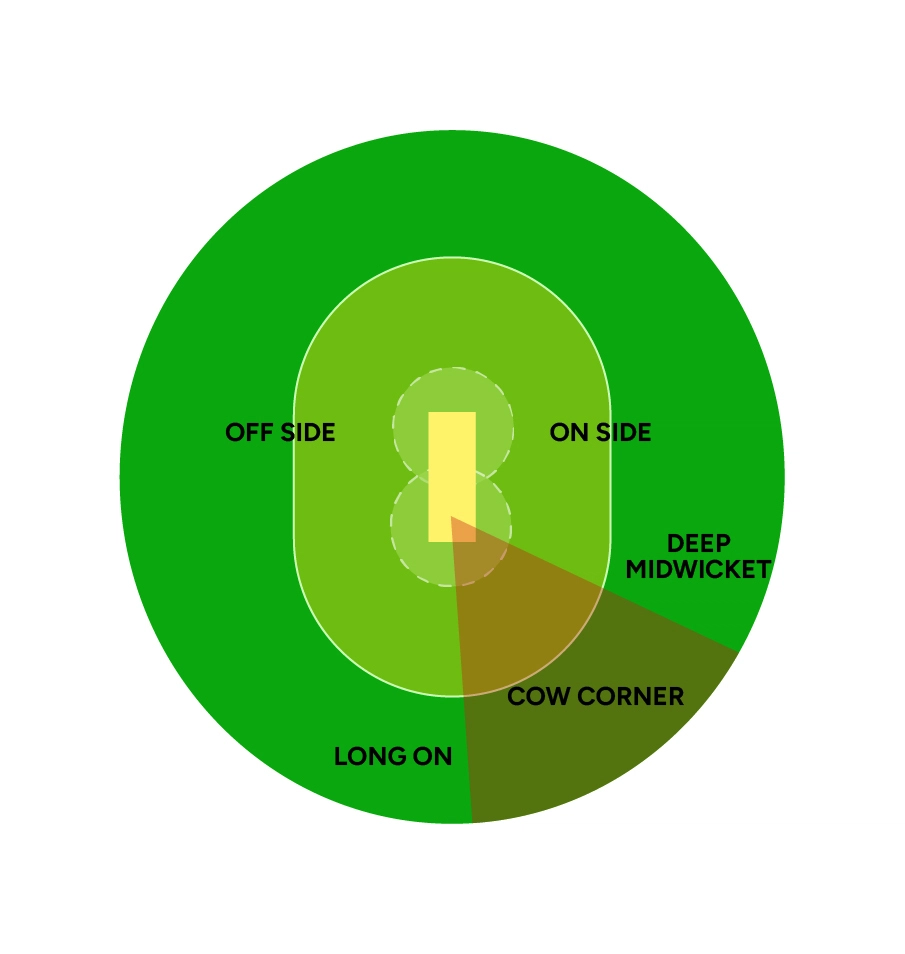
Understanding the cow corner becomes easier when you visualise the cricket field from the batter’s perspective. For a right-handed batter, two key fielding positions help identify this area. Long-on is positioned almost straight down the ground on the leg side near the boundary, while deep mid-wicket lies more square on the leg side, also close to the boundary. Cow corner lies between these two positions, forming a diagonal zone toward the leg-side boundary. From the batter’s point of view, it sits at roughly a 45-degree angle, making it a natural target for aggressive shots played over the infield.
This region has become a go-to scoring area, especially in modern cricket. Batters frequently target the cow corner with powerful strokes such as the slog, slog sweep, cross-batted hits, and the iconic helicopter-style shot. These shots rely on strong bat swing and timing rather than classical technique, which is why they are so effective for clearing the boundary in this zone.
Modern players like AB de Villiers, Glenn Maxwell, and Jos Buttler have mastered hitting in this region, consistently turning it into a high-scoring hotspot. For left-handed batters, the position mirrors the opposite side of the field, but the concept remains the same: cow corner is the deep leg-side zone built for aggressive, attacking play.
Why is it Called Cow Corner in Cricket?
The term cow corner may sound humorous, but it has its roots in cricket’s early history. It is widely believed to have originated in 19th-century England, where matches were often played on open, shared grounds rather than dedicated stadiums. These fields were commonly used for grazing livestock, and cows could often be seen wandering around parts of the ground.
During that time, batting focused more on timing and placement rather than power hitting. As a result, certain deep leg-side areas were rarely targeted by batters. These quieter zones remained largely undisturbed, making them a convenient spot for cows to graze. Over time, players began referring to this region as “cow corner,” and the name continued to stick even as cricket evolved into a more professional sport.
Popular Theories Behind the Name
While the explanation above is the most widely accepted, a few other popular theories add depth to the origin of the term:
1. The Grazing Theory: In early cricket, very few shots were played toward this deep leg-side area. Because of this, it was jokingly said that even cows could graze there peacefully without being disturbed by the game.
2. The Dulwich College Connection: Another theory links the term to Dulwich College in England, where cattle were reportedly kept near a section of the cricket field. Over time, that part of the ground came to be known as cow corner.
3. The “Agricultural Shot” Link: Shots played toward this region were once considered unrefined or unorthodox. Batters who lacked proper technique often swung across the line, sending the ball in that direction. These were humorously called “agricultural shots,” reinforcing the association with rural imagery and the term cow corner.
Understanding Cow Corner in Cricket Position and Role
Here’s a quick overview of the cow corner in cricket, including its position, purpose, and role in both batting and fielding strategies:
| Aspect | Details |
| Location | Between long-on and deep mid-wicket on the leg side, near the boundary |
| Best For | Defending against big leg-side hits and setting catching opportunities |
| Batting Use | Targeted for powerful shots like sixes and boundary hits |
| Fielding Role | Boundary fielder positioned to stop or catch aerial shots |
| Format Relevance | Most important in T20s and ODIs; less prominent in Test cricket |
Evolution of Cow Corner in Modern Cricket
Cow corner hasn’t always been the high-impact scoring zone we see today. In traditional cricket, playing across the line toward the leg side was often discouraged. Coaches focused on textbook technique, encouraging straight-batted shots like drives and defensive play. As a result, hitting toward the cow corner was seen as risky, unorthodox, and something to avoid rather than exploit.
Earlier Cricket:
- Shots to the cow corner were considered risky and unrefined
- Greater focus on classical strokes like straight drives
- This region was less targeted and less protected by fielders
Modern Cricket:
- Cow corner is now a primary scoring zone
- T20 cricket promotes innovation, power hitting, and intent
- Players actively train to target the leg-side boundary
The shift began with the rise of limited-overs formats and accelerated with T20 leagues, where strike rate often matters more than textbook technique. Today, Cow Corner is no longer a low-percentage option. It is a calculated, high-reward strategy that defines modern batting.
Why Cow Corner is Crucial in Modern Cricket
In modern cricket, especially in ODIs and T20s, cow corner is a key scoring zone. It is heavily targeted for power hitting because it aligns with the natural leg-side swing of the bat, with players like Glenn Maxwell, Jos Buttler, and Suryakumar Yadav consistently exploiting this area.
- High Scoring Potential: Cow corner offers high scoring potential as it allows batters to generate power with minimal adjustment. This is why many sixes in white-ball cricket are hit in this region.
- Fielding Restrictions Advantage: During powerplays, fewer boundary fielders create more opportunities to target the deep leg-side. This forces bowlers to vary their lines and avoid predictability.
- Death Overs Impact: In the final overs, batters target the cow corner to maximise runs. Fielders are placed here to prevent boundaries and create catching chances, while also applying pressure that can lead to mistimed shots.
Batting Techniques to Target Cow Corner Successfully
For batters, the cow corner is both a high-reward scoring zone and a calculated risk. Targeting this area effectively requires a mix of power, timing, and awareness of field placement rather than just brute force.
Key shots used to exploit the cow corner include:
- Lofted Drive: A controlled, full-face shot played over the infield, ideal for clearing the boundary in this region.
- Pull or Slog Sweep: Common against spin or short-pitched deliveries, allowing batters to generate power and target the deep leg-side.
- Helicopter Shot: Popularised by MS Dhoni, this wrist-driven shot helps whip yorkers and full deliveries into the cow corner with surprising elevation.
- Batting Tip: Avoid swinging blindly. Always read the field. If the cow corner is open or the fielder is inside the circle, it’s a scoring opportunity. If a boundary fielder is in place, aim for gaps or keep the shot along the ground to reduce risk.
Conclusion
Cow corner may sound like a quirky term, but it plays a crucial role in modern cricket. From its origins as an overlooked part of the field to becoming a key scoring and strategic zone, it reflects how the game has evolved over time. Understanding cow corner not only helps you follow matches better but also gives you insight into batting strategies, field placements, and modern power hitting.
Download Playo on Android or iOS, or visit playo.co to start playing!
Frequently Asked Questions
Cow corner in cricket refers to the deep leg-side area between long-on and deep mid-wicket, typically near the boundary. It is not an official fielding position but a commonly used term to describe this zone, which is frequently targeted for powerful shots, especially in limited-overs formats like T20s and ODIs.
The term “cow corner” is believed to have originated in early cricket played on open grounds in England, where livestock often shared the field. Since this deep leg-side area was rarely targeted by batters, it was humorously described as a place where cows could graze undisturbed. Over time, the name became widely accepted in cricketing language.
A boundary fielder, often referred to as a deep mid-wicket or long-on variant depending on placement, is positioned at cow corner. This fielder’s role is to stop boundaries, take catches from aerial shots, and support adjacent fielders in the deep leg-side region.
Cow corner is generally safer than close-in positions like slip or short leg because fielders stand farther from the batter. However, it still requires strong catching ability, awareness, and boundary judgment, as players often deal with high catches and fast-travelling shots.
In cricket, a score of zero is called a “duck” because the number 0 resembles a duck’s egg. The term originated from the phrase “duck’s egg” in British English and was later shortened to just “duck” in cricket terminology.