

Cricket fielding positions define how a team controls scoring areas and creates wicket-taking opportunities. Every placement on the field is deliberate, based on the batter’s scoring patterns, the bowler’s line and length, and the match situation. From close-in catchers like slip and short leg to boundary riders like long-on and third man, each position is designed to either cut off runs or force mistakes. Understanding these placements reveals the tactical layer of cricket that goes beyond just batting and bowling.
For many, terms like gully, silly point, cow corner, or sweeper cover can feel confusing at first. However, these positions follow a clear structure built around off side, leg side, angles, and distance from the batter. Once you grasp this system, field setups become easier to read, helping you understand captaincy decisions, anticipate strategies, and follow the game with far greater clarity.
This comprehensive guide breaks down every major cricket fielding position, explains its tactical role, and shows you how captains use them to control runs, build pressure, and take crucial wickets.
Cricket Field Layout: Off Side, Leg Side and Fielding Zones
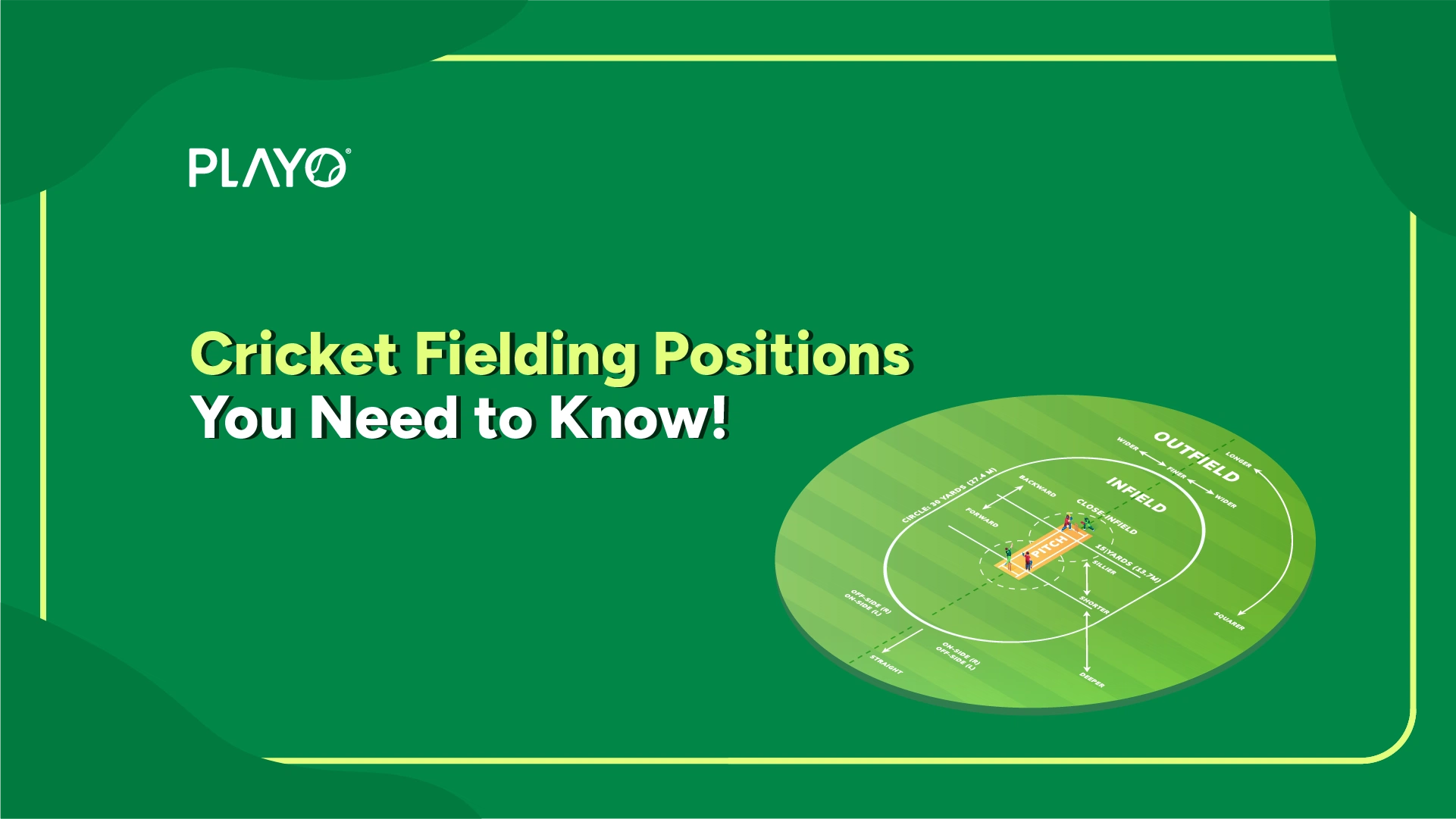
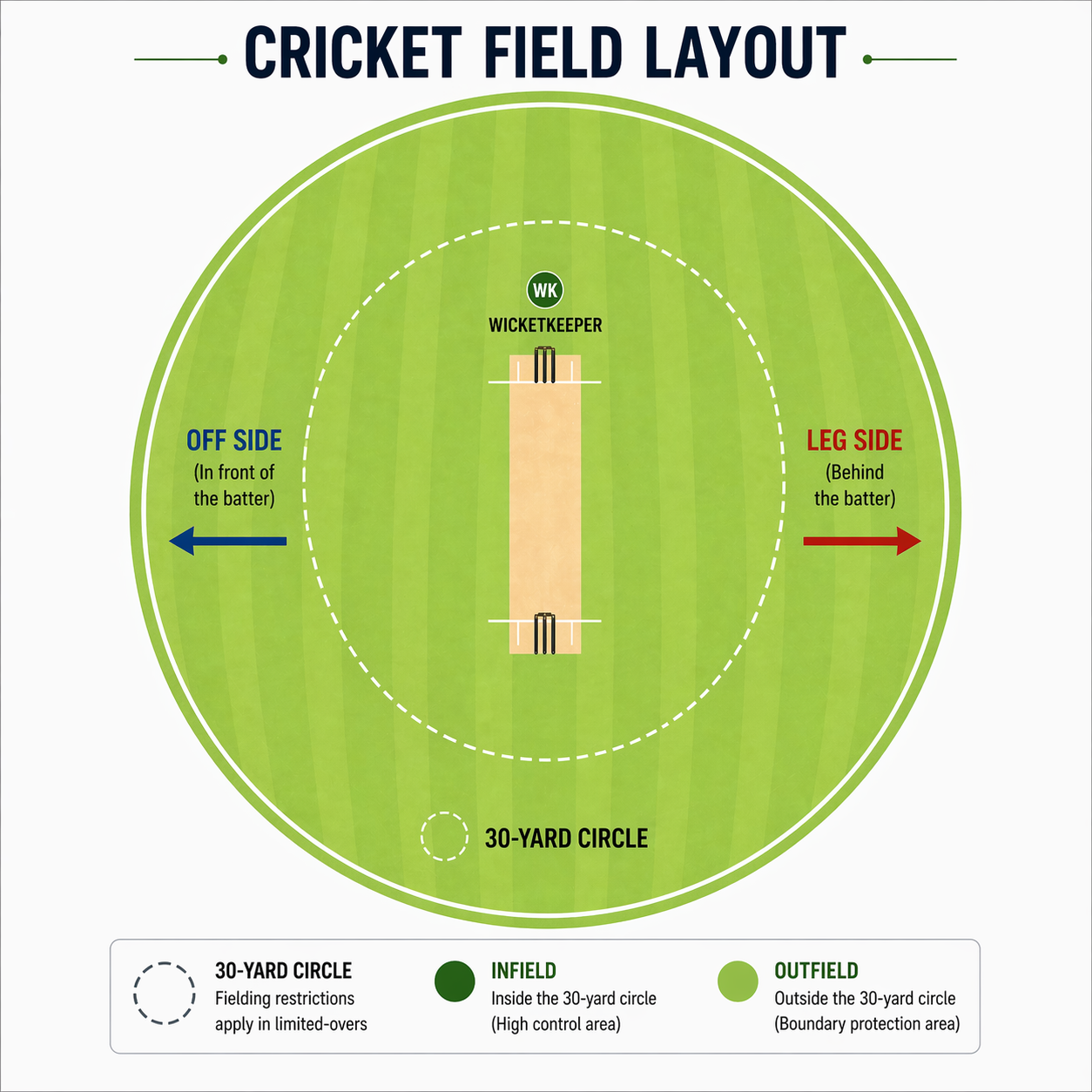
Before diving into specific positions, it’s crucial to understand how the cricket field is divided. Unlike fixed-field sports like football or basketball, cricket’s field is circular and highly flexible, but it follows a clear anatomical logic based on the batter’s stance.
Off Side vs. Leg Side (On Side)
Imagine a right-handed batter taking their stance at the crease. Draw an imaginary line straight down the pitch through the stumps. Everything to the batter’s right is the off side, while everything to their left is the leg side (often called the on side). For a left-handed batter, these sides are simply reversed.
The off side is traditionally associated with classical stroke play: drives, cuts, and deft placements. The leg side, on the other hand, hosts more aggressive, wrist-driven shots like pulls, flicks, hooks, and slogs. Captains use this natural shot preference to cluster fielders where runs are most likely to be scored.
The 30-Yard Circle: Infield vs. Outfield
Modern cricket heavily regulates field placements through the 30-yard circle (a painted oval extending 30 yards (27.4 metres) from the centre of the pitch). This circle dictates field restrictions in limited-overs cricket:
- Powerplay Overs (ODI/T20): Only 2 fielders allowed outside the 30-yard circle.
- Middle Overs (ODI): Maximum of 4 fielders outside.
- Death Overs: Restrictions ease, allowing more boundary riders.
The infield (inside the circle) focuses on preventing quick singles, building dot-ball pressure, and creating catching opportunities. The outfield (beyond the circle) is dedicated to boundary prevention, requiring speed, anticipation, and strong throwing arms.
Close-In Fielding Zone
Positions within 5–10 yards/5–9 metres of the batter form the close-in field. These are high-intensity, high-risk roles primarily used against spin bowlers or on turning tracks. Fielders here wear helmets, chest guards, and thigh pads due to the risk of bats or balls deflecting. Their job isn’t to stop runs, but it’s to capitalise on split-second edges, bat-pad deflections, and mistimed flicks.
Essential Cricket Fielding Positions
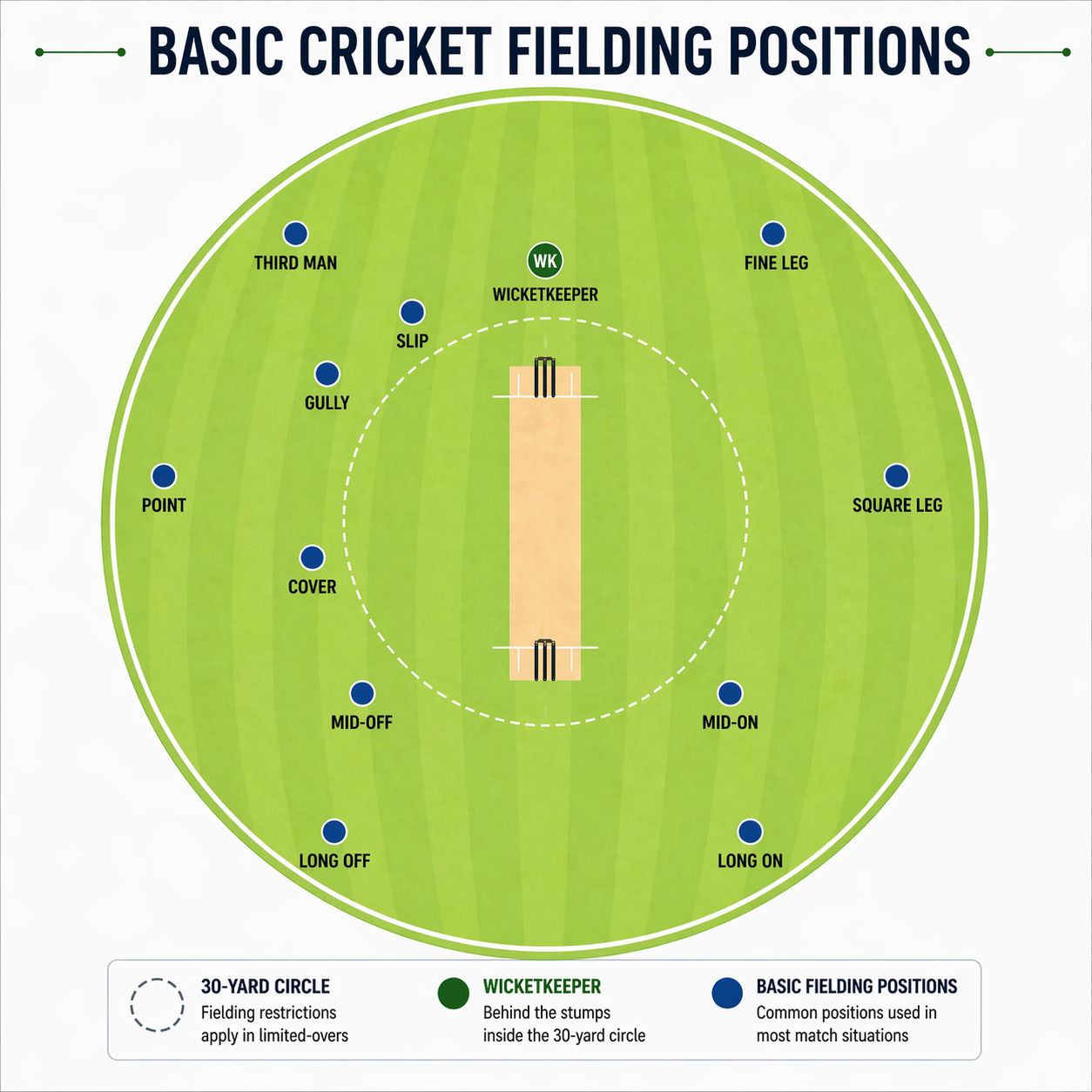
These are the foundational positions you’ll see in almost every match, across all formats. Understanding them is the first step to reading cricket like a seasoned analyst.
Wicketkeeper and Slip Cordon
The wicketkeeper is the only fielder allowed to wear gloves and stand directly behind the stumps. They’re involved in nearly every delivery, handling catches, stumpings, run-outs, and acting as the captain’s on-field tactical voice.
The slip cordon sits diagonally behind the batter on the off side, aligned with the wicketkeeper’s outside edge line. Slips are the primary catching zone for fast and medium-fast bowlers. Depending on pitch bounce and bowler accuracy, captains deploy 2 to 4 slips. A first slip takes the sharpest edges, while second/third slips cover slightly wider deflections.
Gully, Point and Cover
Gully sits wider than the slip cordon, almost square to the batter. It’s designed to catch thick edges or square deflections that don’t carry to slip. Requires quick reflexes and soft hands.
The point is positioned square on the off side, roughly 15–20 yards (around 14–18 metres) out. Its primary role is to cut off square drives, cut shots, and prevent quick singles through the off-side arc. A strong point fielder can single-handedly choke a batter’s scoring rate.
Cover sits between point and mid-off, angled slightly forward. It’s the classic catching and stopping zone for elegant off-side drives. Extra cover is slightly straighter than cover, used when batters favour lofted or driven shots down the ground on the off side.
Mid-Off and Mid-On
These are the straight-down-the-ground fielders. Mid-off (off side) and mid-on (leg side) typically stand 20–30 yards (around 18–27 metres) from the batter, aligned with the bowler’s run-up. They stop straight drives, prevent quick singles, and often act as tactical decoys to force batters into less comfortable shots. In limited-overs cricket, they’re frequently pushed deeper during the death overs to protect straight boundaries.
Square Leg, Fine Leg and Third Man
Square leg sits on the leg side, roughly aligned with the popping crease. It stops flicks, nudges, and working shots into the leg side. Fine leg is positioned behind the square on the leg side, near the boundary, to catch glances, deflections, or mistimed pulls. Short fine leg brings this position closer to the batter for catching opportunities against spin.
The third man is the off side equivalent of fine leg, stationed behind the batter near the boundary. It catches edges that fly over the keeper or slip cordon, especially on pitches with variable bounce or when bowlers pitch the ball short.
Long-On and Long-Off
These are deep boundary positions on the leg and off sides, respectively. Long-on stops big straight hits, slog sweeps, and lofted drives down the ground. Long-off covers the same role on the off side. In T20s, they’re often positioned slightly angled to cover the batter’s preferred hitting arc, and their throwing accuracy is critical to prevent overthrows and quick doubles.
Advanced and Tactical Cricket Fielding Positions
As matches progress or formats shift, captains deploy specialised positions to exploit batter weaknesses or bowler strengths. These roles require intense focus, specialised training, and sometimes protective gear.
Silly Point and Short Leg
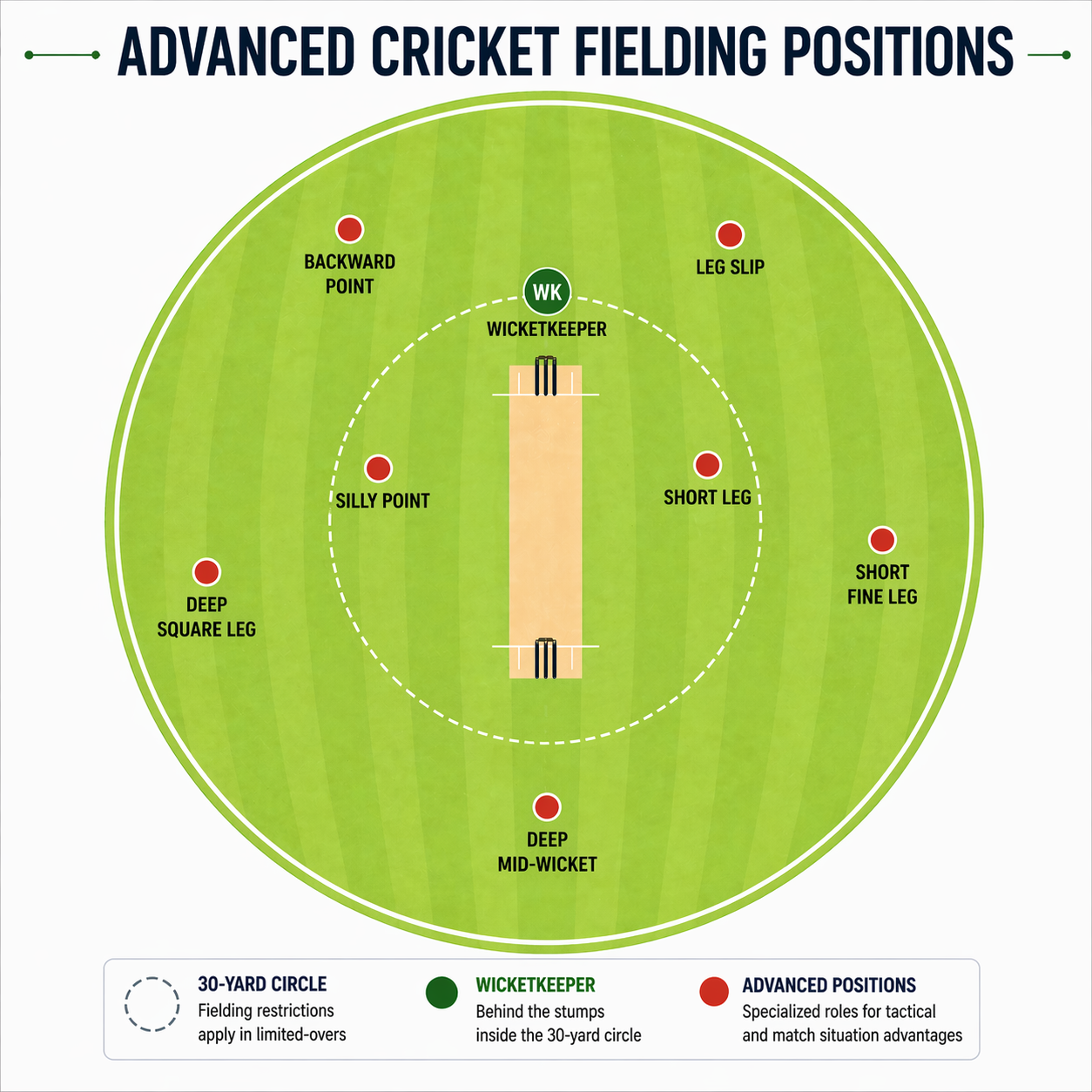
Silly point sits extremely close to the batter on the off side, often just 3–5 yards away. It’s almost exclusively used against spin bowlers to catch quick deflections off the bat’s leading edge or outside edge. The position demands courage, lightning reflexes, and excellent hand-eye coordination.
Short leg mirrors silly point, but on the leg side. It targets bat-pad deflections, inside edges, and mistimed flicks. Because of the proximity, fielders wear comprehensive protective gear. Short leg is a psychological weapon as much as a tactical one. Batters often alter their shot selection to avoid hitting directly at the fielder.
Leg Slip and Backward Point
Leg slip is placed behind the batter on the leg side, catching faint edges, deflections off the pads, or glances that don’t carry to fine leg. It’s rare but highly effective on turning tracks or against batters who play across the line.
The backward point sits slightly behind the traditional point position. It’s used to cut off late cuts, square drives played late, and deflections that go behind the square on the off side. Particularly useful against batters who play the ball later than usual or on slower pitches where timing is delayed.
Deep Mid-Wicket and Deep Square Leg
Deep mid-wicket is stationed near the boundary between square leg and long-on. It’s the primary defence against powerful pull shots, hook shots, and cross-batted slogs. A skilled deep mid-wicket fielder reads the batter’s hip rotation and steps into the shot early to cut off boundaries.
Deep square leg operates similarly but focuses on shots played fine and powerful on the leg side. It’s often rotated with deep mid-wicket depending on the batter’s hitting preference.
Short Fine Leg and Bat-Pad
Short fine leg is a catching position placed 10–15 yards (around 3–5 metres) behind the batter on the leg side. It targets mistimed flicks, inside edges, and deflections that drop short rather than fly to the boundary.
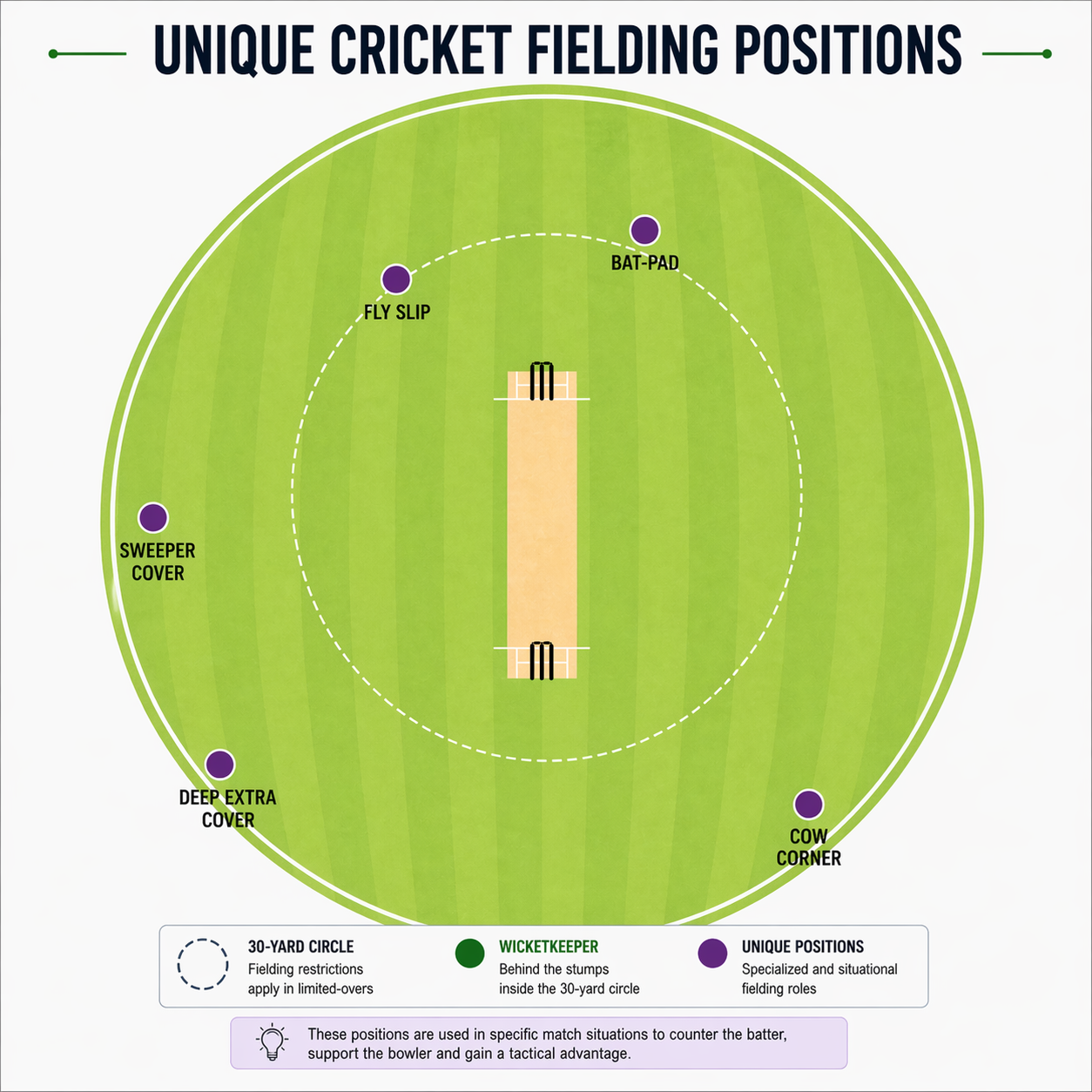
Bat-pad is a specialised close-in position used almost exclusively against spin. The fielder stands 2–3 yards (around 2–3 metres) away, directly in line with the batter’s front pad, waiting for deflections that occur between the bat and pad as the batter defends or plays forward. It’s high-risk, high-reward, and requires exceptional anticipation.
Unique and Strategic Field Placements
Cricket’s rich history and evolving tactics have given rise to several uniquely named positions that reflect cultural quirks, tactical developments, or specific match situations.
Cow Corner
Located deep on the leg side between mid-wicket and long-on, cow corner isn’t an official coaching term but a widely recognised commentary phrase. It’s where batters often aim big slog shots, and where fielders are stationed to catch mistimed heaves. The name likely originates from rural cricket grounds, where that corner of the field was literally where cows grazed.
Sweeper Cover and Deep Extra Cover
Sweeper cover is a T20 and ODI innovation. Positioned wide and deep on the off side, it “sweeps” the boundary arc to stop aggressive cover drives and lofted cuts. It’s often paired with a deep point to create a defensive wall against modern power-hitting.
Deep extra cover sits slightly straighter than sweeper cover, targeting straighter off-side boundaries. It’s frequently used against batters who favour the lofted drive or play with an open face to clear the infield.
Fly Slip
A wider, slightly deeper version of the traditional slip, the fly slip is occasionally deployed against aggressive openers or on pitches with extra carry. It’s designed to catch edges that fly over the standard slip cordon but don’t reach third man. It’s a hybrid attacking/defensive position that requires excellent lateral movement and safe hands.
Read More: What is Cow Corner in Cricket?
How Captains Decide Fielding Placements
Field settings are never arbitrary. Modern captains blend traditional cricket wisdom with data analytics, pitch reports, and real-time match situations to optimise their cricket fielding positions.
Bowler Type and Delivery Pattern
- Fast/Medium Pacers: Rely on slip cordon, gully, third man, and fine leg to catch edges from seam movement, bounce variation, or short-pitched deliveries.
- Spinners: Deploy silly point, short leg, bat-pad, and leg slip to capitalise on turn, drift, and batter desperation. Close-in fields apply psychological pressure and force errors.
Batter Strengths and Weaknesses
Captains study strike rates, dismissal patterns, and shot selection maps. If a batter scores 40% of runs through the cover region, cover and extra cover will be packed. If they struggle against short balls, fine leg and deep square leg may be pushed in. Modern IPL and international teams use Hawk-Eye and pitch-tracking data to place fielders within a 2-yard margin of a batter’s most frequent scoring zones.
Match Format and Phase
- Test Cricket: Attacking fields with multiple slips, close-in catchers, and minimal boundary riders. Wickets > run rate.
- ODIs: Balanced fields. Powerplay focuses on catching and dot balls; middle overs use ring fielders; death overs prioritise boundary protection.
- T20s: Defensive by default. Sweeper covers, deep mid-wickets, and long-ons dominate. Fielders are often positioned on the batter’s “hot zones” rather than traditional zones.
Pitch, Weather and DRS Considerations
Green tops with seam movement demand more slips and gully. Dry, cracked pitches favour short leg and silly point. Overcast conditions encourage attacking fields. Additionally, captains now consider DRS limitations: if a team has reviews left, they may push fielders back to avoid giving away easy catches that could be overturned.
Conclusion
Cricket fielding positions may seem complex at first, but understanding them makes the game far more engaging. Each position, from slip and cover to deep mid wicket and sweeper cover, plays a specific role in controlling runs and creating wicket opportunities. Captains use these placements strategically based on the batter, bowler, pitch conditions, and match format. As cricket evolves, fielding has become more dynamic and data-driven, with positions constantly adjusting to modern playing styles. Whether you are a beginner or an experienced player, learning fielding positions helps you read the game better and appreciate the tactical depth behind every delivery.
Download Playo on Android or iOS, or visit playo.co to start playing!
Frequently Asked Questions
The off side is the half of the field in front of the batter, while the leg side (or on side) is behind the batter. These sides are determined based on the batter’s stance.
Close-in positions like silly point, short leg, and bat-pad are placed very near the batter to catch quick deflections, especially against spin bowling.
There are 10 ways a batter can be dismissed in cricket: Bowled, Caught, Leg Before Wicket (LBW), Run Out, Stumped, Hit Wicket, Obstructing the Field, Hit the Ball Twice, Timed Out, and Retired Out.
The point is positioned square to the batter on the off side, primarily stopping cut shots and square drives. Cover is slightly forward and angled between point and mid-off, designed to stop drives and lofted off-side shots.
During the power play (overs 1–6), only 2 fielders can be outside the circle. From overs 7–20, a maximum of 5 fielders are allowed outside.
Yes. Captains can adjust field placements after every delivery, though in limited-overs cricket, they must comply with powerplay and circle restrictions.