

Cricket is one of the most widely followed sports in the world, but finding a full-sized ground is not always easy, especially in urban areas. This challenge led to the rise of box cricket, a fast-paced and space-efficient version of traditional cricket designed for smaller, enclosed playing areas. Also known as turf box cricket, the game retains the core excitement of cricket while adapting its rules to suit limited space and shorter match durations. With the rapid growth of artificial turfs across cities in India, box cricket has gained immense popularity in recent years. In this blog, we break down the essential box cricket rules, format, scoring system, and regulations to help you understand how the game is played.
What is Box Cricket?
Box cricket, is a popular variation of traditional cricket. The box cricket meaning has a distinct set of rules and dynamic, fast-paced gameplay. The gameplay and scoring are quite similar to traditional cricket, but special rules are included to accommodate the smaller playing field. The following are some of the main features of box cricket:
- Compared to a regular cricket pitch, the playing surface is a much smaller rectangle or square “box.”
- Participation increases because the game involves fewer players.
- Rules of box cricket have been changed to allow for smaller spaces for play.
Box Cricket vs Traditional Cricket
While box cricket follows the basic principles of traditional cricket, several aspects of the game are modified to suit smaller, enclosed playing areas.
| Feature | Box Cricket | Traditional Cricket |
| Playing Area | Small, enclosed turf or indoor box | Full-size open cricket ground |
| Pitch Length | Shorter pitch, usually 12–18 yards (varies by venue) | Standard 22-yard pitch |
| Team Size | 6–8 players per side | 11 players per side |
| Match Duration | Short and fast-paced | Several hours to multiple days |
| Ball Used | Tennis ball or soft cricket ball | Hard leather cricket ball |
| Bat Type | Standard cricket bat | Standard cricket bat |
| Overs per Innings | Limited overs (venue or format-based) | Format-based (T20, ODI, Test) |
| Bowling Style | Usually underarm or restricted overarm | Overarm bowling |
| Protective Gear | Optional | Mandatory at competitive levels |
| Boundaries | Nets, walls, or enclosure panels | Rope-marked boundaries |
Read More: Box Cricket Dimensions
Why is box cricket popular?
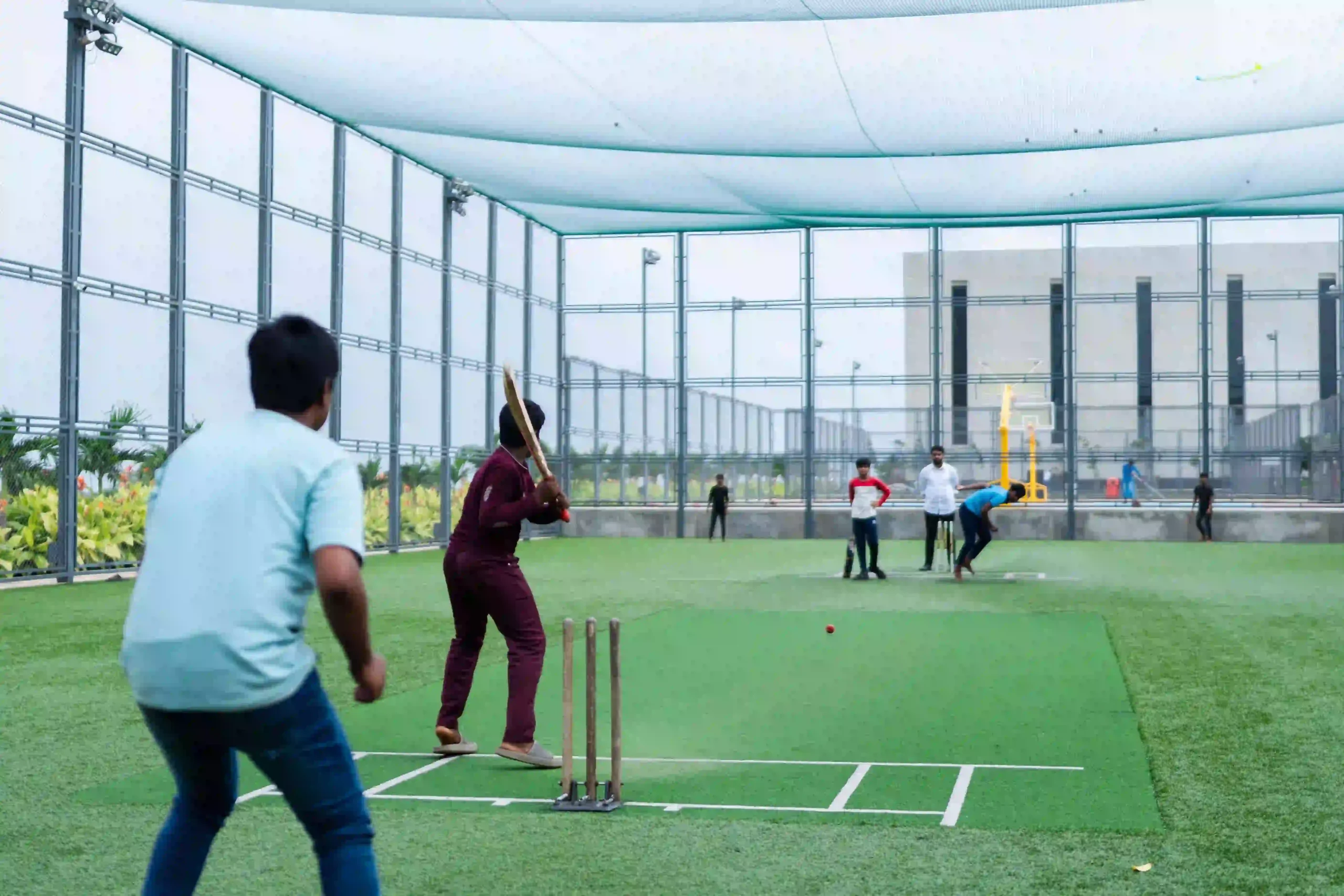
Love cricket but can’t get a field because you live in a city? Fear not! For those living in cities, box cricket is an ideal way to enjoy your favourite game in a more compact setting. The activities are quicker and really simple to master, making them a fun way to get moving without taking up your entire day. It’s also entertaining and ideal for getting together with friends for a lively competition or a relaxed afternoon match. There are also Hindi box cricket regulations in nations like India, where cricket is extremely popular! Basically, it’s like playing cricket whenever you want, wherever you are!
Box Cricket Format, Scoring and Gameplay Rules
1. Teams and Players
Box cricket teams generally consist of 6 to 8 players, with free fielding allowed for all players except the designated bowler and wicketkeeper.
2. Toss and Innings
A coin toss determines which team bats or bowls first. Each team plays one innings of limited overs, usually between 6 and 12 overs, depending on the venue or tournament rules.
3. Scoring Runs
Turf cricket rules for scoring runs are pretty straightforward:
- Each run made while the ball is in play counts as a single point.
- If the ball reaches the net directly, it equals four runs.
- Six runs are scored if the ball hits the roof net.
4. Underarm Box Cricket Rules
Underarm bowling is commonly used in box cricket to ensure safety in enclosed playing areas. As per underarm box cricket rules, the bowler must deliver the ball below waist level without a throwing or slinging action.
In most matches, the ball must bounce before reaching the batter, and full-toss deliveries are usually called no-balls. While some tournaments allow restricted overarm bowling, underarm deliveries remain the standard in recreational and turf box cricket games.
5. Outs and Dismissals
Box/turf cricket follows the standard dismissals of bowled, stumped, caught, and run-out, but adds a “twice out” rule, in which the batter continues to bat after an out, losing three runs each time.
In box cricket, there are various ways a batsman can be dismissed. Let’s take a look at them:
- Bowled: Irrespective of previous bat or body contact, a batsman is dismissed immediately when a ball hits the stumps and dislodges a bail.
- Caught out: If a fielder catches the ball inside the boundary line without any bounce, the batsman is out.
- Run Out: If a bail is removed with the ball by the fielding team while the batsman is far outside his crease, the batter is out.
- Stumped: If a batsman moves out of the crease while trying to hit the ball and misses hitting it, the wicketkeeper can knock down the wickets to dismiss the batsman.
- LBW (Leg Before Wicket): In this cricket version, a batsman can be dismissed LBW if he gets hit on the legs and the ball is headed for stumps. However, this kind of dismissal is rare.
- Hit Wicket: Dislodging bails with the bat while running or playing results in a “hit wicket” dismissal for the batter.
These are the common modes of dismissal in box cricket, but do keep in mind that the specific rules may vary depending on the game being played.
6. Boundaries and fielding restrictions
The rules do not generally involve any fielding restrictions. However, it’s strictly advised not to field too close to the batting crease to avoid collisions.
7. Extras and Penalties
Extra runs like “wides” and “no-balls” are counted in box cricket. To maintain fair play and enjoyment, there are additional penalties, such as for a team failing to bowl all of its overs on time.
Box Cricket Regulations
Before you start playing, it’s important to familiarise yourself with a few key aspects of box cricket regulations. Let’s have a look at them!
1. Venue and Pitch Dimensions
Box cricket is usually played indoors or in enclosed outdoor turfs on a much smaller field than regular cricket. While pitch dimensions are not officially standardised, most are shorter than the traditional 22-yard pitch, generally ranging between 12 and 18 yards. Many venues use standard cricket stumps, though some opt for modified wickets, with boundaries marked by nets or walls.
2. Equipment Regulations
Other than the game rules, box cricket has some gear rules. A tennis ball, a standard cricket bat, and the standard wicket accessories (bails and stumps) are used. Generally, you can play without gloves, pads, or a helmet because the ball is softer.
3. Umpire and Referee Roles
In box cricket, the referee decides disputes and makes major decisions, while the umpire calls shots and maintains fair play.
4. Code of Conduct
Act like a nice sport! Nothing harsh spoken, no physical play, and no surprises, like underarm bowling. These may result in your being dismissed.
5. Fair Play and Spirit of the Game
This game is about playing fairly, that’s all. It entails treating others with respect and being a good teammate. Cheating can get you into trouble and is not cool. Keep in mind that having fun comes before achievement!
Tips for Playing Box Cricket
Do you like box cricket? Played in a small area, it’s quick and enjoyable. Do you want to win at box cricket? We have advice to help you succeed!
1. Batting Tips
- To keep the ball on the ground, aim for accuracy rather than power when swinging.
- To ensure balance and control, hold the bat firmly.
- To direct the ball where you want it to go, use your wrists.
2. Bowling Tips
Varying the pace and length of your deliveries in bowling can help confuse the batter and make it harder for them to settle at the crease. Regularly practising spin and swing bowling also adds variety to your attack and can be highly effective in creating wicket-taking opportunities in box cricket.
3. Fielding Tips
Improve your agility through quick exercises and effective fielding techniques to ensure faster movement across the turf. Regularly practising catching skills and other box cricket fielding techniques can make a big difference, as consistent catches often change the course of the game.
Conclusion
Box cricket proves that you don’t need a full-sized ground to enjoy the thrill of cricket. Designed for smaller spaces and shorter formats, it keeps the game fast, engaging, and easy to organise. With flexible rules, minimal equipment, and quick matches, box cricket is perfect for casual games, fitness-focused play, or friendly competition. Understanding the rules and basic techniques ensures a safer, more enjoyable experience for everyone on the turf.
Download Playo on Android or iOS, or visit playo. co to start playing!
Frequently Asked Questions
Box cricket is like a faster, indoor-friendly version of cricket. The rules are slightly tweaked, bowling is usually underarm, overs are limited (around 6 to 12), and runs can even come from hitting the walls or nets. Different venues may have their own small variations, but the idea is to keep the game short, fun, and exciting.
Unlike regular cricket with 11 players, box cricket is played with smaller teams, usually 6 to 8 players on each side. This way, the game moves quickly and everyone gets more chances to bat, bowl, and stay involved.
Scoring is a little unique. Apart from running between the wickets, you also earn runs based on where the ball hits. For example, striking a sidewall might give you 1 run, while hitting the back boundary net directly could count as 4 or even 6. The exact points can change depending on the turf, so always check the local rules before you start.
Box cricket is mainly played at a recreational and amateur level. However, many organised leagues, corporate tournaments, and turf competitions are held regularly, though it is not governed as a professional sport like traditional cricket.
Box cricket is usually played with a tennis ball or a soft cricket ball to ensure safety in enclosed spaces. The exact type of ball may vary depending on the turf or tournament rules.
Box cricket matches are played in a limited-overs format, with each team typically batting for 6 to 12 overs, depending on the venue or competition rules.