

Hockey formations describe how a field hockey team organises its players across the pitch during different phases of play. A formation gives players a basic structure for attacking, defending, building possession and transitioning between the two. However, formations are not fixed positions. Players regularly move, interchange roles and change their shape depending on where the ball is and how the opposition is playing.
In standard outdoor field hockey, each team has 11 players on the field, including the goalkeeper. Coaches can arrange the 10 outfield players in different combinations of defenders, midfielders and forwards. Common structures include 4-3-3, 4-4-2, 3-4-3 and 3-3-4, although teams can shift between several shapes during the same match.
Understanding hockey formations helps explain how teams create passing options, protect space and move the ball efficiently.
What is a Formation in Hockey?
A hockey formation is the team’s basic positional structure on the field. It determines how players are distributed between the defensive, midfield and attacking areas. For example, a 4-3-3 formation generally consists of four defenders, three midfielders and three forwards, while a 4-4-2 formation uses four defenders, four midfielders and two forwards.
The goalkeeper is not included in these numbers because the formation describes the distribution of the 10 outfield players.
A formation provides a starting structure, but players do not remain in their designated areas throughout the match. Hockey is a fluid game, and a defender may move into midfield to support an attack while a midfielder can drop deeper to cover the defence.
Main Positions in Field Hockey
Before understanding formations, it is important to know the main roles within a hockey team.
| Position | Main responsibility |
| Goalkeeper | Protects the goal and organises the defence |
| Defenders | Stop attacks, win possession and start the build-up |
| Midfielders | Link defence and attack and control transitions |
| Forwards | Create scoring opportunities and apply pressure in the attacking third |
Defenders can also have different responsibilities. A central defender may organise the defensive line and help circulate possession, while wider defenders can provide passing options along the sides of the pitch.
Midfielders are particularly important because they connect the defensive and attacking units. Forwards are generally responsible for pressing defenders, creating space and converting attacking opportunities. Modern coaching can also involve players changing their positions according to the phase of play rather than remaining in one fixed role.
Common Hockey Formations
1. 4-3-3 Formation
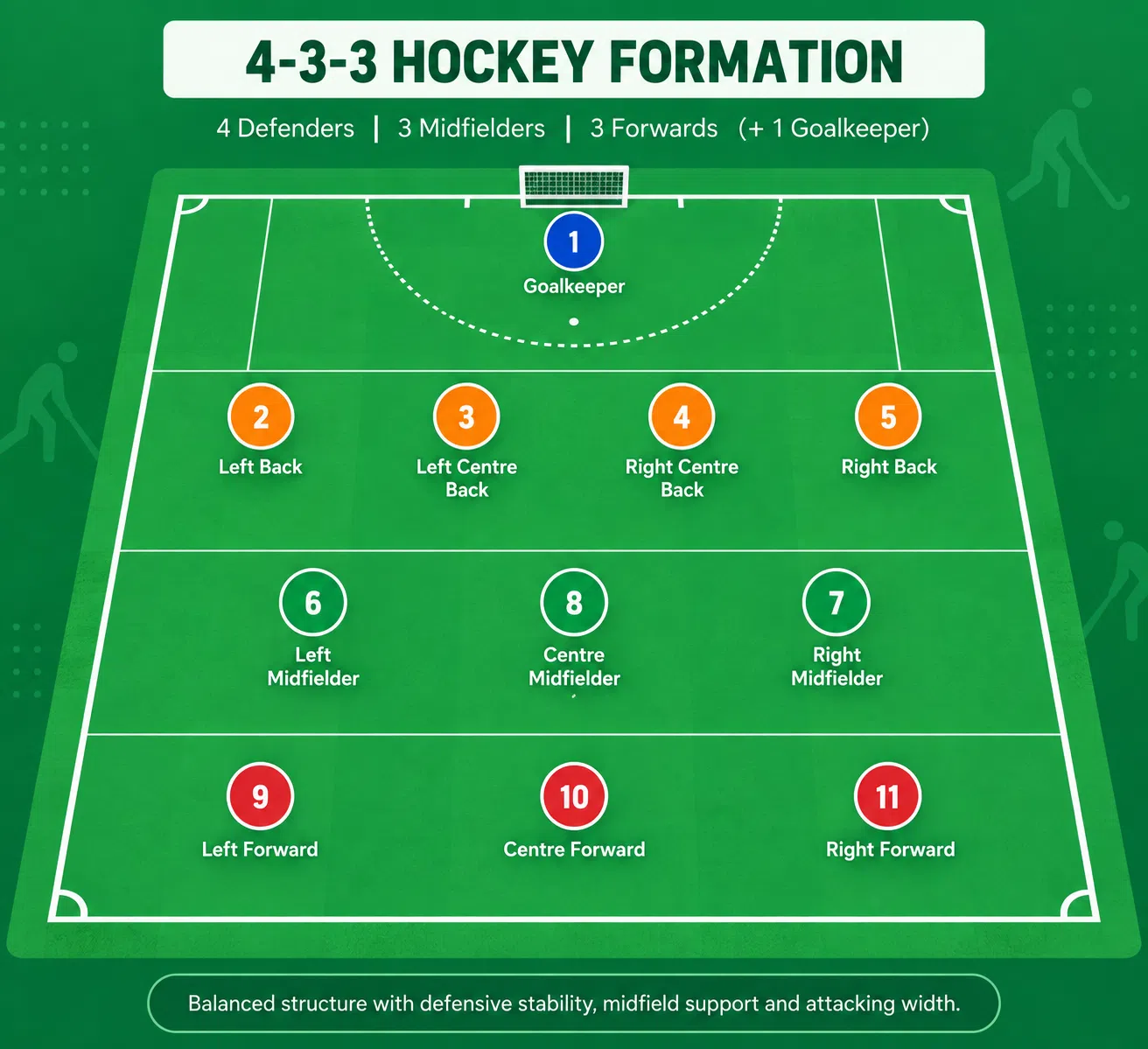
The 4-3-3 formation uses four defenders, three midfielders and three forwards.
It provides a balanced structure because the team has a clear defensive line, a three-player midfield and three attacking outlets. The forwards can occupy different areas of the attacking third, while the midfielders support both the defence and attack.
The three forwards can also help create width and provide multiple passing options around the opposition’s defensive structure.
One advantage of 4-3-3 is that it can provide good attacking width without completely sacrificing midfield support. However, the midfielders need to cover significant areas, particularly when the wide forwards push high up the field.
2. 4-4-2 Formation
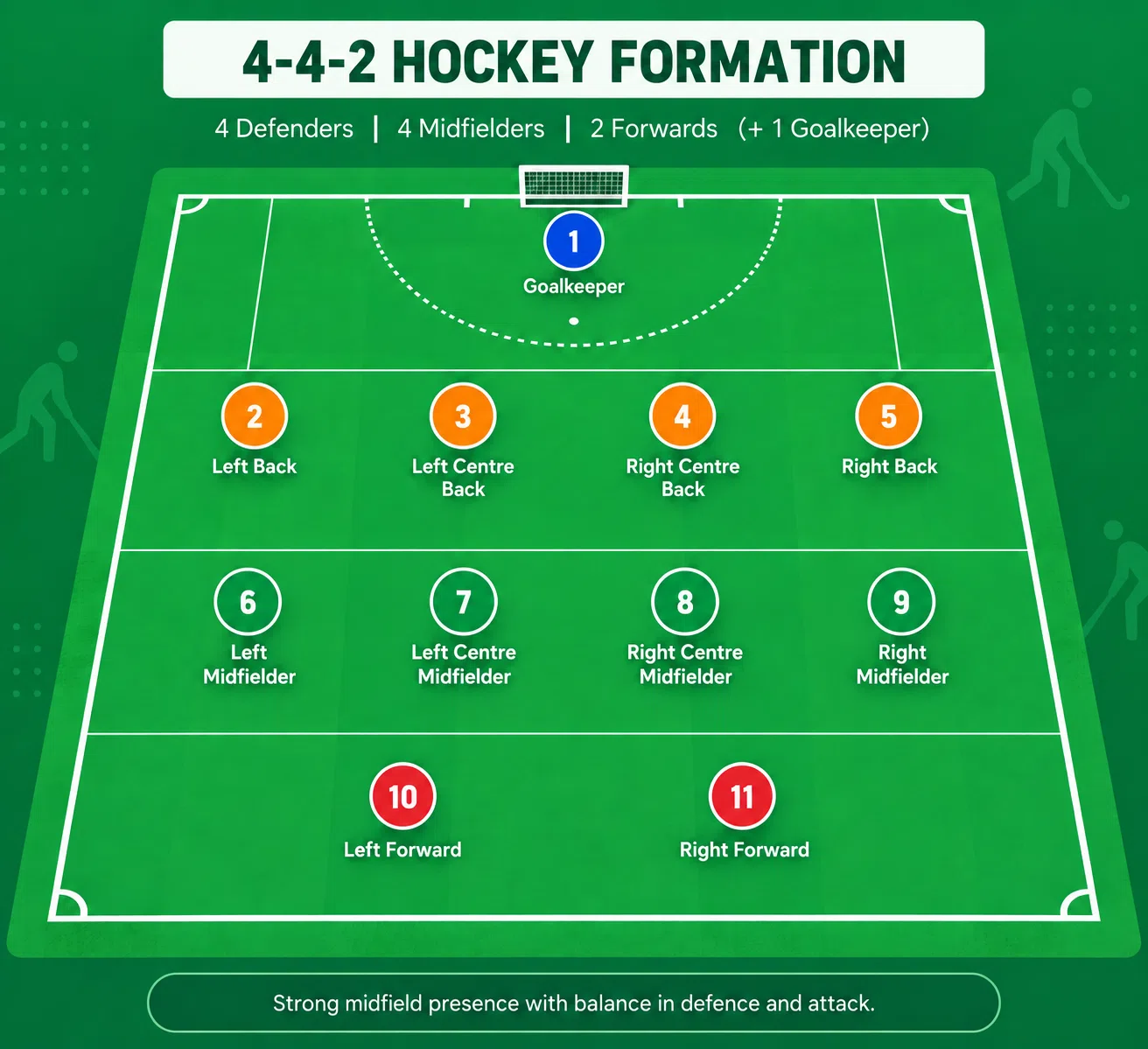
The 4-4-2 formation consists of four defenders, four midfielders and two forwards.
With four midfielders, this shape can provide a strong presence through the middle of the pitch. The midfield line can move together when defending and create several short passing options when the team has possession.
The two forwards can work together by making different movements. One may drop deeper to receive the ball while the other stays higher to threaten the defensive line. The main challenge is that two forwards may provide fewer natural attacking options than a three-forward system, meaning midfielders often need to contribute to attacks.
3. 3-4-3 Formation
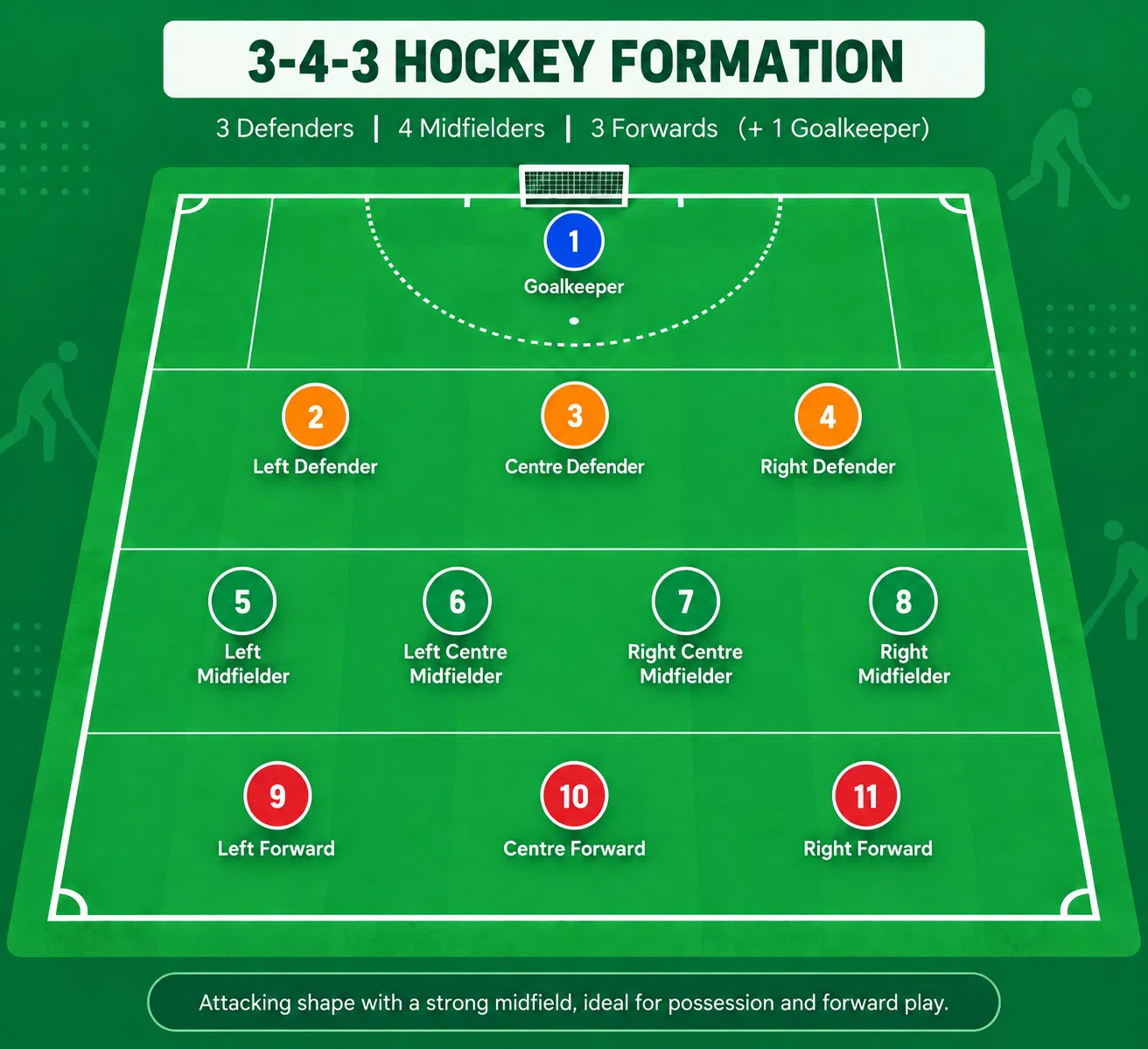
The 3-4-3 formation uses three defenders, four midfielders and three forwards.
This formation places more players in midfield and attack while using three primary defenders. The midfielders can provide width and support the forwards, making the shape useful for teams that want to maintain possession and create multiple attacking options.
The three defenders, however, must communicate effectively and cover space when midfielders move forward. Wide midfielders or players operating on the flanks may have particularly demanding roles because they may need to contribute in both defensive and attacking phases.
4. 3-3-4 Formation
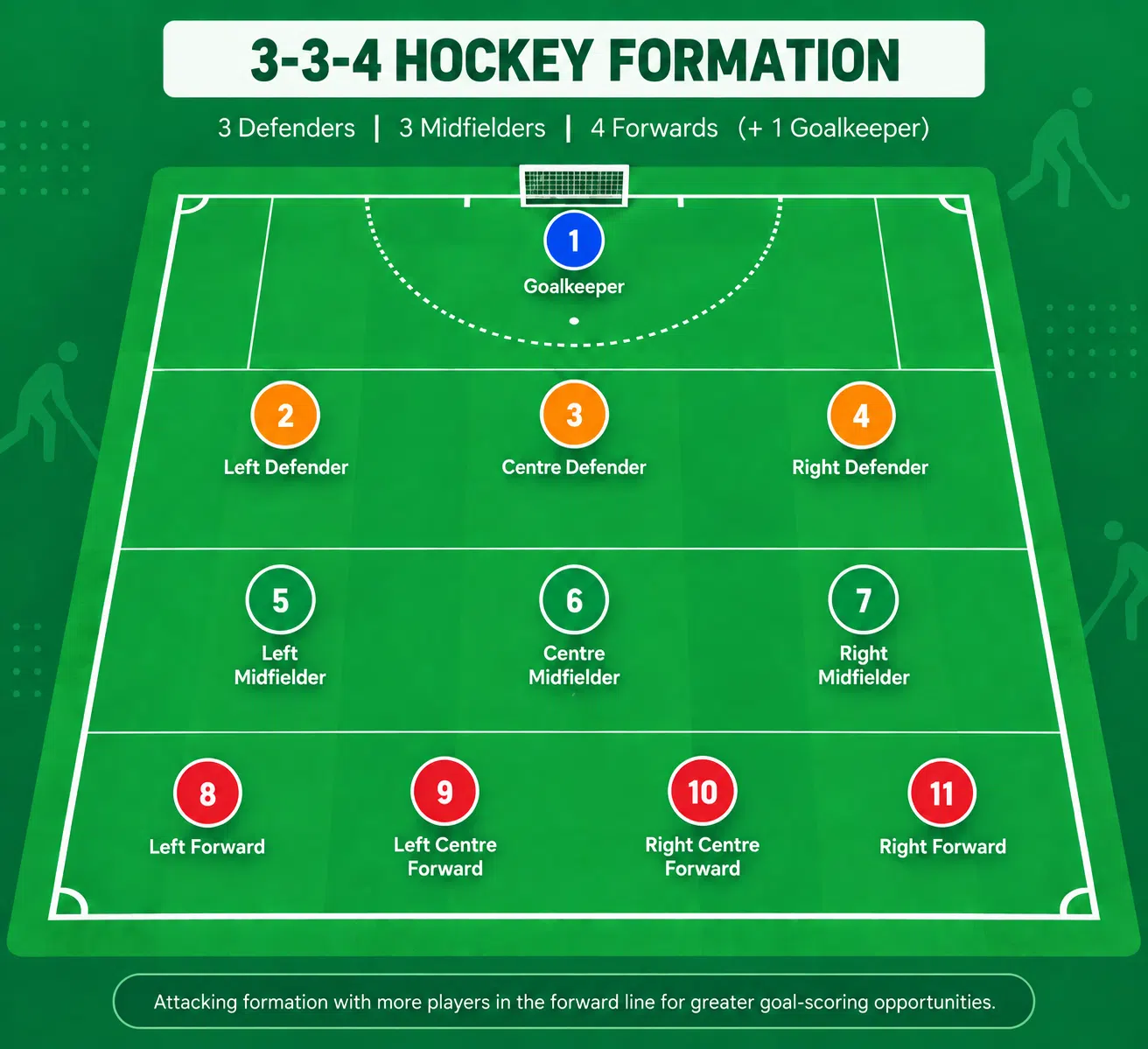
A 3-3-4 formation uses three defenders, three midfielders and four forwards.
It is an aggressive attacking structure because four players are positioned in advanced areas. This can create several options near the opposition circle and allow a team to apply strong pressure after losing possession.
The trade-off is defensive security. With fewer players naturally positioned behind the ball, the team can become vulnerable to quick counter-attacks if possession is lost. For this reason, the three midfielders must be disciplined and able to recover quickly.
Read More: Hockey Positions
How Hockey Formations Change During a Match
One of the most important points about hockey formations is that the formation shown before the match does not necessarily remain unchanged during play.
A team may start in a 4-3-3 but effectively become a different shape when it has possession. For example, a defender may move forward to create an additional passing option, while a midfielder drops into the defensive line to maintain balance.
The same applies when a team loses possession. Players may immediately move into a compact defensive structure rather than maintaining their attacking positions. This means coaches often talk about attacking shape, defensive shape and transition shape rather than relying on one formation for the entire match.
Attacking Formation in Hockey
When attacking, the main objective is to create space and passing options while maintaining enough defensive cover to deal with a turnover.
Players may spread across the width of the pitch to stretch the opposition. Forwards can move between defenders, midfielders can advance to support attacks, and defenders can move higher to help circulate possession. A good attacking structure usually provides:
- Width across the pitch
- Passing options in front of and behind the ball
- Support around the player in possession
- Players positioned to receive passes into the attacking circle
- Defensive cover against counter-attacks
The exact structure depends on the coach’s tactical approach and the players available.
Defensive Formation in Hockey
When defending, teams generally try to reduce the space available to the opposition and prevent easy progression towards the circle. Players may form a compact defensive block, with midfielders dropping back to support defenders. Forwards can also participate in the defensive press by attempting to restrict the opposition’s passing options.
Two common approaches are a high press and a deeper defensive block. In a high press, players move forward to pressure the opposition closer to its defensive area. A deeper block allows the opposition more possession in less dangerous areas but focuses on protecting space closer to the goal.
The choice depends on factors such as the score, time remaining, opposition style and the team’s tactical plan. Modern hockey teams may also switch between pressing structures during a match.
What is the Best Formation in Hockey?
There is no single formation that is officially designated as the best formation in field hockey. The appropriate structure depends on the team’s playing style, player characteristics, opposition and match situation. A formation that works well for a possession-based team may not suit a team that relies heavily on pressing and quick transitions.
For example, a coach may choose a structure with more midfielders when controlling the centre of the pitch is a priority. A team looking for greater attacking presence may use a formation with more advanced players.
Player movement and tactical discipline are often more important than the numbers used to describe the formation.
Why are Hockey Formations Important?
Hockey formations help teams organise their players and define responsibilities. They can influence how effectively a team attacks, defends and transitions between possession phases. A well-organised formation can help players understand where they should be positioned, which areas they need to cover and where passing options are likely to develop.
Formations also make it easier for coaches to make tactical adjustments. A team can change its structure during a match to respond to an opponent’s pressing strategy, protect a lead, create more attacking opportunities or strengthen its defence.
At the elite level, tactical structures can be highly flexible. Coaching programmes commonly work on different defensive structures, including back-three, back-four and back-five systems, demonstrating how teams can alter their defensive organisation depending on the situation.
Hockey Formations vs Positions
A position describes a player’s role, while a formation describes how the entire team is organised. For example, “defender” is a position, whereas “4-3-3” is a formation. A defender may have responsibilities that change depending on whether the team is attacking or defending.
This distinction is important because modern field hockey is not based on players standing in fixed locations. Teams constantly adjust their shape according to possession, pressure and space.
Conclusion
Hockey formations provide the basic framework for organising a field hockey team, but they should not be viewed as rigid arrangements. Structures such as 4-3-3, 4-4-2, 3-4-3 and 3-3-4 distribute players differently across defence, midfield and attack, giving coaches different ways to manage space and possession.
The most effective tactical structure depends on the players, opposition and match situation. In modern field hockey, successful teams frequently change their shape between attacking, defending and transition phases rather than relying on one fixed formation.
Download Playo on Android or iOS, or visit playo.co to start playing!
Frequently Asked Questions
A standard outdoor field hockey team has 11 players on the field, including one goalkeeper. The remaining 10 players are generally organised into defensive, midfield and attacking roles.
The 4-3-3 formation consists of four defenders, three midfielders and three forwards, in addition to the goalkeeper. It provides a balance between defensive organisation, midfield support and attacking width.
The 4-4-2 formation consists of four defenders, four midfielders and two forwards, plus the goalkeeper. It gives the team a strong midfield presence while maintaining four players in the defensive line.
No. Hockey formations are flexible. Players can move between lines and change the team’s shape depending on possession, pressing, attacking movements and defensive requirements.
There is no single officially prescribed formation in field hockey. Coaches can use structures such as 4-3-3, 4-4-2, 3-4-3 and 3-3-4, depending on their tactical approach and the players available.