


Swimming has four main competitive strokes: freestyle, backstroke, breaststroke and butterfly. Each stroke uses a different combination of arm movement, leg action, body position and breathing technique. Learning how these swimming strokes differ can help beginners choose where to start and help experienced swimmers improve their technique.
Among the four, freestyle is generally the fastest, while breaststroke is usually the slowest. Butterfly is highly demanding because of its simultaneous arm and leg movements, while backstroke is unique because it is performed on the back.
This guide explains the four main types of strokes in swimming, how each one is performed, what makes them different and where they are used in competitive swimming.
What are the 4 Main Types of Strokes in Swimming?
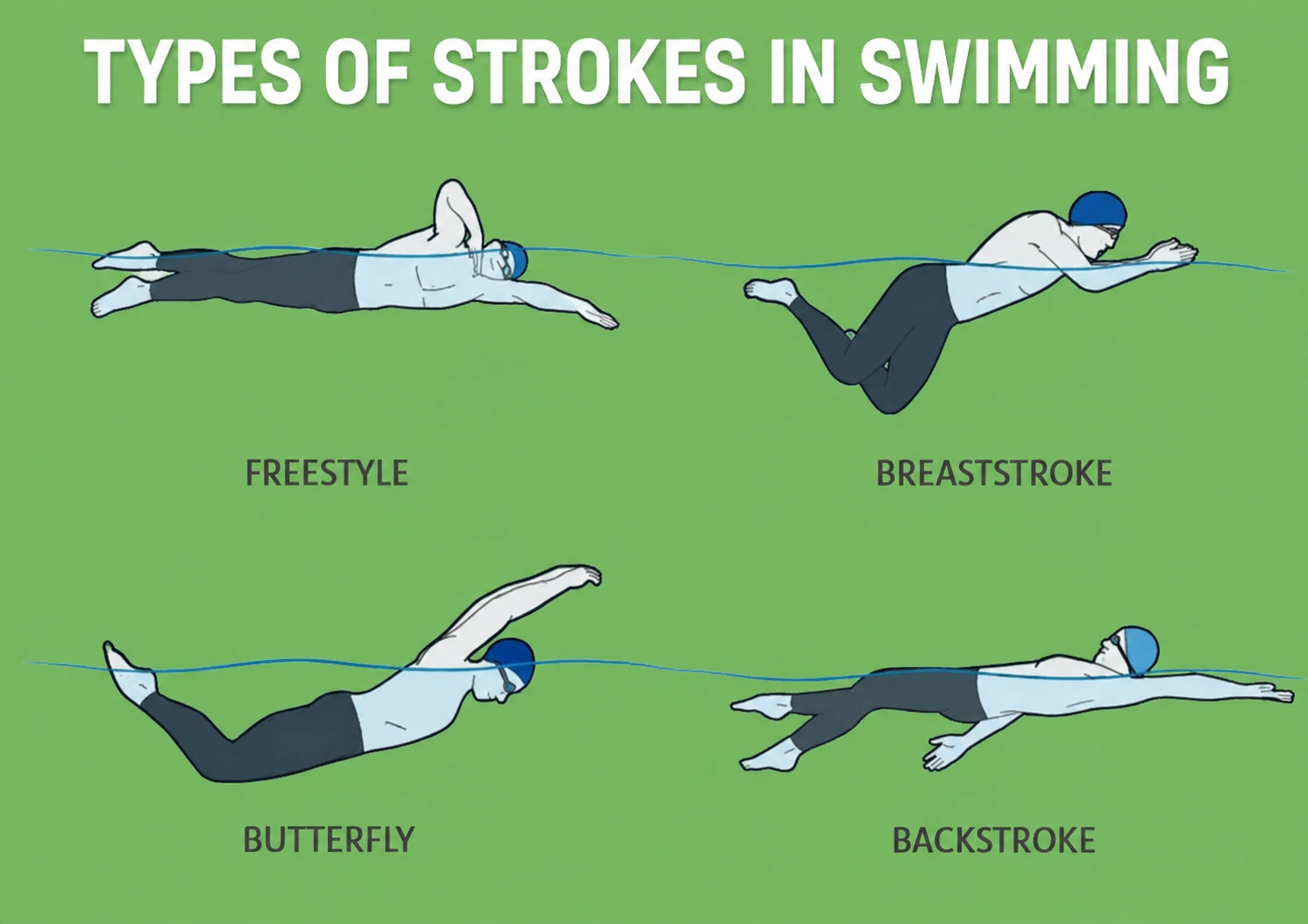
The four main types of swimming strokes are freestyle, backstroke, breaststroke and butterfly. These are the strokes used in competitive swimming, including individual medley and medley relay events.
Other swimming techniques, such as sidestroke and elementary backstroke, are also used for recreation, training, lifesaving and water-safety purposes. However, they are not among the four primary competitive strokes.
1. Freestyle
Freestyle is generally the fastest of the four competitive swimming strokes and is widely used for racing, fitness and recreational swimming.
Technically, freestyle is an event category rather than the name of a specific stroke. Swimmers can use any stroke in a freestyle race, but the front crawl is almost always used because it provides greater speed and efficiency.
How is Freestyle Performed?
The swimmer maintains a streamlined, face-down position with the body close to the surface. The arms move alternately, with one arm pulling underwater while the other recovers above the surface.
The legs perform a continuous flutter kick, moving alternately up and down. The kick should come mainly from the hips, with relaxed movement through the knees and ankles. Breathing is usually performed by turning the head to one side during the arm recovery. Swimmers may breathe every two, three or more strokes depending on their pace and training.
The combination of alternating arms, continuous kicking and controlled breathing gives freestyle a smooth rhythm. It is particularly effective for longer distances because swimmers can maintain propulsion without stopping the stroke cycle.
2. Backstroke
Backstroke is the only one of the four main competitive strokes performed while lying on the back. The swimmer’s face remains above the water, allowing breathing without turning the head. Like freestyle, backstroke uses alternating arm movements and a continuous flutter kick.
How is Backstroke Performed?
The swimmer maintains a streamlined position on the back with the head relatively still. One arm exits the water and rotates backwards over the shoulder before entering the water above the head. As one arm begins its underwater pull, the opposite arm starts its recovery. This alternating movement creates continuous propulsion.
The legs perform a flutter kick, similar to freestyle. Keeping the hips near the surface and maintaining a consistent kick helps reduce drag.
A major advantage of backstroke is that swimmers can breathe naturally because the face remains above the water. However, swimmers need good spatial awareness because they cannot see directly ahead while moving through the pool.
3. Breaststroke
Breaststroke is one of the most recognisable swimming strokes. It uses simultaneous arm and leg movements and follows a controlled pull, kick and glide sequence. Unlike freestyle and backstroke, where the arms alternate, both arms move together in breaststroke. The legs also work together using a frog-like kick.
How is Breaststroke Performed?
The swimmer begins with both arms extended forward in a streamlined position. The hands then sweep outward and backwards to create propulsion before moving toward the chest.
The legs perform a frog kick. The heels are brought toward the body, the feet turn outward, and the legs push backwards and outward before coming together. After the kick, the swimmer extends the body and glides through the water before starting the next stroke cycle.
Breathing is usually coordinated with the arm pull. As the arms pull backwards, the swimmer raises the head enough to breathe before returning the face to the water. Timing is particularly important in breaststroke. Poor coordination between the pull, kick and glide can increase drag and reduce efficiency.
Breaststroke is generally the slowest of the four competitive strokes, but its controlled rhythm makes it popular for both recreational and competitive swimming.
4. Butterfly
Butterfly is one of the most technically demanding swimming strokes. It is characterised by simultaneous arm movements and a powerful dolphin kick. Both arms move together during each stroke cycle, while both legs move simultaneously in a wave-like motion.
How is Butterfly Performed?
The swimmer starts face-down with both arms extended forward. The arms enter the water together and pull simultaneously toward the hips. After the underwater pull, both arms recover over the water at the same time before entering again.
The legs perform a dolphin kick, with both legs moving together rather than alternating. The movement creates a wave-like action that travels from the hips through the legs. Butterfly also requires coordinated body movement. The chest, hips and legs work together to maintain rhythm and generate propulsion.
Breathing is generally performed by lifting the head forward during the stroke cycle before returning the face to the water. Butterfly requires considerable strength, coordination and timing. Swimmers generally learn the dolphin kick and individual arm movements before combining them into the complete stroke.
Swimming Strokes Compared
The four swimming strokes differ mainly in their body position, arm action and kicking technique. Freestyle and backstroke both use alternating arm movements and flutter kicks. Breaststroke combines simultaneous arm movements with a frog kick, while butterfly uses simultaneous arms and a dolphin kick.
| Stroke | Body Position | Arm Action | Leg Action |
| Freestyle | Face-down | Alternating | Flutter kick |
| Backstroke | On the back | Alternating | Flutter kick |
| Breaststroke | Face-down | Simultaneous | Frog kick |
| Butterfly | Face-down | Simultaneous | Dolphin kick |
Which is the Fastest Swimming Stroke?
Freestyle is generally the fastest swimming stroke. Competitive swimmers normally use the front crawl in freestyle events because its alternating arm action and continuous flutter kick allow them to generate speed efficiently.
However, stroke speed also depends on technique, strength, body position, fitness, starts and turns. A technically efficient swimmer can perform better than someone using the same stroke with poor technique.
Which Swimming Stroke is Best for Beginners?
There is no single swimming stroke that is best for every beginner. The right starting point depends on the swimmer’s confidence, coordination and goals.
Breaststroke can be approachable because its movements are relatively easy to understand and swimmers can bring the head above the water to breathe. Freestyle is also commonly taught because it develops important skills such as streamlined body position, breathing control and coordinated arm and leg movements.
Backstroke can be introduced once swimmers are comfortable floating on their backs. Butterfly is usually learned later because it requires greater strength, coordination and timing. Beginners can benefit from learning under the guidance of a qualified swimming instructor, particularly when developing breathing and body-position techniques.
What is an Individual Medley in Swimming?
An individual medley (IM) is a competitive swimming event that combines all four main strokes in a fixed order:
Butterfly → Backstroke → Breaststroke → Freestyle
Each stroke covers one-quarter of the total race distance. For example, a 200 m individual medley consists of 50 m butterfly, 50 m backstroke, 50 m breaststroke and 50 m freestyle.
The order is different in a medley relay, which follows:
Backstroke → Breaststroke → Butterfly → Freestyle
The individual medley therefore requires swimmers to be proficient in all four competitive strokes.
Other Types of Swimming Strokes
Apart from the four competitive strokes, swimmers may also use other techniques for recreation, training and specific purposes.
- Sidestroke: Swum on one side using a scissor kick; commonly associated with lifesaving and rescue swimming.
- Elementary backstroke: A simplified backstroke technique with controlled arm and leg movements, often used for basic instruction and water-safety training.
- Combat sidestroke: An efficient sidestroke variation commonly associated with military and tactical swimming.
How to Improve Your Swimming Stroke
Improving swimming technique is about more than simply moving faster. A streamlined body position helps reduce drag, while proper coordination makes each stroke more efficient.
Start by learning the correct body position and arm and leg movements for your chosen stroke. Breathing should then be coordinated with the stroke cycle. For example, freestyle requires controlled side breathing, while butterfly generally involves forward breathing.
Swimming drills can also help isolate specific movements. Practising kicks, arm actions or breathing separately before combining them can make it easier to correct technical problems and develop a consistent rhythm.
Conclusion
The four main types of strokes in swimming are freestyle, backstroke, breaststroke and butterfly. Each uses a distinct combination of body position, arm movement, leg action and breathing technique.
Freestyle is generally the fastest and is usually performed using the front crawl. Backstroke is performed on the back with alternating arms, breaststroke uses a frog kick and simultaneous arm movement, while butterfly combines simultaneous arms with a powerful dolphin kick.
Learning the four strokes can help swimmers improve their technique, versatility and overall performance, whether they swim for fitness, recreation or competition.
Download Playo on Android or iOS, or visit playo.co to start playing!
Frequently Asked Questions
There are four main competitive swimming strokes: freestyle, backstroke, breaststroke and butterfly. Other techniques, such as sidestroke and elementary backstroke, are also used for recreation, training and water safety.
Freestyle is generally the fastest competitive swimming stroke. The front crawl is normally used in freestyle races because it provides high speed and efficiency.
Butterfly is generally considered the most technically demanding stroke because it requires simultaneous arm movements, a coordinated dolphin kick and precise timing.
There is no universally easiest stroke. Many beginners find breaststroke approachable, while freestyle is also commonly taught as a foundational swimming skill.
Freestyle is an event category, while front crawl is a specific swimming technique. Swimmers can technically use any stroke in a freestyle event, but front crawl is almost always used because it is the fastest option.
The four strokes are butterfly, backstroke, breaststroke and freestyle, in that order. Each stroke covers one-quarter of the race distance.
No. Sidestroke is a recognised swimming technique but is not one of the four strokes used in standard Olympic swimming competition.