

Volleyball is a game where a single touch can turn a rally around. A well-timed block, a precise set, or a powerful spike can make all the difference, but every move must follow a specific set of rules. Whether you’re learning to play or trying to understand what happens during a competitive match, knowing the official volleyball rules helps you follow the game and avoid common mistakes.
From court dimensions and player positions to scoring, serving, rotations, and the three-touch rule, volleyball has regulations that govern every stage of play. The rules also cover specialised roles such as the libero, along with common faults, timeouts, and substitutions. This guide breaks down the official rules of volleyball so you can understand how the game is played, how points are won, and what can cost a team a rally.
Court Dimensions and Player Positions
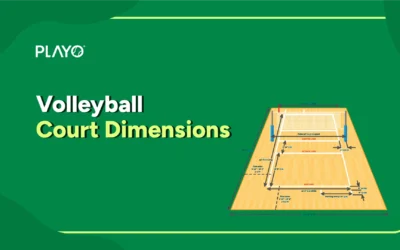
Before the first serve, you need to understand the playing environment and the team structure. A standard indoor volleyball court measures 18 metres long and 9 metres wide, divided into two equal 9×9 metre halves by a net. The net height is set at 2.43 metres for men and 2.24 metres for women. An attack line is drawn 3 metres from the centre line on both sides.
Each team is allowed a maximum of 6 players on the court at one time. These players are divided into front-row and back-row players, typically filling these specialised roles:
- Setter: The playmaker who runs the offence and sets up the attackers.
- Outside Hitter: The primary attacker who hits from the left side.
- Middle Blocker: The defensive anchor at the net who blocks and hits quick sets.
- Opposite Hitter: The secondary attacker who plays opposite the setter.
- Libero: A defensive specialist (more on them below).
How Scoring Works in Volleyball
Modern volleyball rules utilise a “rally scoring” system. This means a point is scored on every single rally, regardless of which team served. This keeps the game moving quickly and maintains high energy.
An official match is played as a best-of-five sets. The first team to win three sets wins the match. Here is how the scoring breaks down:
- Sets 1 through 4: Played to 25 points.
- Set 5 (The Tie-Breaker): If the match is tied 2-2, the final set is played to 15 points.
- Win by Two: In all sets, a team must win by a minimum margin of 2 points. If the score is tied at 24-24, play continues until one team establishes a 2-point lead (e.g., 26-24, 27-25).
Touches and the Net Rules in Volleyball
The core objective is to send the ball over the net and ground it on the opponent’s court, while preventing them from doing the same.
The Three-Touch Rule and the Ideal Sequence
Each team is allowed a maximum of three touches to return the ball over the net. A block does not count as one of these three touches. The ideal sequence for these three touches is:
- Pass (Bump): Receiving the opponent’s serve or attack.
- Set: Positioning the ball for an attacker.
- Spike (Hit): Attacking the ball over the net.
A single player cannot hit the ball twice in succession (except immediately after a block). Furthermore, the ball must be hit cleanly. Catching, throwing, or letting the ball come to a rest in your hands is illegal and results in a “lift” or “carry” fault.
Net and Antenna Rules
The ball must cross the net within the designated crossing space, bounded by the two red and white antennas on the outer edges of the net. If the ball hits the antennas or crosses outside of them, it is out of bounds. If the ball hits the top of the net during a serve or attack and still goes over, it remains in play.
Serving Rules in Volleyball
The serve starts every rally and is the only time a player has complete control over the ball.
- The 8-Second Rule: The server has exactly 8 seconds to serve the ball after the referee’s whistle.
- Execution: The ball must be hit with one hand or any part of the arm. The server must stand behind the end line and cannot step on or over it before making contact.
- Serve Types: Players can use various techniques, including the underhand serve, overhand serve, float serve, and the powerful jump serve.
Understanding Rotations and the Libero
One of the most unique aspects of volleyball rules is the rotation system, which ensures all players play both the front and back rows.
Clockwise Rotation
Whenever a team wins the serve back from the opposing team (a “side-out”), all six players on that team must rotate one position clockwise. Players must maintain their rotational order until the exact moment the ball is served; overlapping or serving out of turn results in a rotational fault. Once the serve is contacted, players can move freely to their specialised positions.
The Libero
The Libero is a specialised defensive player who wears a contrasting jersey colour.
- They can replace any back-row player without counting as a regular substitution.
- They are strictly a back-row player; they cannot attack the ball if it is entirely above the height of the net, and they cannot block.
- If the Libero sets the ball using an overhand finger pass in the front court, their teammates cannot complete an attack hit on it.
Read More: Volleyball Rotations Rules
Common Volleyball Faults and Fouls
Violating the volleyball rules results in a fault, which immediately ends the rally and awards a point to the opposing team. Here are the most common infractions:
- Foot Fault: Stepping on or over the end line before contacting the serve.
- Net Touch: Touching the top band of the net or the antennas while in the act of playing the ball.
- Centre Line Fault: Completely crossing the centre line under the net and interfering with the opponent.
- Double Contact: A player hits the ball twice in a row, or the ball bounces off different parts of their body unevenly.
- Four Hits: The team takes more than three touches to return the ball.
- Back-Row Attack: A back-row player jumps from inside the 3-metre attack line and hits the ball while it is completely above the height of the net.
Timeouts and Substitutions
Strategic pauses are a crucial part of the game. Under official rules, each team is entitled to two 30-second timeouts per set. Timeouts can only be called by the head coach or the game captain when the ball is out of play. (Note: Some high-level competitions also utilise mandatory “technical timeouts”).
Regarding substitutions, FIVB rules allow up to 6 substitutions per set per team. A starting player can be replaced by a substitute, and that specific starting player can only re-enter the game for the exact substitute who replaced them. Between sets, there is a mandatory 3-minute interval. During the decisive 5th set, teams must switch sides as soon as the first team reaches 8 points.
5 Rules Every Beginner Must Remember
If you are just stepping onto the court for the first time, keep this quick checklist in mind:
- Never touch the ball more than twice in succession.
- Your team gets only three contacts to get it over the net.
- Rotate clockwise whenever your team wins the serve.
- Avoid touching the net while playing the ball.
- Always serve from behind the end line.
Conclusion
While the official volleyball rules might seem detailed at first glance, they are designed to keep the game fair, fast, and incredibly exciting. From the precise rotational mechanics to the strict three-touch limit, every rule adds to the strategic depth and athletic brilliance of the sport. Knowing these regulations improves teamwork, reduces mistakes, and helps you play with confidence.
The best way to truly internalise these rules is to get out on the court and play. Don’t be afraid to make a few rotational errors when you are first starting out. With a little practice, these rules will become second nature, allowing you to focus on what really matters: spiking, digging, and enjoying the game!
Download Playo on Android or iOS, or visit playo.co to start playing!
Frequently Asked Questions
The basic volleyball rules state that two teams of six players compete to score points by grounding the ball on the opponent’s side of the court. Each team is allowed a maximum of three touches to return the ball, players rotate clockwise when they win the right to serve, and matches are usually played as best-of-five sets. The first four sets are played to 25 points, while the deciding set is played to 15 points.
The terms 4-2, 6-2, and 5-1 refer to different offensive systems used in volleyball. A 4-2 system uses four hitters and two setters and is commonly used by beginners. A 6-2 system employs two setters who set only from the back row, ensuring three attackers are always available in the front row. The 5-1 system uses one dedicated setter and five hitters and is the most popular formation in competitive volleyball.
The six basic positions in volleyball are setter, outside hitter, opposite hitter, middle blocker, libero, and defensive specialist. Each position has a specific role that contributes to the team’s offence, defence, and overall strategy.
The 3-hit rule states that a team may contact the ball a maximum of three times before sending it over the net. A typical sequence involves a pass, a set, and an attack. Contacts made during a block do not count as one of the three allowed touches.
Common volleyball fouls include double contact, four hits, net touches, foot faults during serving, carrying or lifting the ball, rotation faults, illegal back-row attacks, and crossing the centre line in a way that interferes with the opposing team. These violations result in a point being awarded to the opponents.
Official indoor volleyball matches are played to 25 points per set, with teams required to win by a margin of two points. If the match reaches a fifth set, that set is played to 15 points. While some recreational and beach volleyball formats may use 21-point scoring, the standard indoor format follows the 25-point system.
A standard indoor volleyball team has six players on the court at any given time, though a full roster will include additional substitute players on the bench.
No. Players are not allowed to touch the top of the net or the antennas if it interferes with the action of playing the ball. Doing so results in a net fault and the loss of the rally.