


If cricket is a religion in India, then Azad Maidan is its most sacred, chaotic, and inspiring temple. Nestled in the heart of South Mumbai, this 25-acre triangular expanse isn’t just another cricket ground, it’s the beating heart of Mumbai’s cricketing culture, a place where raw talent meets relentless grit and where legends are forged not in luxury academies, but on dusty, overlapping pitches under the blazing Arabian sun.
For decades, Azad Maidan in Mumbai has been the unofficial nursery of Indian cricket. From Sachin Tendulkar and Vinod Kambli’s record-breaking 664-run partnership to the recent rise of Yashasvi Jaiswal and Sarfaraz Khan, this iconic ground has witnessed moments that have shaped the destiny of Indian cricket. But what makes Azad Maidan pitches so special? Why do thousands of young cricketers still flock to azad maidan fort mumbai maharashtra every weekend, despite the chaos, the uneven outfields, and the lack of modern facilities?
This blog explores the history, the culture, the challenges, and the unparalleled legacy of Azad Maidan- the ground that doesn’t just host cricket, but breathes it.
History of Azad Maidan Mumbai
Azad Maidan Mumbai traces its origins back to the 1860s, when the British restructured the vast Esplanade area after demolishing the old fort walls to open up South Mumbai’s Fort district. Over time, a portion of this land evolved into what we now know as Azad Maidan, one of the city’s most iconic cricket grounds.
Spread across 25 acres in South Mumbai’s Fort area, the ground was officially renamed “Azad Maidan” in 1960, with “Azad” meaning free. The name reflects its historical association with public gatherings and its accessibility to the people of Mumbai.
By the early 20th century, the ground had already begun hosting informal cricket matches. These gradually evolved into structured school and club-level tournaments, laying the foundation for Mumbai’s dominance in Indian cricket. As of 2025, Mumbai has won 42 Ranji Trophy titles, the highest by any team, and maidans like this have played a crucial role in building that legacy.
The Mumbai Cricket Association (MCA), established in 1930, took a more active role in managing cricketing activities here during the 1970s. Regular maintenance practices, including annual red-soil relaying after the monsoon, ensure that the ground remains playable for over 300 days a year, despite heavy usage and urban constraints.
Read More: Why Street Cricket is a Way of Life in Mumbai
Key Features of Azad Maidan Mumbai
Azad Maidan in Mumbai is one of the most prominent open cricket grounds in India, known for its accessibility and high volume of play. Located in the Fort area of South Mumbai, it spans approximately 25 acres and serves as a central hub for grassroots cricket.
One of its defining features is the presence of 22 active cricket pitches, allowing multiple matches to be played simultaneously. Unlike private stadiums or academies, Azad Maidan is a public ground, making it accessible to school teams, local clubs, and aspiring cricketers across the city.
The ground hosts a wide range of cricketing activities, including school tournaments, club matches, and daily practice sessions, making it one of the busiest cricket venues in Mumbai. Its central location, near major transport hubs like CST, further adds to its importance in the city’s sporting ecosystem.
Why Azad Maidan Pitches Are Unique
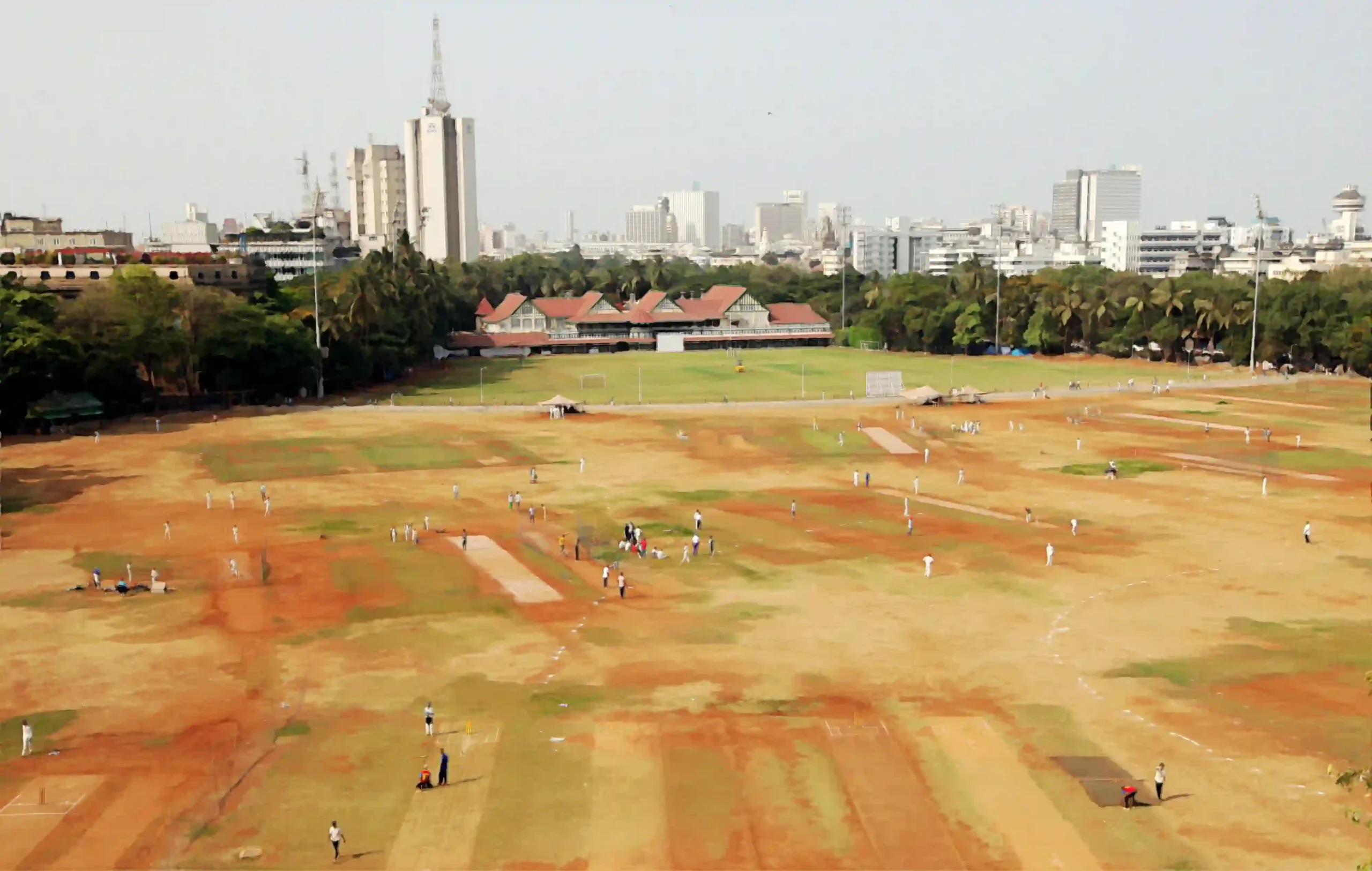
The Azad Maidan pitches are unlike typical cricket surfaces due to their structure, usage, and playing conditions. The ground features 22 pitches, including one maintained by Bombay Gymkhana and 21 public surfaces, each measuring the standard 22 yards in length. Most of these are hard, concrete-based pitches layered with red soil and used extensively throughout the year.
Because of continuous play, the pitches tend to wear out quickly. The bounce often becomes low and inconsistent after 15–20 overs, making batting more challenging and favouring spin bowlers. These conditions require players to rely on strong technique and adaptability rather than aggressive stroke play.
Another unique aspect is the layout of the ground. With multiple matches happening at the same time, players frequently encounter balls entering from nearby pitches. Combined with relatively short boundaries of around 50 to 60 yards, this creates a demanding environment that tests awareness, reflexes, and match discipline.
Legendary Cricketers Born on Azad Maidan
Azad Maidan Mumbai has been the starting point for some of India’s biggest cricketing names, especially through school tournaments like the Harris Shield and Giles Shield. Over the years, it has produced players who have gone on to dominate both domestic and international cricket.
The most iconic moment in the ground’s history came in 1988, when Sachin Tendulkar and Vinod Kambli stitched together a 664-run partnership in a Harris Shield match. This remains one of the highest partnerships in school cricket and marked the arrival of Tendulkar, who later scored 15,921 Test runs and 100 international centuries. Kambli, too, went on to represent India and averaged over 50 in Test cricket during his career.
The tradition of big scores continued with Prithvi Shaw, who smashed 546 not out in a Giles Shield match, and Sarfaraz Khan, who scored 439 runs in a school game at the same venue. Both players progressed through Mumbai’s domestic circuit to earn India caps, reinforcing Azad Maidan’s reputation as a batting powerhouse.
More recently, Yashasvi Jaiswal trained extensively at the ground during his early years, often spending long hours practising in modest conditions. He has since emerged as one of India’s most promising Test batters, continuing the legacy of players shaped on these pitches.
From school cricket to international success, Azad Maidan Fort, Mumbai, Maharashtra, has consistently produced high-impact players, making it one of the most important grassroots cricket hubs in India.
Role of Azad Maidan in Mumbai Cricket
Azad Maidan Mumbai plays a central role in the city’s cricketing ecosystem, acting as a key link between grassroots and professional cricket. It serves as a starting point for young players who begin with school-level matches and gradually progress to club cricket, age-group tournaments, and eventually first-class cricket.
This structured pathway, from school cricket to club cricket and then to the Ranji Trophy, is one of the main reasons behind Mumbai’s long-standing dominance in Indian domestic cricket. As of 2025, Mumbai has won 42 Ranji Trophy titles, the highest in the country, with many players having developed their skills on maidans like this.
Unlike academy-based systems that focus heavily on nets, Azad Maidan offers high match exposure, allowing players to gain real-game experience early. Regular match practice helps improve decision-making, temperament, and consistency, which are essential at higher levels of the game.
Major Tournaments at Azad Maidan
Azad Maidan regularly hosts some of Mumbai’s most important school and club-level cricket tournaments, making it a key venue for competitive cricket throughout the year.
One of the most prominent tournaments played here is the Harris Shield, a prestigious school cricket competition that has produced several international players. Long-format matches in this tournament allow young cricketers to build innings and develop strong fundamentals.
Another major tournament is the Giles Shield, which caters to younger age groups and serves as an early platform for talent identification. Along with these, the Kanga League, played during the monsoon season, is one of Mumbai’s most unique club competitions, known for its challenging wet conditions.
In addition to these structured tournaments, the ground also hosts regular club matches and practice games, ensuring continuous cricketing activity across different levels.
Challenges of Azad Maidan
Despite its importance, Azad Maidan Mumbai faces several challenges due to its heavy usage and open-access nature. One of the primary concerns is the overuse of pitches, as multiple matches are played daily across all 22 surfaces. This leads to quicker wear and more inconsistent playing conditions over time, especially as the day progresses.
The ground also has limited infrastructure, with basic changing areas and minimal facilities compared to modern cricket academies or stadiums. In addition, the overlapping of matches means games are played in close proximity, creating safety concerns as balls from nearby pitches can enter the field, requiring players to stay constantly alert.
Conclusion
Azad Maidan Mumbai continues to be the backbone of grassroots cricket, with its 22 pitches, constant match play, and strong link to school and club cricket. Despite limited facilities, it consistently produces players with solid technique and match awareness. Its role in Mumbai’s cricketing success shows how important real-game exposure is in player development.
If this makes you want to get out and play, you can explore and book nearby cricket grounds or other sports venues around Mumbai on Playo and find a game that fits your schedule.
Download Playo on Android or iOS, or visit playo.co to start playing!
Frequently Asked Questions
Azad Maidan is famous for being one of the most important grassroots cricket grounds in India. It is known for hosting multiple matches daily across 22 pitches and for producing legendary cricketers like Sachin Tendulkar, Vinod Kambli, and more recently, Prithvi Shaw and Yashasvi Jaiswal.
Azad Maidan is a public ground owned and maintained by the Government of Maharashtra, with cricketing activities overseen by local associations like the Mumbai Cricket Association (MCA).
The world’s largest cricket stadium is the Narendra Modi Stadium in Ahmedabad, India, with a seating capacity of over 130,000 spectators.
Azad Maidan has 22 active cricket pitches, making it one of the busiest cricket grounds in the world in terms of match activity.
Azad Maidan hosts major tournaments like the Harris Shield, Giles Shield, and Kanga League, along with numerous school, college, and club matches throughout the year.
Azad Maidan is located in the Fort area of South Mumbai, near Chhatrapati Shivaji Maharaj Terminus (CST), making it easily accessible by public transport.