


Football has produced countless unforgettable moments, but few are as bold and iconic as the Panenka penalty. Instead of striking the ball with power into the corner, the player delicately chips it down the middle of the goal, relying on the goalkeeper to dive early. When executed perfectly, it looks effortless and often leaves fans, commentators, and even opponents in awe. But if the goalkeeper reads the attempt correctly, the same shot can quickly turn into one of football’s most embarrassing misses.
Named after Czech footballer Antonín Panenka, this unique penalty technique has become a symbol of confidence, composure, and exceptional skill. Over the years, some of the world’s greatest footballers, including Zinedine Zidane, Andrea Pirlo, Lionel Messi, Sergio Ramos, and Karim Benzema, have successfully used it in high-pressure matches, proving that sometimes intelligence can be just as effective as power.
But what is a Panenka penalty, how did it originate, and why is it considered one of football’s riskiest skills? Let’s explore its history, technique, famous examples, and what makes this iconic penalty so unique.
What is a Panenka Penalty in Football?
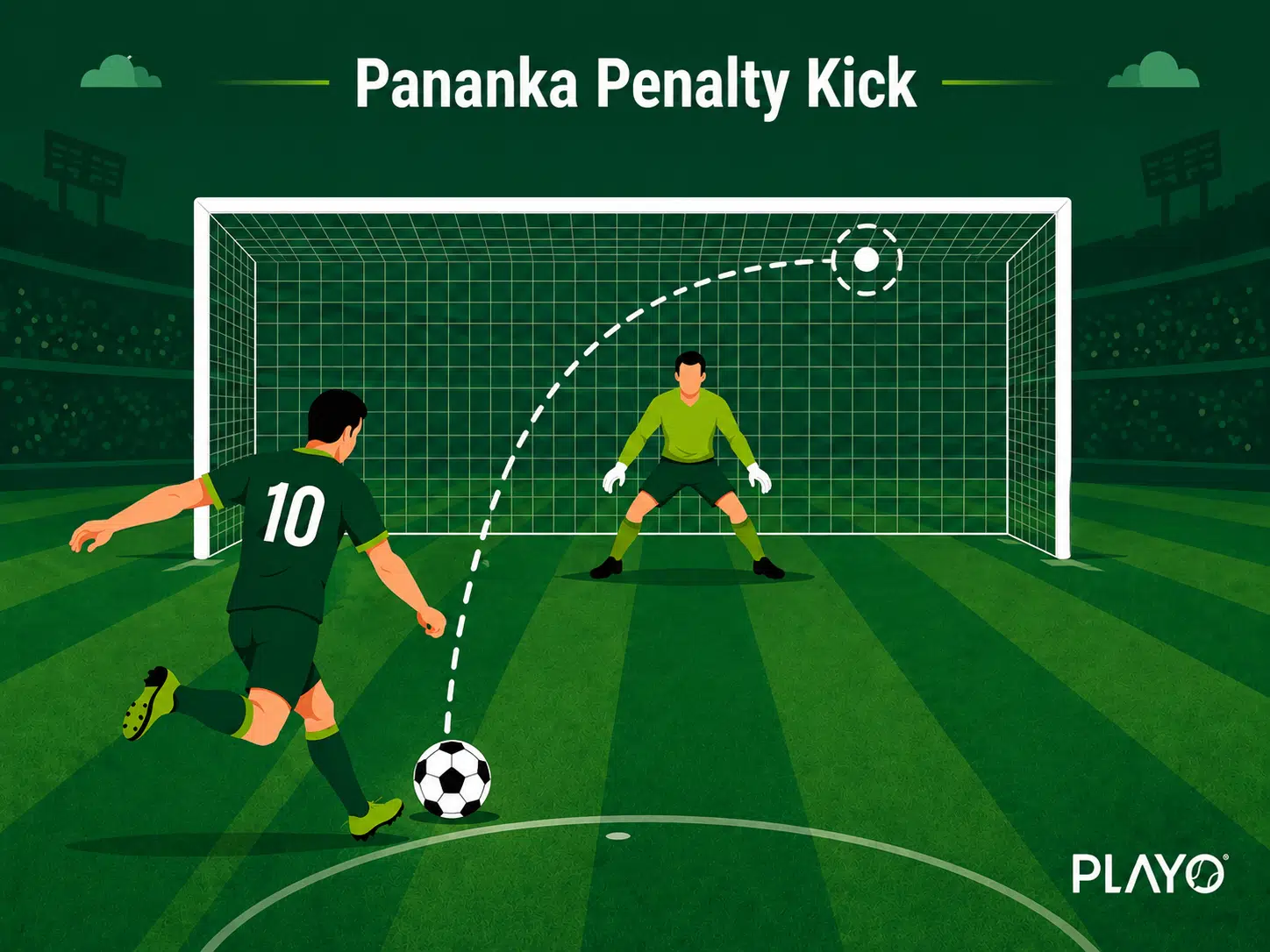
A Panenka penalty is a penalty kick in which the player gently chips the ball straight down the centre of the goal instead of aiming for either corner. The technique is designed to exploit one of the most common habits of goalkeepers: diving to the left or right before the ball is struck.
Unlike a traditional penalty that relies on power or pinpoint placement, a Panenka depends on deception and timing. The player waits for the goalkeeper to commit to a dive before softly lifting the ball into the middle of the goal. If the goalkeeper has already moved away from the centre, the ball drops harmlessly into the net.
Although the finish appears simple, executing a Panenka successfully requires exceptional technique, confidence, and composure. A slight error in timing or ball contact can make the shot easy to save, which is why only a handful of players attempt it regularly in competitive matches.
Why is it Called a Panenka Penalty?
The Panenka penalty gets its name from former Czech footballer Antonín Panenka, who introduced the technique to the world during the 1976 UEFA European Championship Final. His daring approach to penalty-taking forever changed how players viewed one of football’s most pressurised moments.
In the decisive penalty shootout against defending world champions West Germany, Panenka stepped up knowing that a goal would secure the European title for Czechoslovakia. Instead of firing the ball into the corner, he calmly chipped it straight down the middle while legendary goalkeeper Sepp Maier dived away. The ball floated gently into the net, creating one of the most iconic moments in football history.
That single penalty became so famous that the chipped finish has carried Panenka’s name ever since. Today, whenever a player scores using this technique, commentators and fans immediately recognise it as a Panenka penalty.
The History and Origin of the Panenka Penalty
The Panenka penalty is named after Czech footballer Antonín Panenka, who introduced the technique during the 1976 UEFA European Championship Final. While practising penalties after training, Panenka noticed that goalkeepers often dived early, inspiring him to develop a delicate chipped finish that exploited their movement instead of relying on power.
His invention became legendary in the Euro 1976 final between Czechoslovakia and West Germany. After the match ended 2-2, Panenka stepped up to take the decisive penalty and calmly chipped the ball down the middle as goalkeeper Sepp Maier dived away. The goal secured Czechoslovakia’s first major international title and instantly became one of football’s most iconic moments.
Since then, the Panenka has become one of the game’s most recognisable penalty techniques. It continues to symbolise confidence, composure, and technical brilliance, with many of the world’s greatest players attempting it on football’s biggest stages.
How Does a Panenka Penalty Work?
The Panenka penalty is built around anticipation rather than power. Instead of trying to hit the ball beyond the goalkeeper’s reach, the player aims to exploit the goalkeeper’s decision-making.
Because penalties are taken from just 12 yards away, goalkeepers have very little time to react. To improve their chances of making a save, they often decide which direction to dive before the striker actually kicks the ball. A Panenka takes advantage of this instinct by sending the ball into the area the goalkeeper has just abandoned.
Here’s how the technique works:
1. Read the Goalkeeper’s Tendencies
Before attempting a Panenka, the player studies the goalkeeper carefully. Some goalkeepers dive early almost every time, while others prefer to wait until the last possible moment. Recognising these tendencies is one of the most important parts of deciding whether the technique is worth attempting.
2. Use a Natural Run-Up
A Panenka should look identical to a normal penalty until the moment of contact. Any unusual movement or hesitation may alert the goalkeeper, encouraging them to stay in the centre instead of diving.
3. Chip the Ball with Control
Instead of striking through the middle of the ball, the player slides their foot slightly underneath it using the instep. This creates a soft lofted chip that travels slowly toward the centre of the goal. The objective is not power but delicate control and precision.
4. Trust the Technique
Once the goalkeeper commits to either side, the chipped ball drops gently into the middle of the net. The entire move relies on confidence. Hesitation at the final moment often leads to poor execution and an easy save.
Although the Panenka lasts only a few seconds, it is the result of years of technical practice and mental preparation.
Common Mistakes When Attempting a Panenka
Even experienced professionals occasionally get a Panenka wrong. Since the technique relies on precision rather than power, even small mistakes can lead to an easy save or a missed opportunity. Here are some of the most common errors players make:
- Insufficient elevation: Failing to lift the ball high enough allows the goalkeeper to block or catch it before it crosses the line.
- Using too much power: Striking the ball too firmly can send it over the crossbar or ruin the soft trajectory needed for a successful chip.
- Telegraphing the shot: An unusual run-up, hesitation, or obvious body movement can reveal the player’s intentions, encouraging the goalkeeper to stay in the centre.
- Poor ball contact: Hitting the wrong part of the ball can affect its flight, causing it to drift wide or lose control.
- Losing composure under pressure: Rushing the technique or second-guessing the decision at the last moment often results in a poorly executed penalty.
Mastering the Panenka requires not only technical skill but also the confidence to stay calm and commit fully to the technique.
Famous Panenka Penalties in Football History
Ever since Antonín Panenka introduced the technique in 1976, several football legends have successfully recreated it on some of the biggest stages in world football. Each successful Panenka demonstrates not only technical brilliance but also immense confidence under pressure.
Antonín Panenka (UEFA Euro 1976 Final)
No Panenka is more famous than the original. With the UEFA European Championship title on the line, Antonín Panenka calmly chipped the decisive penalty down the middle against West Germany’s Sepp Maier. The goalkeeper dived away, the ball floated into the net, and Czechoslovakia lifted its first major international trophy. More importantly, Panenka’s audacious finish created a technique that football fans still celebrate today.
Zinedine Zidane (2006 FIFA World Cup Final)
One of the boldest Panenka penalties in football history came from Zinedine Zidane during the 2006 FIFA World Cup Final against Italy. In what was his final professional match, Zidane delicately chipped the ball over Gianluigi Buffon, with the shot bouncing off the underside of the crossbar before crossing the goal line. Although France eventually lost the final, Zidane’s penalty remains one of the most memorable moments in World Cup history.
Andrea Pirlo (UEFA Euro 2012 Quarter-final)
Italy midfielder Andrea Pirlo showcased incredible composure during the UEFA Euro 2012 quarter-final penalty shootout against England. With Italy trailing in the shootout, Pirlo calmly executed a perfect Panenka, completely fooling goalkeeper Joe Hart. The goal shifted the momentum in Italy’s favour, and they eventually progressed to the semi-finals.
Lionel Messi
Known for his exceptional vision and ball control, Lionel Messi has successfully scored several Panenka penalties during his illustrious career. His calmness in one-on-one situations and ability to read goalkeepers have made the technique another weapon in his attacking arsenal.
Sergio Ramos
Former Real Madrid captain Sergio Ramos has also become well known for his fearless penalty-taking style. Throughout his career, he has successfully converted multiple Panenka penalties for both club and country, proving that defenders can be just as confident from the penalty spot as elite forwards.
When Should Players Attempt a Panenka?
A Panenka should never be a spontaneous decision. Players usually consider several factors before deciding whether the technique is worth the risk.
The first consideration is the goalkeeper’s tendencies. If the goalkeeper is known for diving early, a Panenka becomes a much more attractive option. However, if the goalkeeper regularly waits until the last moment before moving, attempting a chip can be extremely risky.
The player’s own confidence and technical ability also play an important role. A Panenka should only be attempted by someone who has practised the technique extensively and is comfortable performing under pressure.
Finally, players should consider the importance of the match. While a successful Panenka can create an unforgettable moment, a failed attempt in a crucial knockout game could prove costly. For this reason, many coaches prefer players to choose the safer option unless they are completely confident in their execution.
Conclusion
The Panenka penalty is one of football’s most iconic and daring techniques. Invented by Antonín Panenka during the 1976 UEFA European Championship Final, it transformed the way players approached penalty kicks by proving that intelligence and composure could be just as effective as power.
Although the technique carries significant risk, its ability to deceive goalkeepers and create unforgettable moments has ensured its place in football history. From Antonín Panenka’s historic chip to memorable penalties by Zinedine Zidane, Andrea Pirlo, Lionel Messi, and Sergio Ramos, the Panenka continues to symbolise confidence at the highest level of the game.
Whether you’re a football fan looking to understand the technique or an aspiring player hoping to master it, the Panenka serves as a reminder that sometimes the boldest decisions produce the most memorable moments.
Download Playo on Android or iOS, or visit playo.co to start playing!
Frequently Asked Questions
A Panenka penalty is a chipped penalty kick played softly down the centre of the goal, taking advantage of the goalkeeper diving to either side.
The technique was invented by Czech footballer Antonín Panenka, who famously used it during the UEFA Euro 1976 Final against West Germany.
The penalty is named after Antonín Panenka, whose iconic chipped finish introduced the technique to world football.
Yes. A Panenka is completely legal under the Laws of the Game, provided the player follows the standard rules for taking a penalty kick.
The technique depends on the goalkeeper diving early. If the goalkeeper stays in the centre or the chip is poorly executed, the penalty can be saved easily.