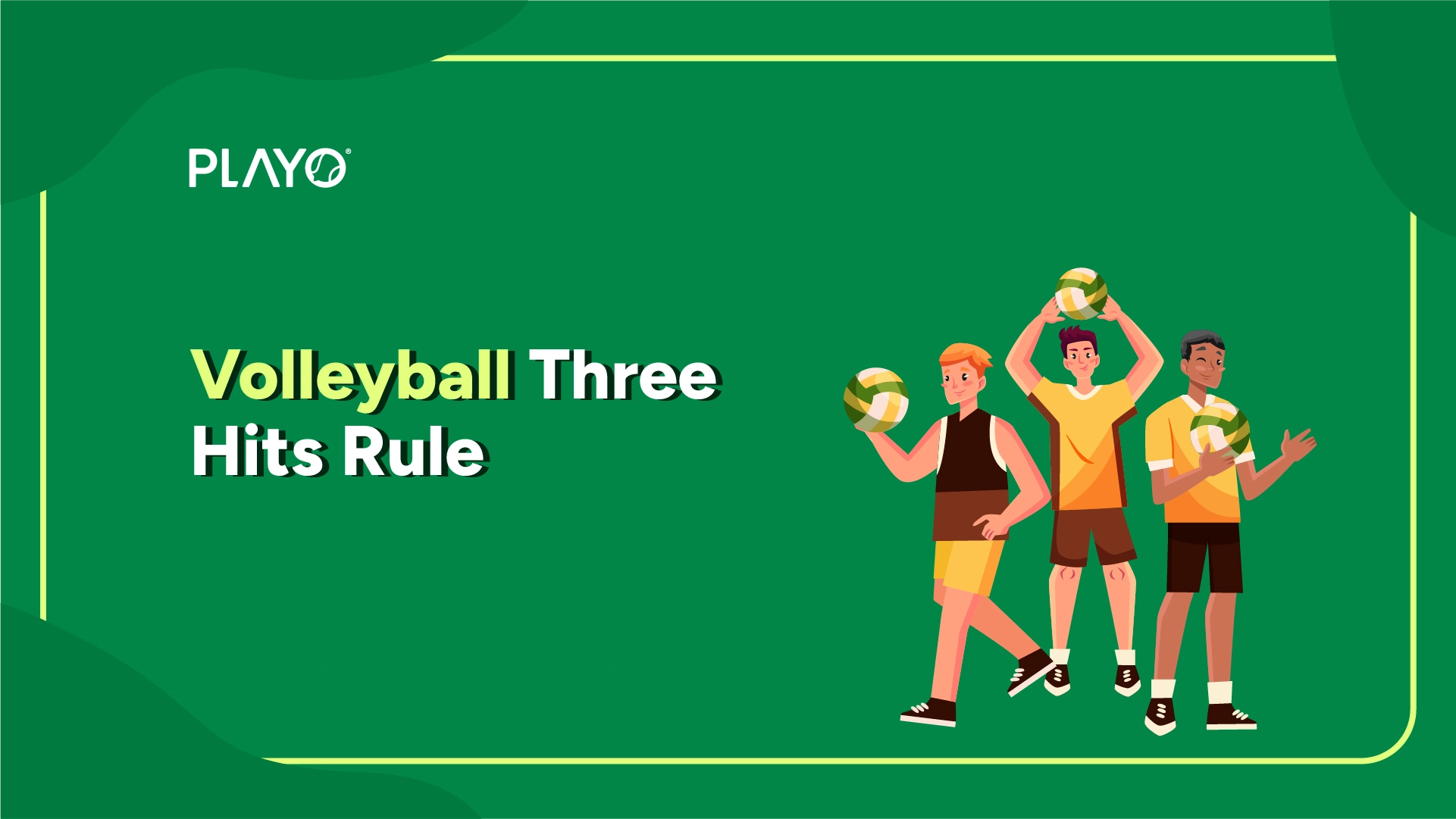


The volleyball three hits rule allows each team to touch the ball a maximum of three times before returning it over the net. These touches are commonly used for receiving the ball, setting up an attack and sending it into the opponent’s court. However, a block does not count as one of these three team hits in indoor volleyball.
The rule encourages coordinated passing, setting and attacking techniques while preventing teams from making unlimited contacts. There are also specific exceptions involving blocking, simultaneous contacts and consecutive touches during a single playing action. Understanding these rules helps players avoid faults and maintain control during a rally.
What is the Three Hits Rule in Volleyball?
The three hits rule in volleyball states that a team can make a maximum of three contacts with the ball to return it to the opponent’s court. If the team makes four hits before sending the ball over the net, it commits a fault known as a four hits violation.
According to the Official Volleyball Rules 2025–2028, a hit is any contact with the ball by a player in play. The three-hit limit applies to the entire team, not to each individual player. The three contacts generally follow this sequence:
- First Hit (Pass): A player receives the opponent’s serve or attack, usually with a forearm pass or dig.
- Second Hit (Set): Another player positions the ball for an attacker, usually through an overhead set.
- Third Hit (Attack): A player spikes, tips or otherwise sends the ball over the net into the opponent’s court.
This is the standard three-touch pattern, although teams can return the ball on the first or second contact when necessary.
How Many Touches are Allowed in Volleyball?
A team is allowed a maximum of three hits before returning the ball over the net. However, a block contact is excluded from this limit in indoor volleyball, meaning a team can make three additional hits after successfully blocking an opponent’s attack.
For example, if a player blocks an opponent’s spike, the team can still pass, set and attack the ball. Although the ball has been contacted four times in total, only three of those contacts count towards the permitted team hits. Here is a breakdown of which contacts count towards the three-hit limit:
| Type of Contact | Counts Towards Three Hits? |
| Serve reception | Yes |
| Forearm pass or dig | Yes |
| Set | Yes |
| Spike or attack | Yes |
| Block | No |
| Tip or push over the net | Yes |
Read More: Volleyball Player Positions
Does a Block Count as One of the Three Hits?
No. In indoor volleyball, a block does not count as one of the team’s three permitted hits. A block occurs when players close to the net attempt to intercept an opponent’s attack by reaching above the top of the net. When the ball touches a blocker, the team retains all three hits to return it.
For example, a player can block an opponent’s spike, after which a teammate receives the ball with a forearm pass, another player sets it, and an attacker spikes it over the net. This sequence is legal because the initial blocking contact does not count towards the three-hit limit.
Another important exception is that the player who makes the block can also touch the ball immediately afterwards. This is permitted because a block contact is not considered the team’s first hit.
What Happens If a Team Touches the Ball Four Times?
If a team makes four hits before returning the ball over the net, it commits a four hits fault. Under the rally-point scoring system, the opposing team wins the rally and receives a point.
For example, consider a rally where Player 1 receives the ball, Player 2 sets it, and Player 3 attempts to control the ball but sends it towards Player 4. If Player 4 makes another contact before the ball crosses the net, the team commits a four hits violation, provided no blocking exception applies.
The referee signals the fault by raising four fingers, indicating that the team has exceeded its permitted number of contacts.
Can the Same Player Touch the Ball Twice in Volleyball?
Generally, a player cannot hit the ball twice consecutively, as this results in a double contact fault. However, the official volleyball rules recognise certain exceptions where consecutive contacts are permitted.
1. First Team Contact
During the team’s first hit, the ball may touch different parts of a player’s body consecutively, provided the contacts occur during a single playing action. For example, a player receiving a powerful spike may have the ball rebound off their forearms and then their chest during one continuous defensive action. This is permitted under the first-hit exception.
2. After a Block
A player who touches the ball during a block can make the next contact immediately. Since the block does not count as a team hit, the same player is allowed to play the ball again without committing a double contact fault.
3. During a Block
One or more blockers can make consecutive contacts with the ball during a single blocking action. These contacts are treated as part of the same block and do not count towards the team’s three permitted hits.
Outside these exceptions, a player who hits the ball twice consecutively commits a double contact fault.
What are the Rules for Simultaneous Touches?
Simultaneous contacts occur when two or more players touch the ball at the same time. The way these contacts are counted depends on whether the players belong to the same team or opposing teams.
1. Two Teammates Touching the Ball Simultaneously
When two or three teammates touch the ball simultaneously, each contact counts as a separate team hit, except during a blocking action. For example, if two teammates attempt to receive the same ball and both make contact, the team is charged with two hits. However, if only one player actually touches the ball, only one hit is counted.
A collision between teammates does not automatically result in a fault unless a playing rule is violated.
2. Two Opponents Touching the Ball Simultaneously
When opposing players touch the ball simultaneously above the net, and it remains in play, the team receiving the ball is entitled to another three hits. This situation commonly occurs when players from both teams attempt to play the ball near the net.
If the ball goes out following simultaneous contact by opponents above the net, the fault is charged to the team on the opposite side of the court from where the ball lands.
What is the Difference Between a Double Hit and a Four Hits Fault?
A double hit occurs when a player makes consecutive contacts outside permitted exceptions, while a four-hit fault happens when a team exceeds its three-hit limit. Both violations award a point to the opposing team.
| Basis | Double Hit | Four Hits Fault |
| Meaning | A player touches the ball twice consecutively | A team touches the ball four times |
| Who commits it? | An individual player | The entire team |
| Common cause | Consecutive contacts outside permitted exceptions | Exceeding the three-hit limit |
| Result | Opponent wins the rally | Opponent wins the rally |
What are the Common Mistakes Related to the Three Hits Rule?
Players can unintentionally commit violations when receiving or returning the ball. Some of the most common mistakes include:
- Making four contacts: Players sometimes lose track of the number of team hits and make an additional contact before returning the ball.
- Consecutive double contacts: A player touches the ball twice in succession outside the permitted exceptions.
- Misunderstanding the block rule: Players incorrectly count a block as one of their three permitted hits.
- Confusing simultaneous contacts: Two teammates touching the ball at the same time can count as two hits rather than one.
- Holding or throwing the ball: A player catches or throws the ball instead of allowing it to rebound cleanly.
Understanding these situations helps players coordinate their movements and avoid unnecessary faults during a match.
Does the Three Hits Rule Apply to Beach Volleyball?
The three-hit principle also applies to beach volleyball, but there is an important difference in how blocking contacts are counted. In indoor volleyball, a block does not count towards the team’s three hits, whereas in beach volleyball, a block contact counts as the team’s first hit.
Therefore, a beach volleyball team has only two additional contacts to return the ball after a block. This distinction is important because indoor and beach volleyball follow separate official rulebooks.
Conclusion
The volleyball three-hits rule allows each team a maximum of three contacts to return the ball to the opponent’s court. The usual sequence involves a pass, a set and an attack, although teams can use fewer touches depending on the situation.
The most important exception is that blocking does not count towards the three-hit limit in indoor volleyball. Players should also understand the rules for double contacts, simultaneous touches and four-hit violations to avoid losing points during a match.
Download Playo on Android or iOS, or visit playo.co to start playing!
Frequently Asked Questions
A team can touch the ball a maximum of three times before returning it over the net. A block does not count as one of these three hits in indoor volleyball.
No. In indoor volleyball, a block is not counted as a team hit. The team gets three additional contacts after blocking the opponent’s attack.
Generally, no. However, a player can make consecutive contacts during a single blocking action or when making the team’s first hit, provided the contacts occur during one playing action. A player may also play the ball immediately after making a block.
If a team makes four hits before returning the ball, it commits a four-hit fault. The opposing team wins the rally and receives a point.
Yes. When two teammates touch the ball simultaneously, it counts as two hits. If three teammates touch it simultaneously, it counts as three hits, except during a blocking action.