


7-a-side football is one of the most popular small-sided formats of the game. It strikes the perfect balance between space, speed, and skill. While it may look like a scaled-down version of 11-a-side football, the game feels completely different, and that difference is defined by the 7-a-side dimensions.
From pitch length and width to centre circle radius, penalty area depth, and goal dimensions, every measurement directly impacts spacing, player movement, and match tempo in 7v7 football. This blog breaks down the officially recommended 7-a-side dimensions as defined by The Football Association (England FA), providing clear measurement ranges and marking specifications required for structured 7v7 football.
What is 7-a-Side Football?
7-a-side football (7v7) is a small-sided format played with six outfield players and one goalkeeper on each team. It is widely played in schools, academies, amateur leagues, and turf competitions across India and globally, particularly in youth development programmes and grassroots tournaments.
Because the format uses a smaller pitch and fewer players, the field dimensions directly influence spacing, passing distances, defensive organisation, and overall match tempo. Clearly defined 7-a-side measurements help ensure balanced gameplay, realistic physical demands, and consistent playing conditions across organised competitions and recreational matches.
Read More: 9-a-side Football Ground Measurement
Official 7-a-Side Dimensions
According to The Football Association’s small-sided football guidelines, the recommended 7v7 pitch dimensions are:
Pitch Length & Width
According to The Football Association’s small-sided football guidelines, the recommended 7v7 pitch dimensions are as follows:
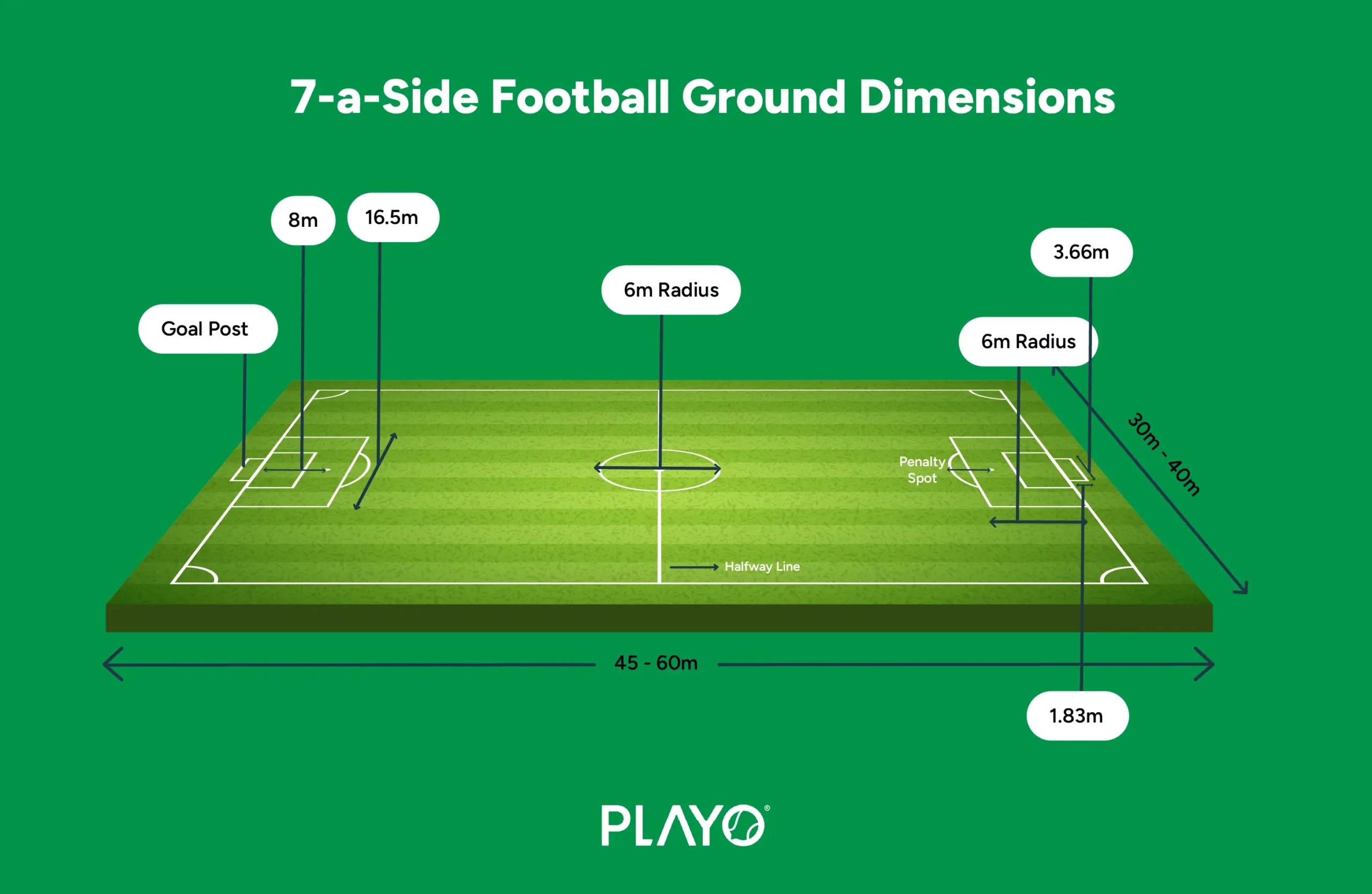
- Length (touchline): 45 to 60 metres
- Width (goal line): 30 to 40 metres
These ranges allow flexibility based on age group, competition level, and available facility space.
For youth football, particularly Under-9 and Under-10 formats, a commonly used pitch size is:
- 60 yards (54.86 metres) in length
- 40 yards (36.58 metres) in width
This size provides sufficient width for wing play, appropriate spacing for build-up phases, and balanced player distribution without creating congestion on the field.
Centre Circle
The centre circle has a radius of 6 metres and must be clearly marked from the centre spot. During kick-off, all opposing players are required to remain outside the circle until the ball is in play.
A 6-metre radius ensures adequate spacing at restarts and remains proportionate to the overall dimensions of a 7-a-side pitch, supporting organised positioning at the start of each half and after goals.
Penalty Area Dimensions
Unlike the large penalty box in 11-a-side football, the 7-a-side penalty area is scaled down.
- The penalty area extends 8 metres from each goalpost into the field of play
- The shape is rectangular
- The penalty mark is positioned 8 metres from the goal line
This proportionate design helps reduce defensive congestion near the goal, supports more structured attacking play, and maintains realistic shooting distances appropriate for the 7v7 format.
Goal Size (7-a-Side Goal Post Dimensions)
The official FA-recommended goal size for 7v7 football is:
- Width: 3.66 metres (12 feet)
- Height: 1.83 metres (6 feet)
These goals are smaller than full-size 11-a-side goals and are proportionate to the reduced pitch dimensions. Using larger goals would alter the balance of play, while smaller ones could overly favour defenders. The 12ft × 6ft goal size maintains appropriate scoring difficulty for the 7v7 format.
Essential Markings on a 7v7 Pitch
A properly prepared 7-a-side football ground must include:
- Touchlines (long sides)
- Goal lines (short sides)
- Halfway line
- Centre circle (6m radius)
- Rectangular penalty areas
- Penalty mark (8m)
- Corner arcs (1m radius recommended)
- Goal areas are clearly marked
Clear, visible markings ensure accurate refereeing, structured gameplay, and fair competition. Poor or unclear markings can lead to confusion during offside decisions, penalty situations, and match restarts, affecting the overall flow of the game.
Key Rules of 7-a-Side Dimensions
While rules may vary by competition, standard 7v7 football generally includes the following:
- Each team consists of seven players, including one goalkeeper, which aligns with the reduced pitch dimensions and ensures balanced spacing across the field.
- Substitutions are usually permitted on a rolling basis, allowing players to enter and exit the game without stopping play, which helps maintain intensity on the smaller pitch.
- Matches are typically played in two halves of 20 to 30 minutes, depending on the competition level and age group.
- The offside rule may be applied depending on league regulations, particularly in organised youth and amateur competitions.
- Throw-ins are taken using the standard overhead technique from the touchline, consistent with traditional football rules.
- Both direct and indirect free kicks are awarded for fouls and rule infringements, following standard football regulations adapted to the 7v7 format.
Conclusion
7-a-side football is a structured format built around specific measurements that shape how the game is played. According to FA England guidelines, the recommended 7-a-side dimensions include a pitch measuring 45 to 60 metres in length and 30 to 40 metres in width, a centre circle with a 6-metre radius, a penalty area extending 8 metres from each goalpost, a penalty mark positioned 8 metres from the goal line, and goalposts measuring 3.66 metres by 1.83 metres (12ft by 6ft).
These measurements provide appropriate spacing, balanced attacking and defensive play, and consistent match conditions across organised competitions. Whether setting up a new turf, marking an existing ground, or understanding youth football standards, following the defined 7-a-side dimensions ensures the format functions as intended.
Download Playo on Android or iOS, or visit playo.co to start playing!
Frequently Asked Questions
7-a-side football is a small-sided format played with six outfield players and one goalkeeper on each team. It is commonly used in youth and grassroots competitions and is played on a smaller pitch than traditional 11-a-side football. Matches are typically played in two halves of 20 to 30 minutes, depending on age group and competition rules.
The recommended 7-a-side pitch size is between 45 – 60 metres in length and 30 – 40 metres in width. For youth football, a commonly used format is 60 yards (54.86m) by 40 yards (36.58m). The penalty area extends 8 metres from each goalpost, and the penalty mark is positioned 8 metres from the goal line.
The standard goal size for 7-a-side football is 3.66 metres wide and 1.83 metres high (12ft × 6ft). This size is proportionate to the smaller pitch dimensions used in 7v7 matches.
The centre circle in 7-a-side football has a radius of 6 metres. Opposing players must remain outside this circle during kick-off until the ball is in play.
The penalty spot in 7-a-side football is positioned 8 metres from the goal line, measured from the centre of the goal.