

A football goal may look simple, but its dimensions are precisely regulated to ensure that matches are played on a consistent and fair playing field. From the distance between the goalposts to the height of the crossbar, every measurement matters.
According to the current 2026/27 Laws of the Game, the standard football goal used in association football is 7.32 metres wide and 2.44 metres high. These measurements apply to the distance between the inside edges of the goalposts and the distance from the ground to the lower edge of the crossbar.
But goal size is not the only requirement. The Laws also specify the shape, colour, thickness, positioning and safety requirements of the goal frame. Here is everything you need to know about football goal post size and regulations.
What is the Standard Football Goal Post Size?
The 7.32-metre width is measured between the inside edges of the two vertical goalposts. The 2.44-metre height is measured from the ground to the lower edge of the crossbar.
These dimensions create the goal opening that players are aiming at during a full-size football match. The same dimensions are used for standard senior matches unless competition regulations or permitted modifications apply. The standard football goal has:
| Measurement | Standard size |
| Goal width | 7.32 m (8 yd) |
| Goal height | 2.44 m (8 ft) |
| Maximum post/crossbar width | 12 cm (5 in) |
| Maximum post/crossbar depth | 12 cm (5 in) |
Football Goal Dimensions in Feet and Yards
Football goal dimensions are commonly expressed in both metric and imperial measurements.
A standard goal is:
- 7.32 metres wide
- 2.44 metres high
- 8 yards wide
- 8 feet high
So, when someone refers to an 8 × 8 football goal, they are referring to the standard goal opening: 8 yards between the posts and 8 feet from the ground to the underside of the crossbar.
It is important to remember that these measurements describe the playing opening, rather than the overall external dimensions of the complete goal structure. The depth and supporting framework behind the goal can vary depending on the goal design.
Read More: Football Ground Dimensions
How are Football Goal Posts Positioned?
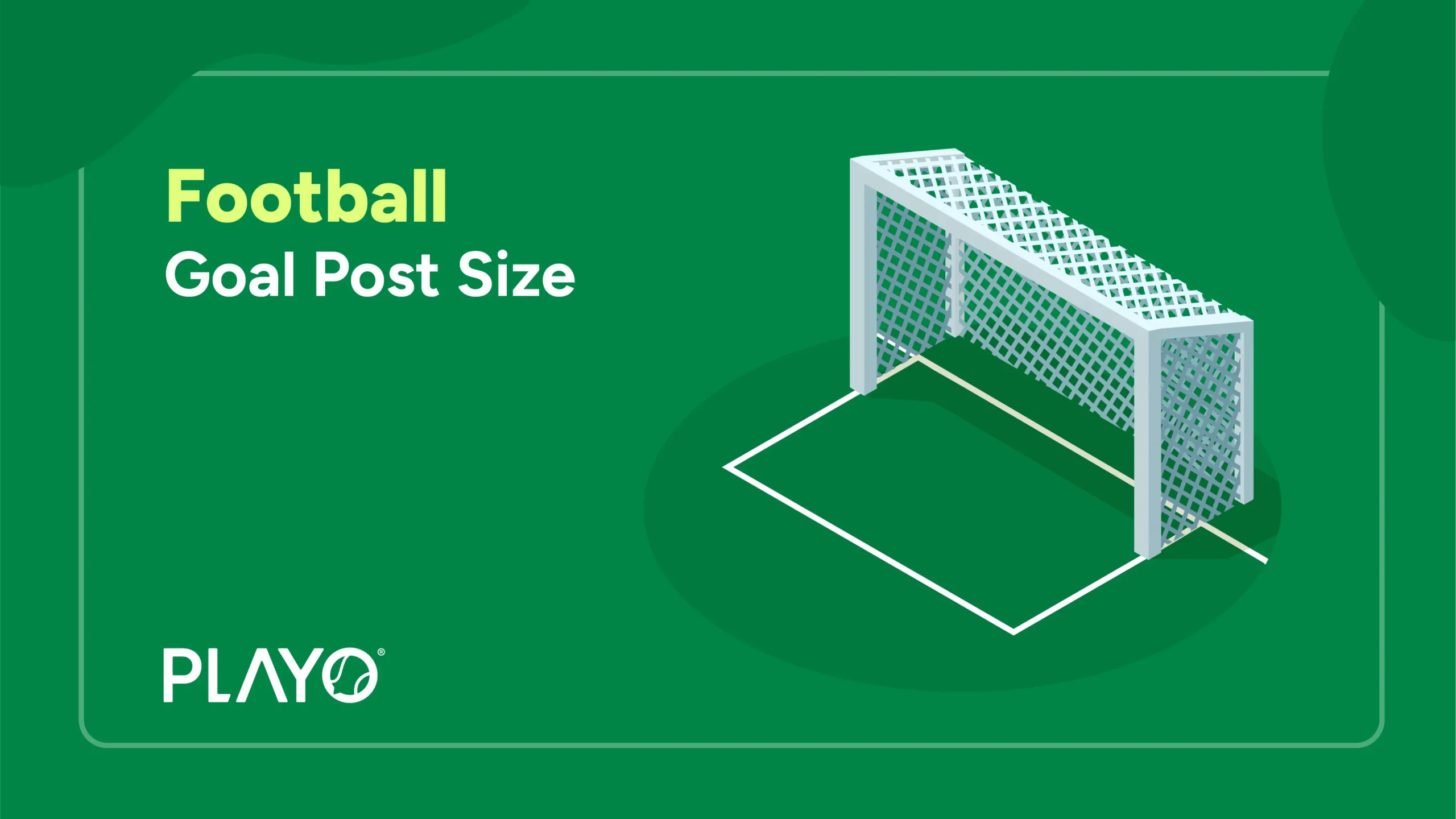
A goal is placed at the centre of each goal line. It consists of two vertical posts connected at the top by a horizontal crossbar. The posts are positioned equidistant from the corner flagposts. The relationship between the goalposts and the goal line is also regulated. This helps ensure that the goal is positioned correctly and that its dimensions are measured consistently.
The goalposts and crossbar must have the same width and depth, and their dimensions must not exceed 12 cm (5 inches). The goal line must also be the same width as the goalposts and crossbar.
This means the markings on the pitch and the physical goal frame are designed to work together rather than being treated as separate measurements.
What Shape Should Football Goal Posts Be?
The Laws of the Game allow goalposts and crossbars to have several approved shapes. They can be:
- Square
- Rectangular
- Round
- Elliptical
- A hybrid of these shapes
The goalposts and crossbar of both goals must have the same shape. They must also be made from approved material and must not be dangerous to players. The posts and crossbar must be white, making the goal clearly visible against the playing surface and surrounding area.
Football Goal Net Dimensions and Requirements
The goal frame is not complete without the net, although the Laws do not prescribe one universal net depth in the same way they prescribe the width and height of the goal opening. Nets may be attached to the goals and the ground behind them. They must be properly supported and must not interfere with the goalkeeper.
This distinction is useful when buying or installing a goal: the 7.32 m × 2.44 m measurement refers to the goal opening, while the supporting structure and net arrangement may differ between goal designs.
Football Goal Post Safety Regulations
Goal safety is an important part of the Laws of the Game. A football goal must not simply be placed on the pitch and left unsecured. The current Laws specifically state that goals, including portable goals, must be firmly secured to the ground.
This is particularly important for training grounds, schools, grassroots facilities and temporary football pitches where portable goals may be used. A goal should also be constructed from materials that are safe for players. Sharp or dangerous structures are not permitted.
What Happens If the Crossbar Breaks?
The crossbar is an essential part of the goal, so play cannot simply continue if it becomes displaced or breaks.
If the crossbar becomes displaced or breaks, play is stopped until it is repaired or replaced. If it cannot be repaired or replaced, the match may have to be abandoned. The Laws specifically do not allow a rope or other flexible or dangerous material to be used as a replacement for the crossbar.
This ensures that the goal continues to meet the required safety and dimensional standards throughout the match.
Are Football Goal Sizes Different for Youth Players?
Yes. The standard 7.32 m × 2.44 m goal is associated with full-size football, but younger players do not necessarily use full-size goals.
The Laws of the Game allow modifications for youth, veterans, disability and grassroots football. These modifications can include the width between the goalposts and the height of the crossbar from the ground. The exact dimensions can therefore be determined by the relevant national association, confederation or competition organiser.
This means there is no single worldwide youth football goal size that applies to every age group and every competition. For youth football, always check the rules of the specific competition or governing organisation before selecting goal equipment.
Standard Football Goal vs Youth Football Goal
The key takeaway is that 7.32 m × 2.44 m should not automatically be used for every youth football pitch. Age-group and competition rules should always be checked.
| Feature | Full-size football | Youth/grassroots football |
| Goal width | 7.32 m | May be modified |
| Goal height | 2.44 m | May be modified |
| Regulations | Standard Laws of the Game | Competition-specific modifications may apply |
| Goal frame | Approved, safe construction | Depends on competition requirements |
| Securing the goal | Must be firmly secured | Must also be safely secured |
Why is Football Goal Size Standardised?
Standardising the size of the goal helps create consistency across competitive football. Players, coaches, referees and teams can work with the same target dimensions regardless of where a match is played.
Goal dimensions also influence several aspects of the game, including:
- Finishing and shooting
- Goalkeeping
- Crossing and attacking play
- Set pieces
- Defensive positioning
- Goal-line decisions
Even a small change in the goal opening could affect the difficulty of scoring and the goalkeeper’s positioning. That is why official competitions follow defined dimensions.
Conclusion
Football goal post dimensions are carefully regulated to maintain consistency, fairness and player safety. For standard full-size football, the goal opening measures 7.32 metres (8 yards) in width and 2.44 metres (8 feet) in height.
The regulations also cover the thickness, shape, colour, positioning and safety of the goal frame. Meanwhile, youth and grassroots football can use modified goal dimensions according to the applicable competition rules.
So, whether you are setting up a professional-standard pitch, buying a goal for training or planning a grassroots football facility, the most important measurement to remember is 7.32 m × 2.44 m for a standard full-size football goal.
Download Playo on Android or iOS, or visit playo.co to start playing!
Frequently Asked Questions
The standard football goal opening is 7.32 metres (8 yards) wide and 2.44 metres (8 feet) high. The width is measured between the inside edges of the posts and the height from the ground to the lower edge of the crossbar.
A standard football goal is 24 feet wide when the 7.32-metre width is converted to feet. In official measurements, however, the width is specified as 7.32 m or 8 yards.
The standard football goal is 2.44 metres (8 feet) high, measured from the ground to the lower edge of the crossbar.
The goalposts and crossbar must have the same width and depth, with neither measurement exceeding 12 cm (5 inches) under the Laws of the Game.
No. The standard full-size goal is 7.32 m × 2.44 m, but modifications are permitted for youth, grassroots and certain other forms of football. The applicable competition rules determine the dimensions in those cases.