
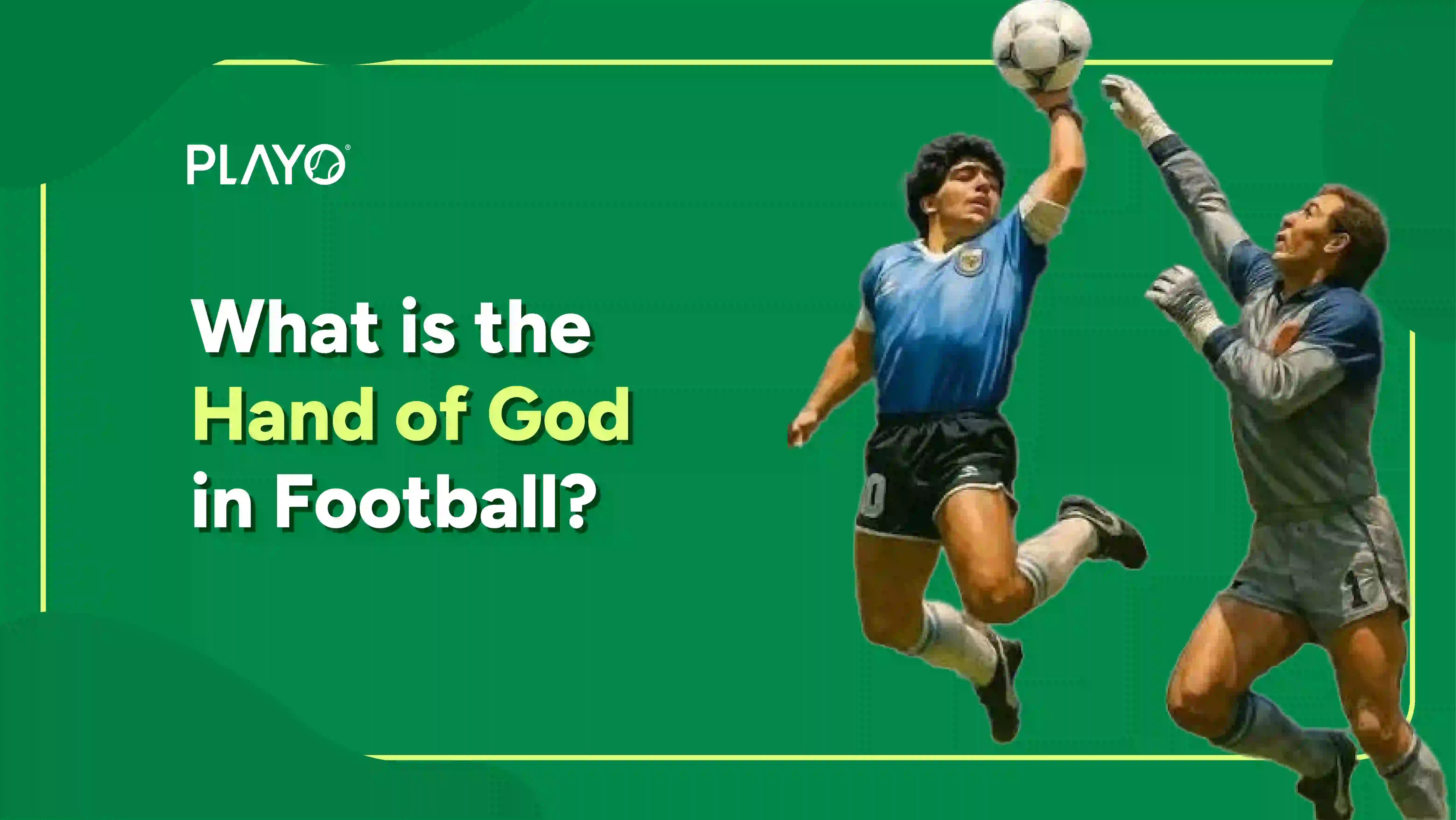


Football has produced countless unforgettable moments, but few have sparked as much fierce, decades-long debate as the Hand of God in football. More than three decades later, the phrase is still instantly recognised by fans, pundits, and historians around the world.
The Hand of God refers to the infamous goal scored by Argentine legend Diego Maradona during the 1986 FIFA World Cup quarter-final against England. Instead of heading the ball into the net, Maradona deliberately punched it with his left hand, fooling both the referee and the linesman.
The goal stood, Argentina won the match, and football history was changed forever.
In this article, we will explain exactly what the Hand of God is, why it became so controversial, how the modern Laws of the Game view such handball incidents, and why this single moment continues to be one of the sport’s greatest talking points.
What is the Hand of God in Football?
The Hand of God is the name given to a goal scored by Diego Maradona for Argentina against England on 22 June 1986 at the iconic Estadio Azteca in Mexico City.
In the 51st minute of the quarter-final, an English clearance fell into the penalty area. Instead of heading the ball, Maradona deliberately used his left fist to knock it past England goalkeeper Peter Shilton. Because the match officials failed to notice the handball in real-time, the goal was awarded.
After the match, when journalists questioned whether he had handled the ball, Maradona famously replied with a sly smile:
“Un poco con la cabeza de Maradona y otro poco con la mano de Dios.”
(“A little with the head of Maradona, and a little with the hand of God.”)
That cheeky, defiant quote gave birth to one of football’s most famous phrases. Ironically, just four minutes later, Maradona scored what is widely considered the “Goal of the Century,” dribbling past five England players before scoring. The same match, therefore, produced both football’s most controversial goal and arguably its greatest legitimate goal.
Breaking Down the Hand of God Incident
Here is exactly how the historic incident unfolded:
- The Setup: Early in the second half, Maradona passed the ball forward before attempting a one-two pass.
- The Deflection: England midfielder Steve Hodge attempted to clear the ball but accidentally lofted it high into the Argentine attacking third.
- The Chase: Goalkeeper Peter Shilton, who was significantly taller than Maradona, rushed off his line to punch the ball clear. Maradona sprinted to challenge him.
- The Handball: Instead of reaching the ball with his head, Maradona jumped and punched it with his left fist into the back of the net.
- The Decision: The referee, Ali Bin Nasser of Tunisia, awarded the goal after a brief consultation with his Bulgarian assistant referee, Bogdan Dochev. Neither had a clear angle to see the infringement.
- The Aftermath: England players immediately surrounded the referee in furious protest, but the decision stood.
Argentina eventually won the match 2-1 and later defeated West Germany in the final to become World Champions.
Read More: What is a Panenka Penalty in Football?
Why Was the Hand of God So Controversial?
Several compounding factors made this incident legendary:
1. It Was Clearly Against the Rules
Even in 1986, deliberately handling the ball to score a goal was a blatant violation of the rules. Had the referee seen the handball, the goal would have been disallowed, and England would have been awarded a goal kick or free kick.
2. It Happened on the World’s Biggest Stage
This wasn’t an ordinary domestic league match. It occurred in the quarter-finals of the FIFA World Cup, the most-watched sporting event on the planet, making the officiating error historically significant.
3. Intense Geopolitical Tensions
The match took place just four years after the 1982 Falklands War between Argentina and the United Kingdom. While FIFA insists football and politics should remain separate, the Argentine public and media heavily framed the match as a chance for national redemption. Maradona himself later acknowledged that the lingering national trauma fueled his desire to defeat England, making the result emotionally charged for both nations.
4. Technology Didn’t Exist
In 1986, officiating relied entirely on the naked eye. There was:
- No Video Assistant Referee (VAR)
- No goal-line technology
- Limited television replay access for officials during the match
Once the referee awarded the goal, it was final.
Was the Hand of God Goal Legal?
No. According to the Laws of the Game, a player cannot deliberately handle the ball to score a goal. Even if the referee fails to spot the infringement in real-time, the action itself remains illegal.
Today, under the modern IFAB (International Football Association Board) Laws of the Game:
- A goal cannot be scored directly using the hand or arm.
- Deliberate handball is punished with a direct free kick (or a penalty if committed by a defender inside their own penalty area).
- If an attacking player handles the ball immediately before scoring or creating a goal-scoring opportunity, play is stopped, and the goal is disallowed.
Would VAR Have Allowed the Hand of God Goal?
Absolutely not. Video Assistant Referee (VAR), which was introduced to the FIFA World Cup in 2018, reviews all potential goals before play restarts. A VAR review of the 1986 incident would have clearly shown:
- Maradona striking the ball with his clenched fist.
- No legal header taking place.
- Deliberate handling immediately before the ball crossed the line.
The referee would have been instructed to cancel the goal and award England a goal kick. In fact, the Hand of God is frequently cited by football analysts as the ultimate historical argument for the introduction of VAR to the sport.
The Duality of Maradona: Hand of God vs. Goal of the Century
One of the most fascinating aspects of this match is that Maradona produced two completely different masterpieces within a span of just four minutes. This contrast perfectly encapsulates his complicated legacy: the ultimate rogue and the ultimate genius.
| Feature | The Hand of God (51st Minute) | Goal of the Century (55th Minute) |
| Legality | Illegal handball | Completely legal, fair play |
| Reception | Highly controversial and debated | Universally admired and celebrated |
| Execution | Officials missed the foul; cunning deception | Brilliant 60-yard solo dribble past 5 players |
| Symbolism | Symbol of gamesmanship and controversy | Symbol of pure footballing genius |
How Did the Key Figures React?
- The Referee: Ali Bin Nasser later admitted in interviews that he genuinely believed Maradona had headed the ball. He also assumed that if his assistant referee had seen a handball, he would have raised his flag. Neither official had the optimal viewing angle.
- England’s Reaction: Goalkeeper Peter Shilton was particularly vocal, arguing for decades that he had been beaten unfairly by deception rather than by skill. For many England supporters, it remains one of the most painful moments in World Cup history.
- Maradona’s Stance: Over the years, Diego Maradona openly admitted that he intentionally used his hand. He rarely expressed regret, instead treating the incident as a clever piece of “criollo” (local) ingenuity and a permanent part of football folklore.
Famous Handball Incidents Similar to the Hand of God
Although none are as culturally iconic, football has witnessed several other controversial handball incidents that drew comparisons to Maradona’s strike:
- Lionel Messi vs. Espanyol (2007): Messi scored a league goal using his hand, drawing immediate, inevitable comparisons to his compatriot Maradona’s famous moment.
- Thierry Henry vs. Republic of Ireland (2009): Henry deliberately controlled the ball with his hand before assisting the winning goal in a World Cup qualifying playoff. France advanced, Ireland was eliminated, and the outrage directly accelerated the push for goal-line technology and VAR.
- Luis Suárez vs. Ghana (2010): In the World Cup quarter-final, Suárez deliberately used his hands on the goal line to stop a certain Ghanaian goal in the final seconds of extra time. He received a red card, Ghana missed the resulting penalty, and Uruguay progressed via a shootout. Unlike Maradona, Suárez was punished in the moment, but his team still benefited.
Conclusion
The Hand of God in football is far more than just an illegal goal. It is one of the sport’s most defining moments, remembered for its sheer controversy, rich historical context, and lasting impact on how the game is officiated.
Scored by Diego Maradona against England in the 1986 FIFA World Cup, the goal sparked debates about ethics, skill, and luck that continue to this day. While modern VAR technology would almost certainly have ruled it out in seconds, the incident remains a powerful reminder of how a single, audacious moment can shape football history forever.
Love it or hate it, the Hand of God ensures that the 1986 World Cup quarter-final will never be forgotten.
Download Playo on Android or iOS, or visit playo.co to start playing!
Frequently Asked Questions
The Hand of God refers to Diego Maradona’s controversial goal for Argentina against England in the 1986 FIFA World Cup quarter-final, where he deliberately used his left hand to punch the ball into the net.
The phrase comes directly from Maradona’s post-match interview, where he jokingly claimed the goal was scored “a little with the head of Maradona, and a little with the hand of God.”
No. Deliberately handling the ball to score is a clear violation of the Laws of the Game. The goal stood only because the match officials did not see the handball in real-time.
He scored it against England, specifically past goalkeeper Peter Shilton, during the quarter-finals of the 1986 FIFA World Cup in Mexico City.
No. With the introduction of VAR (Video Assistant Referee), the handball would almost certainly be detected, and the goal would be disallowed.
Both goals were scored by Diego Maradona in the same 1986 FIFA World Cup quarter-final against England. The Hand of God involved an illegal handball, while the Goal of the Century was a brilliant solo run in which Maradona dribbled past multiple defenders before scoring.