

Choosing the right badminton racket depends on its weight distribution, which affects shot power, racket speed and manoeuvrability. Based on their balance points, badminton rackets are classified into three types: head-heavy, head-light and even-balanced.
A head-heavy badminton racket has more weight towards the racket head, supporting powerful smashes and attacking shots. In contrast, a head-light badminton racket has more weight towards the handle, allowing quicker racket movement and better manoeuvrability. Understanding these differences, along with their advantages and disadvantages, can help you choose a racket that suits your playing style.
In this guide, we explain their differences, advantages, disadvantages and which type of badminton racket you should choose.
What is a Head-Heavy Badminton Racket?
A head-heavy badminton racket is designed with more weight distributed towards the racket head rather than the handle. This balance increases the momentum generated during a swing, helping players execute powerful smashes and attacking clears.
These rackets are commonly preferred by aggressive players who rely on attacking shots to put pressure on their opponents. The additional weight towards the head can help generate more power, particularly when the player has sufficient swing speed and technique.
Key characteristics of head-heavy rackets:
- More weight concentrated towards the racket head.
- Greater head momentum during swings.
- Suitable for attacking and power-oriented playing styles.
- Can feel slower during quick defensive exchanges.
- Often preferred by singles players who rely on powerful shots.
What is a Head-Light Badminton Racket?
A head-light badminton racket has more of its weight distributed towards the handle, making the racket head feel lighter during movement. This design allows players to change racket direction quickly and respond more comfortably during fast-paced rallies.
Head-light rackets are particularly useful for defensive players and doubles players who frequently need to react to smashes, perform quick drives and make rapid changes in racket direction.
Key characteristics of head-light rackets:
- More weight concentrated towards the handle.
- Faster racket manoeuvrability.
- Easier handling during quick exchanges.
- Suitable for defensive and fast-paced playing styles.
- Can feel less powerful during smashes compared with head-heavy rackets, depending on technique and racket specifications.
Key Differences of Head-Heavy & Head-Light Badminton Rackets
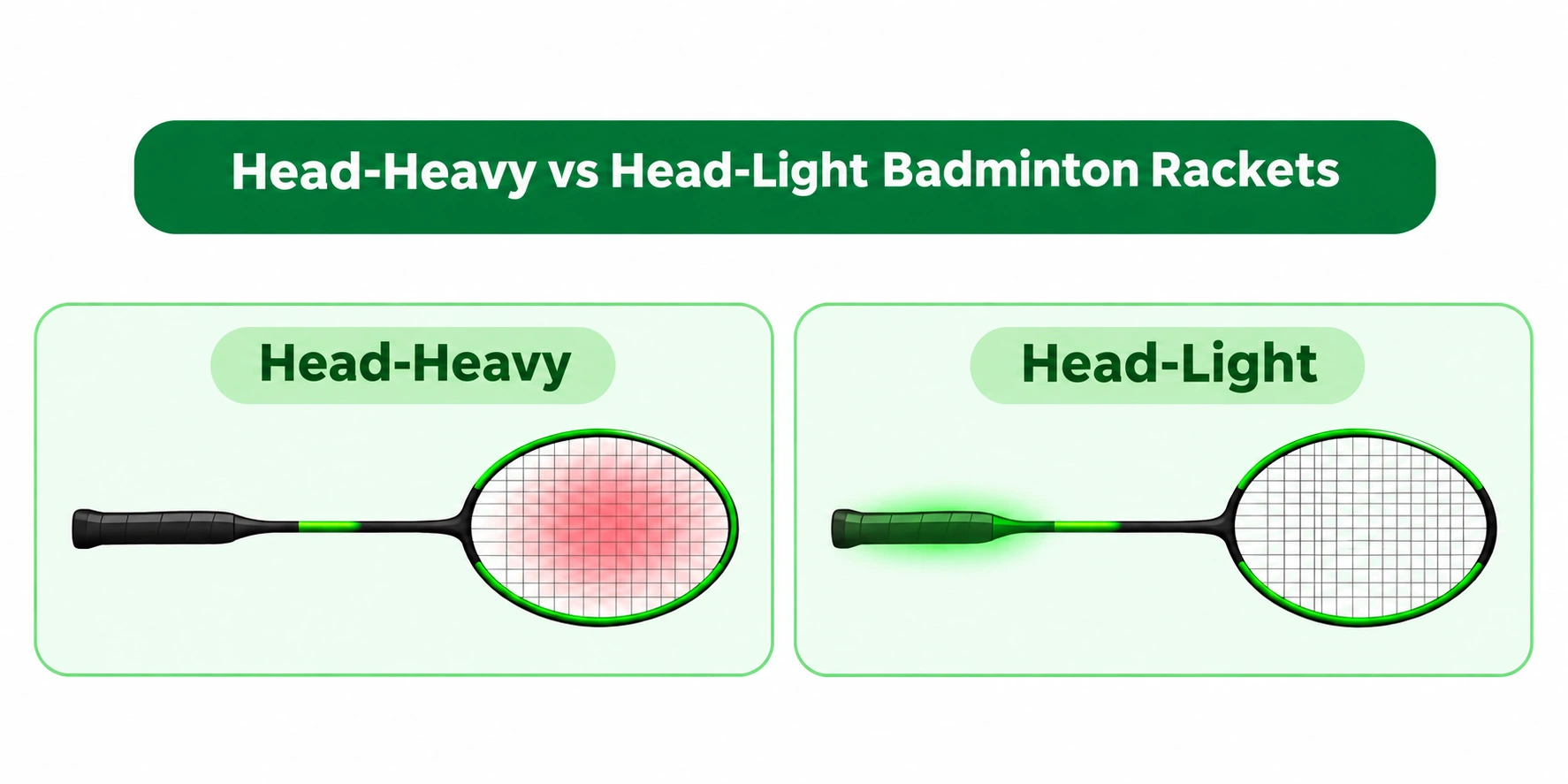
Although both racket types are used in competitive and recreational badminton, their performance differs based on weight distribution, not overall weight. Two rackets with the same weight can have different balance points, affecting their feel and manoeuvrability. The table below highlights their key differences.
| Feature | Head-Heavy Racket | Head-Light Racket |
| Weight distribution | More towards the racket head | More towards the handle |
| Swing feel | Heavier at the head | Lighter at the head |
| Smash performance | Supports powerful attacking shots | Supports faster racket movement |
| Defensive play | Can require more effort during quick reactions | Easier to manoeuvre during defence |
| Racket speed | Generally slower to manoeuvre | Generally faster to manoeuvre |
| Net play | Can feel less agile | Offers better manoeuvrability |
| Playing style | Aggressive and attacking | Defensive and speed-oriented |
| Common preference | Singles and attacking players | Doubles and defensive players |
Read More: 5 Best Badminton Rackets for Intermediate Players
Pros and Cons of Head-Heavy Badminton Rackets
Head-heavy rackets are popular among players who prefer to dominate rallies with attacking shots. However, their weight distribution also comes with certain limitations.
Advantages
- Powerful smashes: The additional mass towards the racket head can increase swing momentum, helping players generate powerful smashes when they have the necessary technique and swing speed.
- Long clears: The head-heavy design can help players generate momentum for deep clears, particularly when playing from the back of the court.
- Attacking gameplay: These rackets are suitable for players who frequently use smashes, attacking clears, and other offensive shots to put pressure on opponents.
Disadvantages
- Slower racket movement: The heavier-feeling racket head can make rapid changes in direction more challenging.
- Defensive limitations: Returning fast smashes and handling quick drives may require more effort and better preparation.
- Physical demands: Players may need more wrist, forearm and shoulder strength, along with proper technique, to handle repeated powerful swings comfortably.
Pros and Cons of Head-Light Badminton Rackets
Head-light rackets are designed to make racket movement quicker and more manageable. They are particularly useful during fast rallies where players need to react immediately.
Advantages
- Faster defensive reactions: The lighter-feeling racket head makes it easier to position the racket quickly when returning smashes.
- Better manoeuvrability: Players can change racket direction more easily during fast exchanges.
- Improved net play: Quick racket movement helps players respond to net shots, perform interceptions and execute fast net kills.
- Faster drives: These rackets can make flat exchanges and quick attacking responses easier to manage.
Disadvantages
- Less head momentum: Compared with a similarly weighted head-heavy racket, a head-light racket generally produces less momentum from the racket head during a swing.
- Greater dependence on technique: Players may need to generate more power through their swing mechanics rather than relying on the racket’s head weight.
- Different attacking feel: Players who depend on heavy smashes may find head-light rackets less comfortable for their preferred playing style.
It is important to remember that racket balance alone does not determine shot power or control. Total racket weight, shaft flexibility, frame design, string tension and the player’s technique also influence performance.
Which Badminton Racket is Better for Singles and Doubles?
The choice between head-heavy and head-light badminton rackets also depends on whether you primarily play singles or doubles.
Head-Heavy Racket for Singles
Singles badminton involves covering the entire court, maintaining rallies and creating opportunities to attack. Players often use clears, smashes and drops to move their opponents around the court.
A head-heavy racket can support this playing style by providing additional momentum during overhead shots. It can be a suitable choice for singles players who prefer aggressive gameplay and frequently attack from the back of the court.
However, singles players who prioritise quick racket handling may also prefer an even-balanced or head-light racket.
Head-Light Racket for Doubles
Doubles badminton involves faster exchanges, quick reactions and frequent changes between attacking and defensive positions.
A head-light racket can be useful in these situations because its weight distribution supports faster racket movement. This makes it easier to handle drives, return smashes and respond to shots near the net.
It is particularly suitable for players who spend more time defending or controlling the front court. However, attacking doubles players can also benefit from head-heavy rackets, especially when playing from the rear court and looking to generate powerful smashes.
Sport Singapore’s racket selection guide similarly highlights the usefulness of head-heavy rackets for powerful back-court play and head-light rackets for quick doubles exchanges.
How to Identify Whether a Badminton Racket is Head-Heavy or Head-Light
You can identify a racket’s balance type by checking its balance point. The balance point is the position along the racket’s length where its weight is evenly balanced. Follow these steps to identify the balance of your racket:
- Hold the racket horizontally with its shaft and handle supported.
- Place your index finger underneath the racket’s shaft.
- Slowly move your finger until the racket balances without tilting.
- Observe the position of the balance point.
If the balance point is closer to the racket head, it is head-heavy. If it is closer to the handle, it is head-light. If the weight is distributed relatively evenly, it is an even-balanced racket.
You can also check the manufacturer’s specifications for the racket’s balance point. Remember that the measurement may change depending on whether the racket is measured with or without strings and grip accessories.
Which Badminton Racket Should You Choose?
The best badminton racket depends on your playing style, experience and comfort rather than simply choosing the racket that offers more power or speed. Here are some recommendations to help you make the right choice:
| Player type | Recommended racket | Reason |
| Aggressive players | Head-heavy | Supports powerful attacking shots |
| Defensive players | Head-light | Helps with quick reactions and racket movement |
| Singles players | Head-heavy or even-balanced | Supports back-court attacking and all-round play |
| Doubles players | Head-light or even-balanced | Helps with fast exchanges and defensive shots |
| Beginners | Head-light or even-balanced | Can be easier to manoeuvre and control |
Choose a head-heavy racket if:
- You frequently play attacking shots and powerful smashes.
- You prefer controlling rallies from the back of the court.
- You have good swing technique and can comfortably handle the racket.
Choose a head-light racket if:
- You prefer defensive gameplay and quick reactions.
- You frequently play doubles and participate in fast rallies.
- You prioritise racket manoeuvrability and net play.
If you are a beginner and are unsure about your playing style, an even-balanced racket can also be a good starting point.
Conclusion
The difference between head-heavy and head-light badminton rackets comes down to weight distribution and how it affects racket movement. Head-heavy rackets are generally suitable for players who prioritise attacking shots and powerful smashes, while head-light rackets are useful for those who prefer quick reactions, defensive play and faster racket movement.
Neither type is universally better. Your playing style, technique, physical comfort and experience should determine your choice. If possible, try both racket types before purchasing to understand which balance feels more comfortable during actual gameplay.
Download Playo on Android or iOS, or visit playo.co to start playing!
Frequently Asked Questions
Head-light or even-balanced rackets are generally easier for beginners to manoeuvre. However, the choice also depends on racket weight, shaft flexibility and comfort.
Yes, they can generate greater swing momentum due to the weight towards the racket head. However, smash power also depends on technique, swing speed and timing.
Yes, they offer quicker manoeuvrability, helping players return smashes, handle drives and execute net shots. However, head-heavy rackets also suit attacking doubles players.
Yes, head-heavy rackets can be used defensively. However, their heavier racket head may make quick defensive reactions more challenging.
Head-heavy rackets distribute more weight towards the racket head for attacking shots, while even-balanced rackets distribute weight more centrally, offering a balance between power and manoeuvrability.