

Badminton is a fast-paced sport that requires quick footwork, sudden changes in direction, jumping and landing. While players often focus on their rackets, shuttlecocks and playing techniques, the badminton court surface also plays an important role in the overall playing experience.
The type of flooring used on a badminton court can influence grip, movement, shock absorption and player comfort. A suitable surface helps players move confidently, maintain balance and reduce the impact of repeated movements on their joints.
Badminton courts are available in different flooring types, including synthetic PVC or PU mats, wooden flooring, polyurethane surfaces and acrylic coatings. Each has its own characteristics, advantages and limitations.
Whether you are a beginner looking for a badminton court, a regular player, or someone planning to set up a sports facility, understanding these surfaces can help you make an informed decision. Let’s explore the five common types of badminton court surfaces and understand how they differ.
1. Synthetic Badminton Court Surface (PVC/PU)
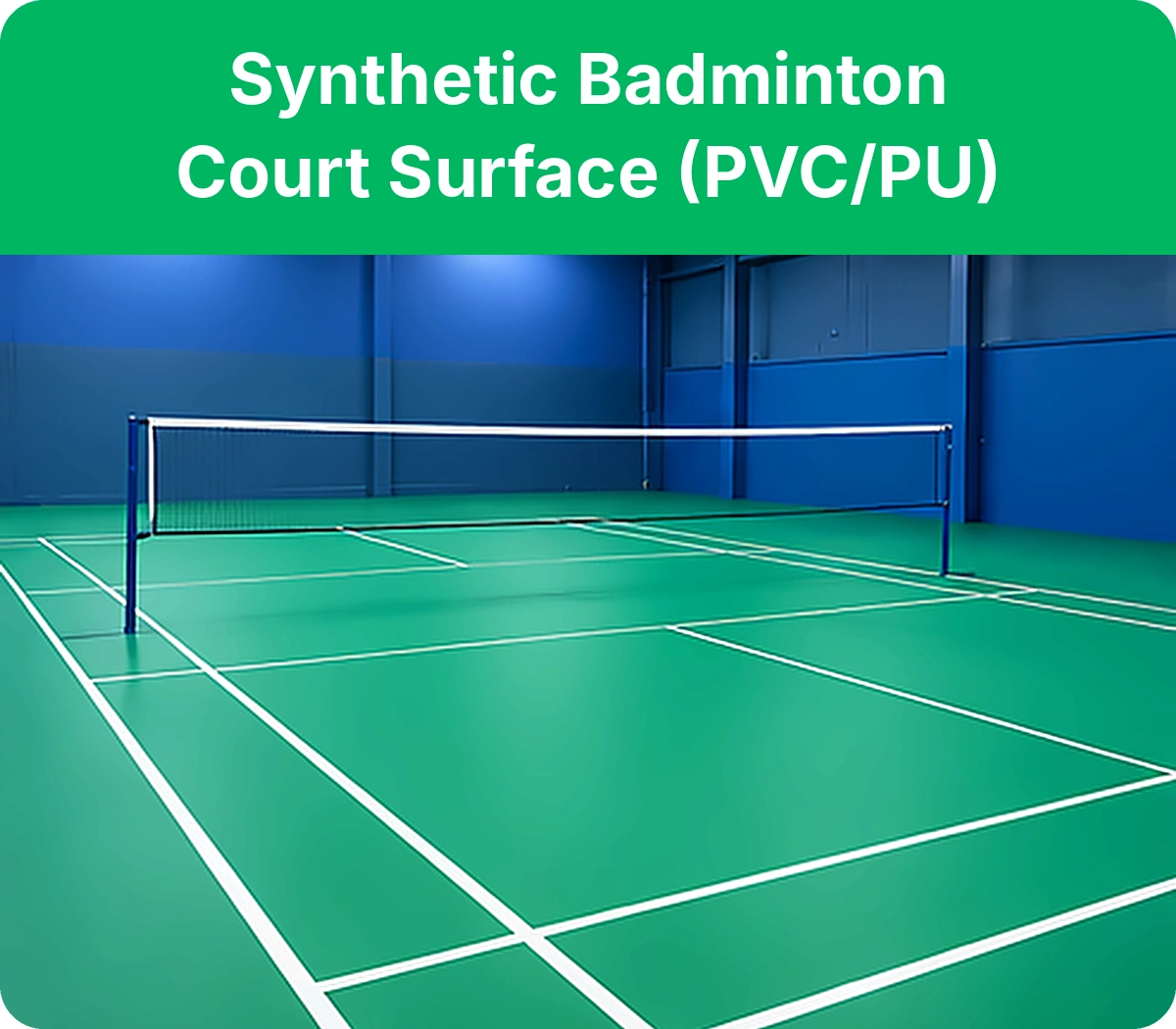
Synthetic flooring is one of the most commonly used options in modern indoor badminton facilities. These courts generally feature a synthetic sports mat made from materials such as polyvinyl chloride (PVC) or polyurethane (PU).
The mat is installed over a suitable subfloor, which may include a wooden sprung floor or another approved supporting system. The combination provides a playing surface designed to offer grip, controlled movement and shock absorption.
Synthetic badminton mats are available in different colours, thicknesses and surface finishes. Green and blue are common choices because they provide good visual contrast against the shuttlecock.
Advantages:
- Provides a consistent playing surface for regular badminton.
- Offers grip to support quick movements and changes in direction.
- Can provide shock absorption when installed as part of an appropriate flooring system.
- Available in portable and permanent formats.
- Relatively easy to clean and maintain.
Disadvantages:
- Installation quality and the supporting floor affect overall performance.
- Damaged or poorly maintained mats can develop uneven or slippery areas.
- High-quality sports flooring can involve considerable installation costs.
Best suited for indoor badminton courts, sports academies, clubs and professional training facilities.
2. Wooden Badminton Court Surface
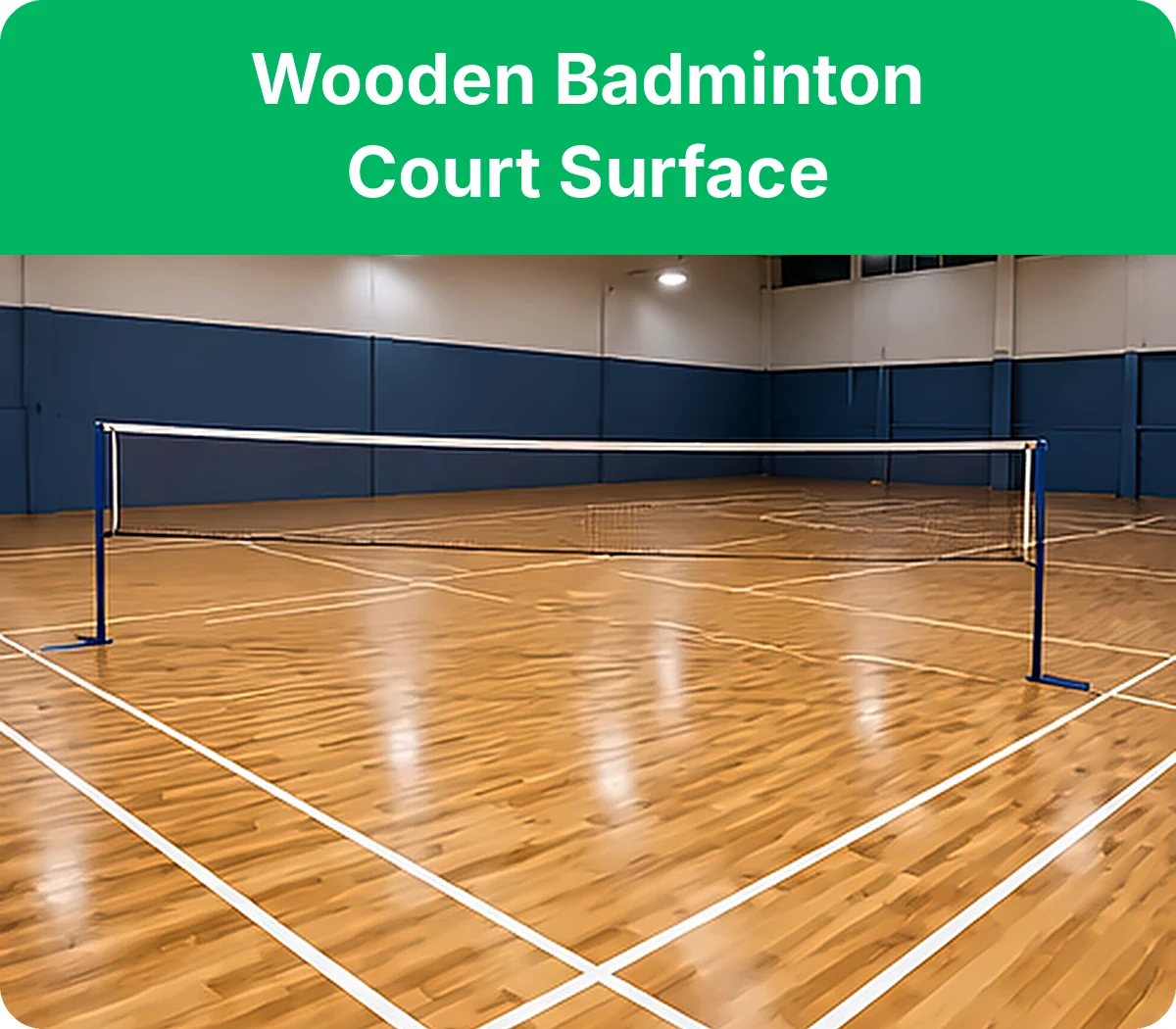
Wooden flooring is another established option for indoor badminton courts. It is particularly valued for its playing characteristics and ability to provide a supportive surface for quick footwork. However, not all wooden floors are suitable for badminton. Sports facilities generally use specially designed sprung wooden flooring systems rather than ordinary wooden flooring.
A sprung floor has a supporting structure beneath the wooden surface that allows controlled movement and deformation when players land or move across it. This helps absorb some of the impact generated during play.
Wooden sports floors are commonly constructed using hardwood strips, with a suitable protective finish to maintain the surface.
According to Badminton England’s Badminton Design Guidance Note, sprung wooden flooring is one of the accepted flooring options for badminton. The guide also recommends laying the wooden strips parallel to one another to avoid distracting patterns.
Advantages:
- Provides area-elastic properties that help distribute impact.
- Offers a stable surface for footwork and movement.
- Suitable for regular training and competitive indoor play.
- Can provide a durable playing surface with proper maintenance.
Disadvantages:
- Requires regular cleaning and maintenance.
- Can become slippery if sweat, water or dust accumulates.
- Installation and maintenance can be expensive.
- May be affected by moisture and changes in environmental conditions.
Best suited for indoor sports halls, badminton academies, clubs and competition venues.
3. Polyurethane (PU) Badminton Court Surface
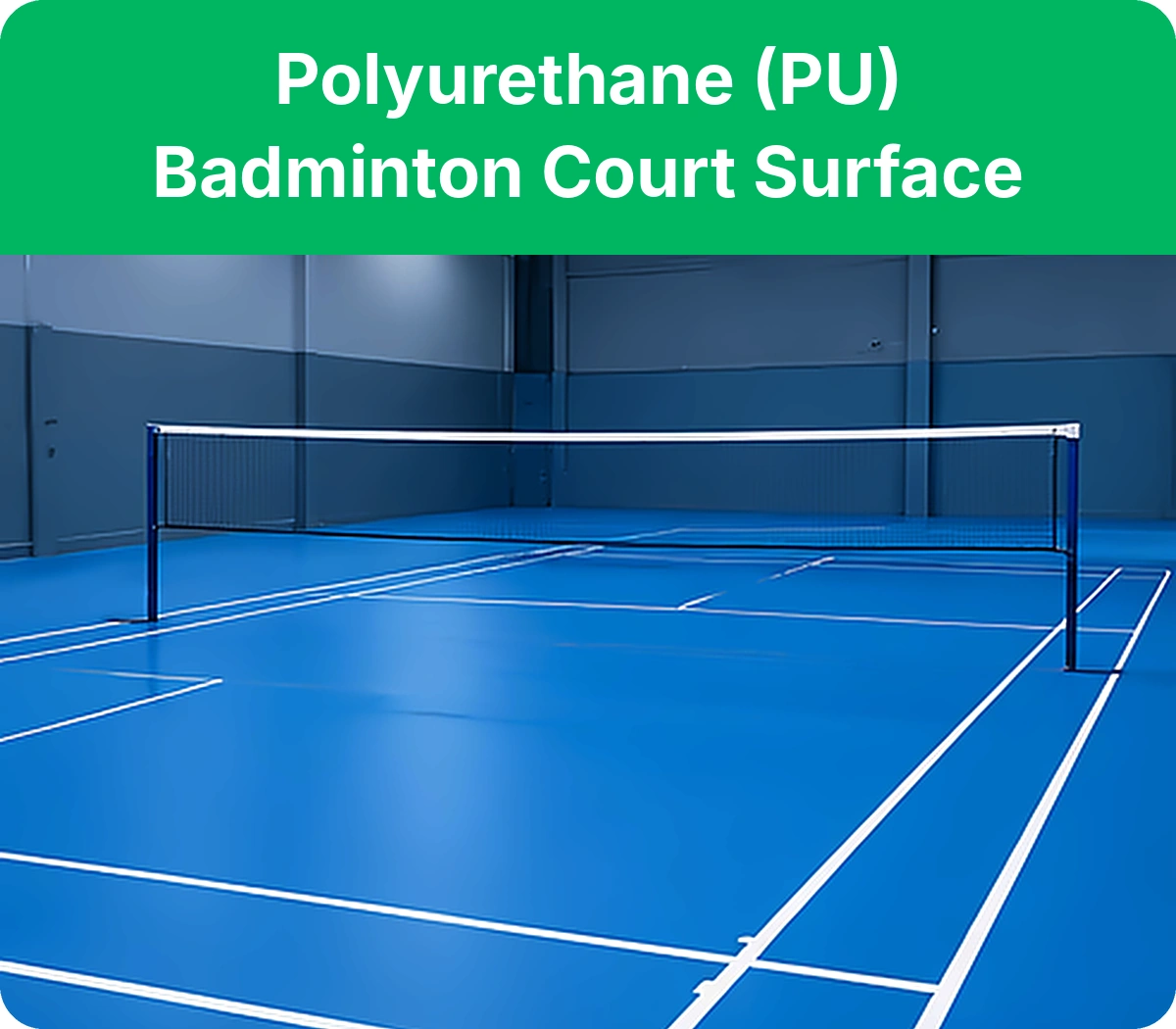
Polyurethane flooring is a synthetic sports flooring system used in several indoor sports facilities. It is generally applied as a seamless, liquid-based coating that forms a continuous surface once cured.
Unlike portable PVC badminton mats, polyurethane flooring is usually installed directly over a prepared subfloor. It can be designed with different levels of elasticity depending on the flooring system and its construction.
One of its key features is its seamless finish, which eliminates joints between individual flooring panels. This can make cleaning and routine maintenance easier. However, not every polyurethane floor is automatically suitable for badminton. The surface needs to provide appropriate grip, shock absorption and playing characteristics.
Badminton England’s design guidance identifies seamless wet-poured polyurethane flooring as an option used in some multi-sport facilities. It notes that additional area-stiffening components may be necessary to achieve suitable mixed-elastic properties for badminton.
Advantages:
- Provides a seamless and uniform playing surface.
- Available in different colours and finishes.
- Easy to clean because it does not have individual mat joints.
- Can be designed to provide different levels of surface elasticity.
Disadvantages:
- Performance depends on the complete flooring system and installation.
- Not every PU coating is designed for badminton.
- Repairs may require professional attention.
- Initial installation can be expensive.
Best suited for indoor multi-sport facilities, sports halls and dedicated badminton facilities with an appropriately designed flooring system.
4. Acrylic Badminton Court Surface
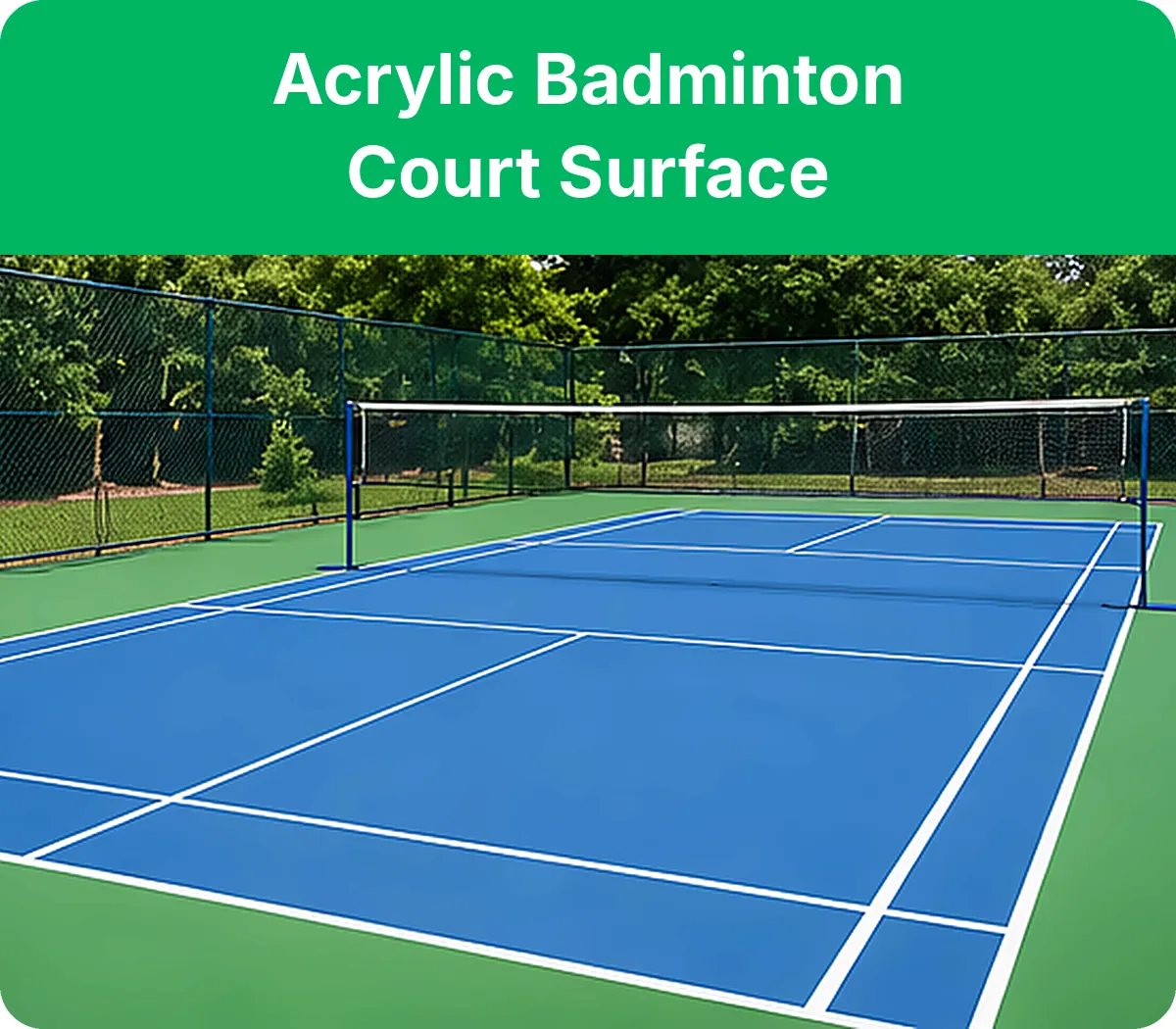
Acrylic flooring is commonly used for outdoor sports courts and recreational badminton facilities. It consists of an acrylic-based coating applied over a prepared concrete or asphalt base.
These surfaces are available in different colours and can be customised with badminton court markings. Their relatively hard finish makes them suitable for recreational settings where a specialised indoor flooring system may not be practical.
Unlike sprung wooden floors or cushioned synthetic mats, standard acrylic surfaces generally provide less impact absorption. Their performance also depends on the number of coating layers and the specifications of the installed system.
Acrylic courts can be a practical choice for outdoor badminton, but weather conditions can affect the playing experience. Wind, rain and direct sunlight may make outdoor badminton more challenging.
Advantages:
- Available in multiple colours.
- Provides a uniform playing surface.
- Can be installed over concrete or asphalt.
- Suitable for outdoor recreational facilities.
- Relatively straightforward to clean and maintain.
Disadvantages:
- Standard acrylic surfaces are relatively hard.
- May provide less shock absorption than specialised indoor sports flooring.
- Can become slippery when wet.
- Outdoor conditions can affect playing comfort and shuttlecock movement.
Best suited for outdoor recreational courts, schools, residential sports facilities and multi-purpose playing areas.
5. Cement or Concrete Badminton Court Surface
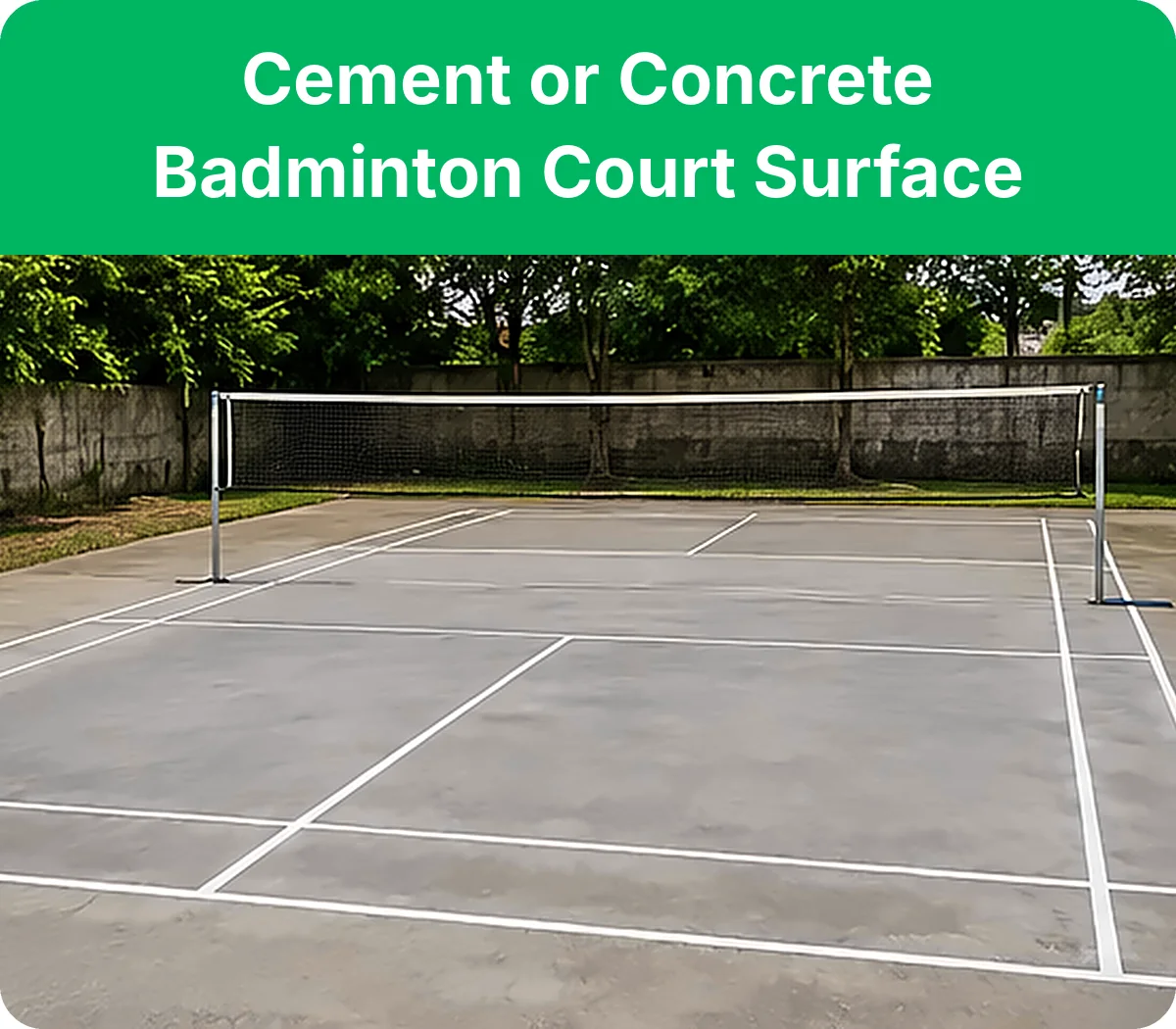
Concrete or cement flooring is one of the simplest and most economical options for setting up a recreational badminton court. These courts are generally created by preparing a level concrete surface and marking the required court boundaries.
Concrete courts are sometimes found in schools, residential areas, community spaces and outdoor recreational facilities. However, plain concrete is not an ideal surface for regular or competitive badminton. It is considerably harder than specialised sports flooring and offers limited shock absorption. Repeated jumping, landing and sudden changes in direction can therefore place additional stress on a player’s joints.
The surface may also become slippery due to dust, moisture or an unsuitable finish. While concrete can serve as the base for an acrylic sports coating, playing directly on untreated concrete is generally not recommended for regular badminton.
Advantages:
- Economical compared with specialised sports flooring.
- Durable and capable of handling regular outdoor use.
- Requires relatively simple maintenance.
- Can be used as a base for acrylic sports coatings.
Disadvantages:
- Very hard compared with sprung or cushioned sports flooring.
- Provides limited impact absorption.
- Can increase discomfort during prolonged play.
- May become slippery when wet or dusty.
Best suited for basic recreational setups and temporary playing spaces, rather than professional or regular competitive badminton.
Read More: Synthetic vs Wooden Badminton Court Surfaces
Comparison of Different Badminton Court Surfaces
The following table summarises the key differences between the five types of badminton court surfaces.
| Court surface | Typical setting | Shock absorption | Maintenance |
| Synthetic PVC/PU mat | Indoor | Depends on mat and subfloor | Moderate |
| Sprung wooden floor | Indoor | Good when properly designed | Moderate to high |
| PU flooring | Indoor | Depends on system design | Moderate |
| Acrylic flooring | Outdoor | Generally limited in standard systems | Low to moderate |
| Cement/concrete | Outdoor | Very limited | Low |
Which is the Best Surface for a Badminton Court?
The best badminton court surface depends on the level of play, location and budget. For professional and competitive badminton, a sprung wooden floor combined with an approved synthetic mat is a preferred choice. This combination provides shock absorption, stability and a consistent playing surface.
For recreational play and regular training, synthetic PVC or PU mats are suitable options when installed over an appropriate subfloor. They offer good grip and a consistent surface for everyday play.
For outdoor courts, acrylic flooring is generally more practical than plain concrete. Ultimately, the right surface should provide adequate grip, player comfort and durability based on the frequency and level of play.
Download Playo on Android or iOS, or visit playo.co to start playing!
Frequently Asked Questions
A sprung wooden floor combined with an approved synthetic mat is preferred for competitive indoor badminton. Synthetic PVC or PU mats are also suitable for recreational play.
The five common types are synthetic PVC/PU, wooden, polyurethane, acrylic and cement or concrete flooring.
Both have advantages. Synthetic mats provide a consistent playing surface, while sprung wooden floors offer shock absorption. Many professional courts combine both.
Concrete courts are suitable for recreational play but are not ideal for regular badminton due to their hard surface and limited shock absorption.
Yes. Acrylic flooring provides a uniform surface for outdoor badminton courts but offers less cushioning than specialised indoor sports flooring.
PVC mats are commonly used as synthetic court coverings, while PU flooring is also available as a seamless, liquid-applied surface. Both vary in performance depending on their construction and installation.