


The longest tennis match in history remains one of the most astonishing feats in sports, a gruelling first-round battle at Wimbledon 2010 between American John Isner and Frenchman Nicolas Mahut. Spanning 11 hours and 5 minutes over three days, this epic showdown shattered records for duration, games played, and sheer endurance, captivating global audiences. Known as the longest tennis match ever, it redefined the limits of human stamina on the grass courts of the All England Club.
The Historic Stage: Wimbledon 2010
The legendary match took place during the first round of the 2010 Wimbledon Championships, played on the iconic grass courts of the All England Club in London. As one of tennis’s four Grand Slam tournaments, Wimbledon is known for its rich traditions, grass-court play, and long-standing history dating back to 1877.
At the time, neither player was among the tournament favourites. John Isner, the towering American, was known for his powerful serve and aggressive baseline play, while Nicolas Mahut, the experienced Frenchman, had built a reputation as a skilled grass-court player with strong volleys and tactical awareness. Few expected their opening-round clash to become a historic sporting event.
The match was scheduled on Court 18, one of Wimbledon’s smaller outside courts. Initially, it attracted modest attention compared to the show courts hosting top-seeded players. However, as the match stretched far beyond normal limits, Court 18 quickly became the centre of global sporting interest.
By the time the contest entered its unprecedented final-set marathon, thousands of spectators had gathered around the court, while millions of viewers worldwide followed the drama unfolding at Wimbledon.
Read More: 5 Greatest Serve Bots in Tennis History
Match Overview: Scoreline and Duration
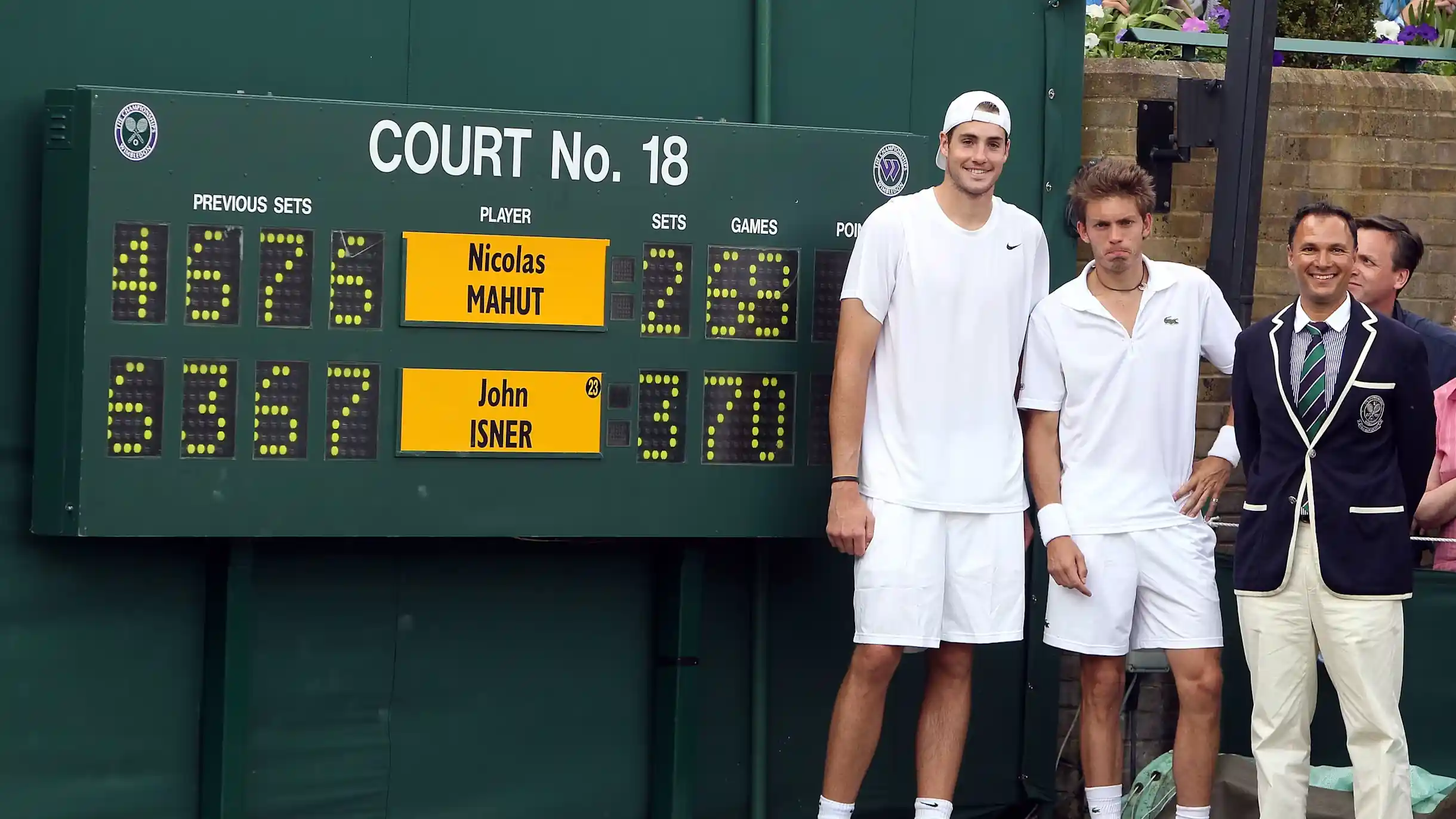
The historic clash between John Isner and Nicolas Mahut produced a scoreline unlike anything tennis had ever seen.
John Isner defeated Nicolas Mahut 6–4, 3–6, 6–7, 7–6, 70–68.
What began as a competitive first-round match eventually turned into the longest tennis match in history, stretching across three days and redefining the limits of endurance in professional tennis.
Key Match Statistics
The numbers from this extraordinary contest highlight just how unprecedented the match truly was:
- Total duration: 11 hours 5 minutes
- Played across: 3 days
- Total games: 183
- Longest set: Fifth set lasting 8 hours 11 minutes
- Fifth set score: 70–68 (138 games)
- Aces: John Isner served 113, while Nicolas Mahut delivered 103
- Total points won: Isner won 980 points, Mahut won 949
To put this into perspective, most tennis matches typically last 1.5 to 3 hours, while even the longest Grand Slam encounters rarely exceed five hours. The final set alone lasted longer than many entire professional matches.
Both players also shattered the previous record for most aces in a single match, highlighting how crucial powerful serving was in sustaining this marathon battle. With neither player able to break serve for hours, the deciding set continued game after game until Isner finally secured victory at 70–68.
How the Match Unfolded Across Three Days
Day One – June 22, 2010
The match commenced on a Tuesday evening under London’s fading light. After several hours of intense play, the players were locked deep into the deciding fifth set. With darkness falling and the outside courts lacking sufficient lighting, umpire Mohamed Lahyani was forced to suspend the match at 9:10 PM local time, with neither player able to gain a decisive advantage.
Day Two – June 23, 2010
Wednesday brought renewed energy and swelling crowds as spectators gathered to witness the continuation of what had already become an extraordinary contest. The electronic scoreboard on Court 18 famously struggled to keep up, unable to display numbers beyond 59 games.
Play continued relentlessly as both players held serve again and again, demonstrating remarkable physical endurance and mental resilience. During the day, the match surpassed the previous record for the longest tennis match ever, which had been the 6-hour, 33-minute battle between Fabrice Santoro and Arnaud Clément at the 2004 French Open. Eventually, darkness forced another suspension with the score tied deep in the historic fifth set.
Day Three – June 24, 2010
Thursday marked the dramatic conclusion. After more than eight hours of play in the final set alone, the match finally reached its turning point. In the 138th game of the fifth set, Isner managed to break Mahut’s serve.
The American collapsed onto the grass in exhaustion and celebration, having secured victory with the unforgettable final score of 6–4, 3–6, 6–7, 7–6, 70–68.
Incredible Records Set During the Match
The Isner–Mahut marathon didn’t just become famous for its duration; it also rewrote the tennis record books in several categories. From the longest match ever played to unprecedented serving numbers, the encounter produced statistics that remain unmatched in the sport.
1. Longest Tennis Match Ever Played
At 11 hours and 5 minutes, the contest between John Isner and Nicolas Mahut became the longest tennis match in history. Before this, the record stood at 6 hours and 33 minutes, set during the 2004 French Open match between Fabrice Santoro and Arnaud Clément. The Wimbledon marathon shattered that record by nearly five hours, setting a benchmark that still stands today.
2. Longest Set in Tennis History
The fifth set alone lasted 8 hours and 11 minutes, making it the longest set ever played in professional tennis. Unlike modern rules that include final-set tie-breaks, Wimbledon in 2010 required a player to win the set by two clear games. As both players continued to hold serve, the deciding set turned into a historic endurance battle.
3. Most Games in a Match
The match featured a staggering 183 games, another record in professional tennis. For comparison, a typical five-set match usually contains around 40 to 60 games, depending on how competitive the sets are. The extraordinary number of games reflected how evenly matched both players were throughout the encounter.
4. Most Aces in a Match
The marathon also produced an incredible serving display from both players.
- John Isner: 113 aces
- Nicolas Mahut: 103 aces
This marked the first time in tennis history that both players surpassed 100 aces in a single match. Their powerful and consistent serving made it extremely difficult for either player to break serve, which was a major reason the match extended for so many hours.
5. Longest Match Spanning Multiple Days
The match stretched across three days, beginning on June 22 and ending on June 24, 2010. Play had to be suspended twice due to fading daylight at Wimbledon’s outside courts. When the match resumed each day, crowds gathered in large numbers, aware that they were witnessing a historic sporting moment.
How the Match Changed Tennis Rules
The extraordinary length of the Isner–Mahut marathon sparked widespread discussions across the tennis world. While fans were fascinated by the historic battle, tournament organisers and governing bodies began to question whether matches should be allowed to continue indefinitely without a deciding tie-break.
The match exposed the logistical challenges of unlimited final sets, including scheduling disruptions, player fatigue, and broadcasting complications. As a result, tennis authorities gradually began introducing rule changes to ensure that future matches would have clearer limits.
Wimbledon’s Rule Change
Nearly a decade after the historic encounter, Wimbledon introduced a new rule in 2019 to prevent endless final sets. Under the updated format, if the score in the deciding set reaches 12–12, a tie-break is played to determine the winner.
This rule was first used during the 2019 Wimbledon Championships. It ensured that matches could still have dramatic extended sets while avoiding the possibility of another marathon like the 70–68 final set between Isner and Mahut.
Grand Slam Unified Rule
In 2022, all four Grand Slam tournaments, the Australian Open, French Open, Wimbledon, and US Open, agreed on a unified format for deciding sets. Under this rule, when the final set reaches 6–6, players compete in a 10-point tie-break, often called a super tie-break, to decide the match.
This system balances tradition with practicality. It preserves the excitement of long matches while ensuring tournaments can maintain schedules and protect player endurance.
The legendary 2010 Wimbledon match between Isner and Mahut played a major role in prompting these discussions and reforms. More than a decade later, its influence can still be seen in how tennis tournaments structure their deciding sets.
Top 5 Longest Tennis Matches Ranked
While the Isner–Mahut match stands alone as the longest tennis match in history, several other marathon encounters have also tested the limits of endurance in professional tennis. For context, here is how some of the longest matches in the sport compare.
| Rank | Players/Event | Duration | Score Highlights | Notes |
| 1 | Isner vs Mahut, 2010 Wimbledon R1 | 11h 5m | 70–68 fifth | 183 games |
| 2 | Nadal vs Djokovic, 2012 AO Final | 5h 53m | 7–5 fifth | Epic rivalry |
| 3 | Isner vs Anderson, 2018 Wimbledon SF | 6h 36m | 26–24 fifth | Heat exhaustion |
| 4 | Federer vs Djokovic, 2019 Wimbledon Final | 4h 57m | 13–12 TB | Old vs new guard |
| 5 | Alcaraz vs Sinner, 2025 French Open Final | 5h 29m | Tiebreak decider | RG Open Era longest |
Conclusion
The historic clash between John Isner and Nicolas Mahut remains the longest tennis match ever played and one of the most remarkable moments in sporting history. Lasting 11 hours and 5 minutes across three days, the match pushed the limits of physical endurance, mental resilience, and competitive spirit.
While modern rule changes make another marathon like this unlikely, the legendary battle at Wimbledon 2010 continues to symbolise the extraordinary determination that defines the sport of tennis.
Download Playo on Android or iOS, or visit playo.co to start playing!
Frequently Asked Questions
The longest tennis match in history was played between John Isner and Nicolas Mahut at the 2010 Wimbledon Championships. The match lasted 11 hours and 5 minutes over three days and ended with a score of 6–4, 3–6, 6–7, 7–6, 70–68. It remains the longest match ever played in professional tennis history.
The longest match involving Novak Djokovic was the 2012 Australian Open final against Rafael Nadal. It lasted 5 hours and 53 minutes, making it the longest Grand Slam final ever. Djokovic won the match 5–7, 6–4, 6–2, 6–7, 7–5.
American tennis legend Billie Jean King won 39 Grand Slam titles in total. These include 12 singles titles, 16 women’s doubles titles, and 11 mixed doubles titles during her career.
Yes. Winning all four major tournaments in the same calendar year is called a Calendar Grand Slam. The first player to achieve it was Don Budge in 1938, and Rod Laver later achieved the feat twice, including in 1969.
All four Grand Slam tournaments are highly prestigious, but the Wimbledon Championships are widely regarded as the most prestigious because of their long history, traditions, and grass-court heritage dating back to 1877.