

In Mumbai, cricket does not begin in stadiums. It begins in narrow gullies, building compounds, and crowded maidans where kids play with tennis balls and improvised wickets. For generations of Mumbaikars, the street cricket game has been a daily ritual. It is played before school, after work, and sometimes even under streetlights late in the evening. With limited open spaces in the city, streets and small playgrounds naturally become cricket grounds where players quickly adapt to tight spaces and unique local rules.
What makes Mumbai special is that this culture of street cricket has produced some of the greatest cricketers in the world, including Sachin Tendulkar and Rohit Sharma. The city’s passion for cricket is so strong that its open grounds often host multiple matches at the same time, turning ordinary spaces into lively cricket hubs. Today, this grassroots passion has even inspired professional competitions such as the street cricket league, proving that a game born in the streets can reach national and global audiences.
What Exactly is Street Cricket?
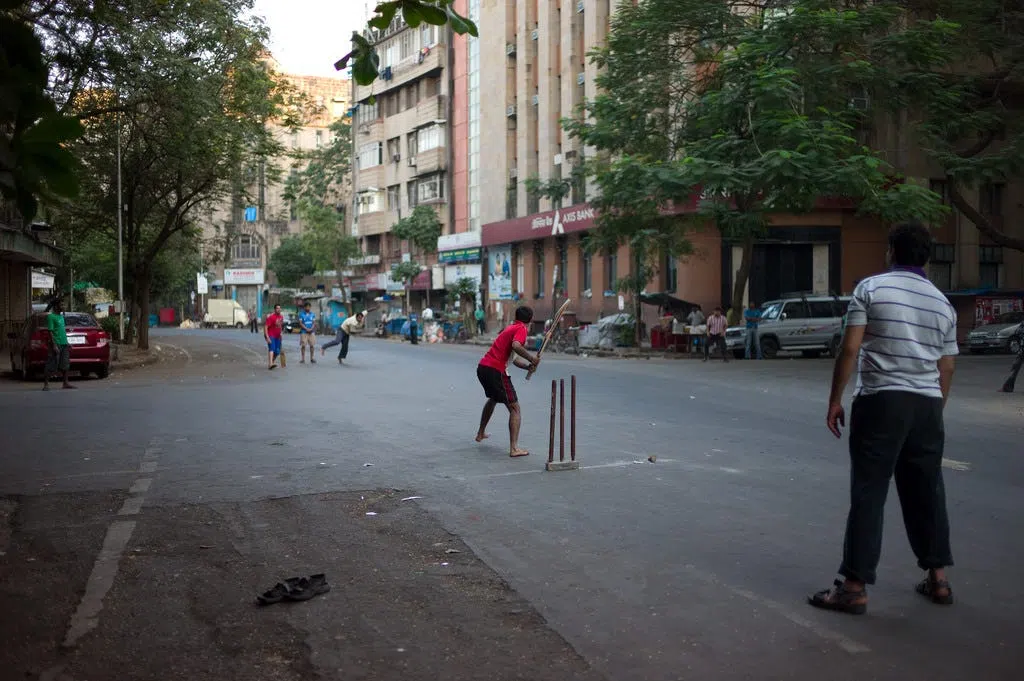
Before diving into Mumbai’s unique relationship with the sport, let’s clarify: What exactly is street cricket? Street cricket is the informal, flexible version of cricket played in streets, alleys, or small open spaces. Unlike professional cricket, the street cricket game adapts to its environment. The rules often depend on the available space and the players involved.
Typical Characteristics of Street Cricket:
- A tennis ball or a tape ball instead of a leather cricket ball
- Bricks, walls, or dustbins used as wickets
- Short boundaries due to limited space
- Unique local rules that vary by neighbourhood
For example, many Mumbai street cricket games include rules such as:
- One-tip one-hand out: A catch taken with one hand after one bounce dismisses the batter
- Six and out: If the ball hits a balcony or leaves the play area, the batter is out
- Last batter continues: The final batter can keep playing until they lose their wicket, regardless of the team’s score
These creative adaptations make every neighbourhood street cricket game unique. There’s no governing body dictating rules—just mutual agreement among players. This flexibility is precisely why street cricket has survived and thrived in Mumbai’s ever-changing urban landscape.
Origins of Street Cricket in Mumbai
Mumbai’s deep connection with cricket dates back to the 19th century, when the British introduced the sport to Bombay. Early matches were played in colonial gymkhanas and open grounds, and the Parsi community soon became the first Indian group to embrace the game. As cricket’s popularity grew, iconic grounds like Azad Maidan, Oval Maidan, and Shivaji Park became major hubs for local matches and school tournaments. Over time, the sport moved beyond formal grounds and began appearing in narrow streets and residential compounds, giving birth to the street cricket game that now defines the city.
As Mumbai became more crowded, children and teenagers adapted the sport to the spaces available. Stones or school bags became wickets, chalk lines or chappals marked the crease, and tennis balls replaced leather cricket balls. Even today, grounds like Shivaji Park and Azad Maidan can host dozens of matches at the same time during peak hours. This mix of organised matches and informal street cricket reflects Mumbai’s unique cricket culture, where the game thrives despite limited space and continues to shape generations of players.
The Rules of the Street: How Mumbai Plays Cricket
While the basic idea of street cricket is similar everywhere, Mumbai has developed its own unique style. The street cricket game played in the city follows a set of informal rules that help players adapt to narrow lanes, crowded neighbourhoods, and limited playing space. These unwritten rules make the game fast, creative, and surprisingly organised.
Essential Equipment and Adaptations
- Tape Ball: Tennis balls wrapped with electrical tape are commonly used instead of leather cricket balls. The tape makes the ball swing faster, adds durability, and keeps the game affordable for daily play.
- Makeshift Stumps: Instead of traditional wickets, players often use chalk lines drawn on walls, stacked bricks, school bags, or even a single tyre to represent the stumps.
- Lightweight Bats: Many players use Kashmir willow bats or lighter bats that are easier to control in tight spaces and narrow streets.
Iconic Mumbai Street Cricket Rules
- One Tip, One Hand: If a fielder catches the ball with one hand after one bounce, the batter is out. This rule makes fielding more exciting and keeps every player involved.
- Boundary Restrictions: In small lanes, hitting a six can send the ball onto rooftops or balconies. To avoid losing the ball, many games count such shots as four runs or declare the batter out if the ball leaves the playing area.
- Bowling Limits: Bouncers are often restricted to reduce the risk of injury in cramped playing conditions. Bowlers usually regulate their speed based on the space available.
- Flexible Overs: Street cricket matches are highly flexible. Depending on time and the number of players, overs may consist of four or six balls.
These adaptations allow street cricket to thrive in Mumbai’s crowded neighbourhoods, turning even the smallest lane into a lively cricket ground.
Stars Born from Mumbai Streets
Mumbai’s cricket legacy is closely linked to its street and maidan culture. Many Indian cricketers began with the street cricket game in gullies, housing society compounds, and local maidans before progressing to structured school and club cricket. These informal matches help young players develop quick reflexes, adaptability, and match awareness in tight playing spaces.
Several legendary cricketers from Mumbai followed this pathway. Sachin Tendulkar trained at Shivaji Park under coach Ramakant Achrekar after spending his early years playing informal matches across Mumbai’s maidans. Sunil Gavaskar also emerged from the city’s strong grassroots cricket system and later became the first cricketer to score 10,000 runs in Test cricket.
Modern players such as Rohit Sharma, Ajinkya Rahane, and Prithvi Shaw have taken similar routes. Rohit Sharma began with tennis-ball matches in Mumbai’s suburbs before rising through school tournaments like the Harris Shield, while Shaw progressed through the city’s competitive school cricket system. This pathway from street cricket to maidans, school tournaments, and domestic cricket has made Mumbai one of India’s most consistent producers of international cricketers.
Street Cricket Leagues Elevate the Game
Street cricket, once played only in gullies and housing society compounds, is now gaining professional recognition through organised competitions. One of the biggest developments in this space is the Indian Street Premier League (ISPL), launched in 2024 to bring the excitement of tennis-ball street cricket to a national stage. The league follows a T10 format played with a tape tennis ball, combining the fast pace of street cricket with the structure of a professional tournament.
The ISPL features franchise teams representing different cities across India, many of which are backed by well-known celebrities. Some of the prominent teams include:
- Majhi Mumbai – owned by Amitabh Bachchan
- Bangalore Strikers – owned by Hrithik Roshan
- Srinagar Ke Veer – owned by Akshay Kumar
- Chennai Singams – owned by Suriya
- Falcon Risers Hyderabad – owned by Ram Charan
- Tiigers of Kolkata – owned by Saif Ali Khan and Kareena Kapoor Khan
- Ahmedabad Lions – Ajay Devgn
- Delhi Superheros – Salman Khan
The first season of the ISPL in 2024 was played at the Dadoji Kondadev Stadium in Thane, Maharashtra, where Tiigers of Kolkata emerged as the inaugural champions. In Season 2 (2025), Majhi Mumbai won the title after defeating Srinagar Ke Veer in the final. The league quickly attracted massive interest, drawing millions of viewers and large stadium crowds, proving that street cricket has a strong fan base beyond local neighbourhoods.
Unlike traditional cricket tournaments, the ISPL retains the spirit of the street cricket game through innovative rules inspired by gully cricket. Some notable features include:
- Tape tennis-ball format, reflecting how street cricket is commonly played across India
- Short T10 matches, making the games fast-paced and highly competitive
- Unique gameplay elements, such as the 50-50 challenge, which adds tactical excitement during key moments
- Open talent trials, allowing talented street cricketers to earn spots in franchise teams
The league also acts as a talent scouting platform, giving players who grew up playing street cricket a chance to perform on a professional stage. This bridge between informal cricket and organised leagues highlights how street cricket in cities like Mumbai is evolving while still preserving its raw energy and improvisational style.
Why Mumbai is the Perfect Ecosystem for Street Cricket
Mumbai’s unique urban and sporting culture has helped street cricket flourish for decades. A combination of dense neighbourhoods, historic cricket grounds, and a strong grassroots structure makes the city one of the most productive cricket ecosystems in India.
1. Limited Space and High Population Density
Mumbai is one of the most densely populated cities in the world, with limited playgrounds in many residential areas. As a result, children adapt by playing the street cricket game in narrow lanes, housing society compounds, and small open spaces. These tight playing conditions encourage quick reflexes, precise batting, and innovative shot selection, skills that are valuable in competitive cricket formats.
2. Historic Cricket Grounds and Maidans
The city is home to several historic cricket maidans such as Azad Maidan, Oval Maidan, and Shivaji Park, where multiple matches take place every day. Azad Maidan alone has over 20 cricket pitches, allowing school, club, and local matches to run simultaneously. These grounds act as a bridge between casual street cricket and organised competitive cricket.
3. Strong School and Club Cricket Structure
Mumbai has one of India’s most competitive school cricket systems, highlighted by tournaments like the Harris Shield and Giles Shield. Many players who start with street cricket eventually progress to these tournaments before entering club cricket and domestic competitions. This structured pathway has helped produce numerous international cricketers from the city.
Conclusion
Mumbai without street cricket is almost impossible to imagine. The game is part of the city’s everyday rhythm, played in gullies, housing society compounds, and open maidans across neighbourhoods. The street cricket game brings together people of different ages and backgrounds, turning small lanes and playgrounds into lively community spaces where skills, rivalries, and friendships develop.
From Sachin Tendulkar’s early tape-ball matches in Mumbai’s streets to modern competitions such as the street cricket league, the spirit of the game has remained the same. It continues to thrive despite limited space and changing urban landscapes. For many Mumbaikars, street cricket is not simply a pastime but an important part of the city’s sporting culture and identity.
For those looking to take their love for cricket beyond the streets, platforms like Playo make it easy to find nearby cricket turfs, book sports venues, and connect with other players in the city. Whether it’s a casual match with friends or a competitive game, the spirit of street cricket can continue on proper grounds with just a few taps.
Download Playo on Android or iOS to start playing!
Frequently Asked Questions
Street cricket is an informal version of cricket played in streets, alleys, housing society compounds, or small open spaces. The street cricket game usually uses a tennis or tape ball and improvised wickets, with flexible rules based on the playing area.
Street cricket is popular in Mumbai because of the city’s limited open spaces and strong cricket culture. Many players grow up playing in gullies and maidans, making the sport a daily part of neighbourhood life.
Several famous cricketers began their journeys playing street cricket in Mumbai, including Sachin Tendulkar, Sunil Gavaskar, Rohit Sharma, Ajinkya Rahane, and Prithvi Shaw.
The Indian Street Premier League (ISPL) is a professional tennis-ball cricket tournament launched in 2024. It follows a T10 format and aims to showcase talented players who grew up playing street cricket across India.
Common street cricket rules include “one tip one hand out,” restrictions on sixes to avoid losing the ball, makeshift wickets, and flexible overs depending on the number of players and available space.