


Volleyball is a game of precision, split-second decision-making, and spatial awareness. Whether you are a player perfecting your approach, a coach drawing up a defensive scheme, or a facility manager preparing for a major tournament, understanding the official volleyball court markings is absolutely essential.
The lines on a volleyball court are not just boundaries; they dictate the rules of engagement, define player roles, and determine the legality of every single play. In this comprehensive guide, we will break down the official volleyball court dimensions, the specific names and purposes of every physical line, and the crucial conceptual zones they create according to FIVB (International Volleyball Federation) standards.
Standard Volleyball Court Dimensions
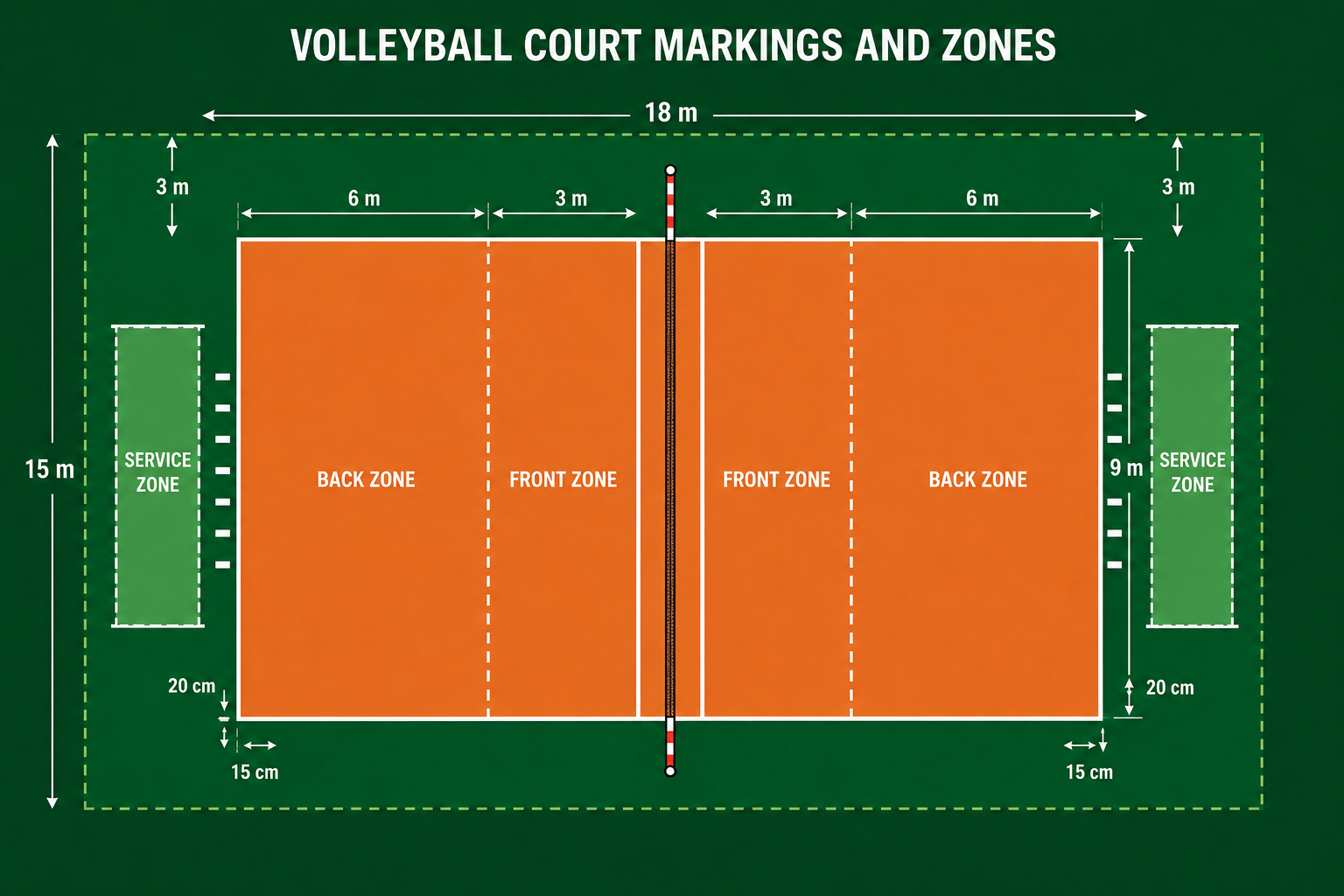
Before diving into the specific lines, it is important to understand the canvas they are drawn upon. According to official FIVB rules, the standard indoor volleyball court is a rectangle measuring 18 metres long by 9 metres wide (approximately 59 feet by 29.5 feet).
1. The Physical Court Markings
All lines on the court must be 5 centimetres (2 inches) wide and painted in a white or light colour that contrasts sharply with the floor. The lines are considered part of the area they bound. Here is the detailed breakdown of the physical markings:
Boundary Lines (Sidelines and Endlines)
The two longer boundary lines are called sidelines, and the two shorter ones are called endlines (or baselines).
These lines define the legal playing area. If a volleyball touches any part of the sideline or endline, it is ruled “in.” They are heavily relied upon by line judges to determine in/out calls and are used for player positioning during serves.
The Centre Line
The centre line runs directly underneath the net, dividing the court into two equal 9m x 9m halves.
This marking separates the two teams and prevents interference during rallies. A player commits a fault if their foot (or any part of the body) completely crosses the centre line and touches the opponent’s court, though partial crossing is allowed if it doesn’t interfere with play.
The Attack Line (3-Metre Line) and Dashed Extensions
One of the most important official volleyball court markings is the attack line, drawn 3 metres from the centre line on each side.
It separates the front court from the back court. Crucially, FIVB rules mandate that the attack line must be extended through the free zone with dashed hash marks (five lines, 15cm long, 30cm apart). These dashed extensions are vital for referees to judge if a back-row player legally jumps from behind the 3-metre line to attack a ball above the net height.
The Service Zone & Boundary Markings
The service zone is the 9-metre-wide area behind each endline.
Players must serve from within this area without stepping on the endline. The service zone is bounded laterally by two specific short lines, 15 cm long, drawn 20 cm behind the end line as an extension of the sidelines. These small physical marks define the exact depth and width limits of the legal serving area.
The Substitution Zone
The substitution zone is located between the extension of the two attack lines up to the scorer’s table.
Player substitutions must occur only through this designated area. Facility managers often place small tape marks at the edge of the attack lines to help referees monitor this zone and maintain match organisation.
The Libero Replacement Zone
The Libero is a specialised defensive player, and their unique entry and exit require a specific marked area.
This zone is positioned outside the sideline near the team benches, between the attack line and the endline. It is usually marked by a dashed line extending 1.75 metres from the sideline. Libero replacements happen here without counting as official substitutions, maintaining the fast pace of the game.
Read More: Volleyball Rotations Rules and Position Guide
The Conceptual Zones Defined by the Markings
While the lines above are the physical paint on the floor, FIVB rules also define specific zones created by these markings. Understanding these zones is just as critical as knowing the lines themselves.
The Front Zone
The front zone lies between the centre line and the attack line on each side of the court.
Only front-row players can legally perform certain attacking actions (like blocking or spiking above the net) from this area. The setter usually operates within the front zone to organise attacks, making spatial awareness here critical for offensive plays.
The Back Zone
The back zone extends from the attack line to the endline.
Back-row players primarily defend, receive serves, and initiate attacks from this area. Although they can attack the ball, they must jump from behind the attack line (or its dashed extensions) if the contact is made above the height of the net. This rule maintains the balance between offensive and defensive play.
The Free Zone
The free zone surrounds the physical playing court.
According to FIVB regulations, the minimum width is 3 metres, though international competitions often require larger free zones (5m from sidelines, 6.5m from endlines). Players are allowed to chase and play the ball within this area as long as it has not touched the ground. It provides safe player movement, space for spectacular defensive saves, and reduces the risk of collisions with walls or benches.
The Warm-Up Area
Competitive matches also include designated warm-up areas located outside the free zone.
Players waiting to enter the match or substitutes can warm up here without interfering with active play. Keeping this area clearly defined outside the free zone ensures the safety of both active players and those preparing to enter the game.
Indoor vs. Beach Volleyball Court Markings
If you are setting up a court, it is vital to know that indoor and beach volleyball have different official markings.
- Dimensions: An official beach volleyball court is smaller, measuring 16 metres by 8 metres.
- Line Width: Beach lines must be 5 to 7 centimetres wide and are marked using sand-resistant tape.
- The Attack Line: Beach volleyball courts do not have an attack line, front zone, or back zone. Because there are only two players per side, there are no front-row or back-row attacking restrictions.
- Service Zone: The service zone in beach volleyball extends to the end of the free zone, without the 15cm boundary lines used in indoor courts.
Conclusion
Understanding official volleyball court markings goes far beyond simply knowing where the boundaries are. From the physical painted lines like the centre line and attack line extensions, to the conceptual spaces like the front zone and free zone, these markings govern the flow of the game, dictate tactical rotations, and ensure fair play.
Whether you are stepping onto a polished hardwood floor for an indoor league or sinking your toes into the sand for a beach tournament, respecting the dimensions and rules of the court is the first step toward volleyball mastery.
Ready to hit the court? Make sure your facility’s markings are up to code, study your rotational zones, and get ready to serve!
Download Playo on Android or iOS, or visit playo.co to start playing!
Frequently Asked Questions
The lines are considered “IN”. If any part of the ball touches the 5cm boundary line, it is a legal hit.
The substitution zone is located between the attack lines at the scorer’s table and counts against the team’s limited substitution limit. The libero replacement zone is near the team benches, and libero swaps do not count as official substitutions.
The 3-meter line (or attack line) separates the front zone from the back zone. It is primarily used to determine if a back-row player has legally executed an attack hit from behind the line.
It’s called the 10 ft line because the attack line is located 10 feet (3 metres) from the centre line. It separates the front court from the back court.
Yes. An official indoor volleyball court measures 30 feet × 60 feet (9 m × 18 m), with each team’s side measuring 30 feet × 30 feet (9 m × 9 m).