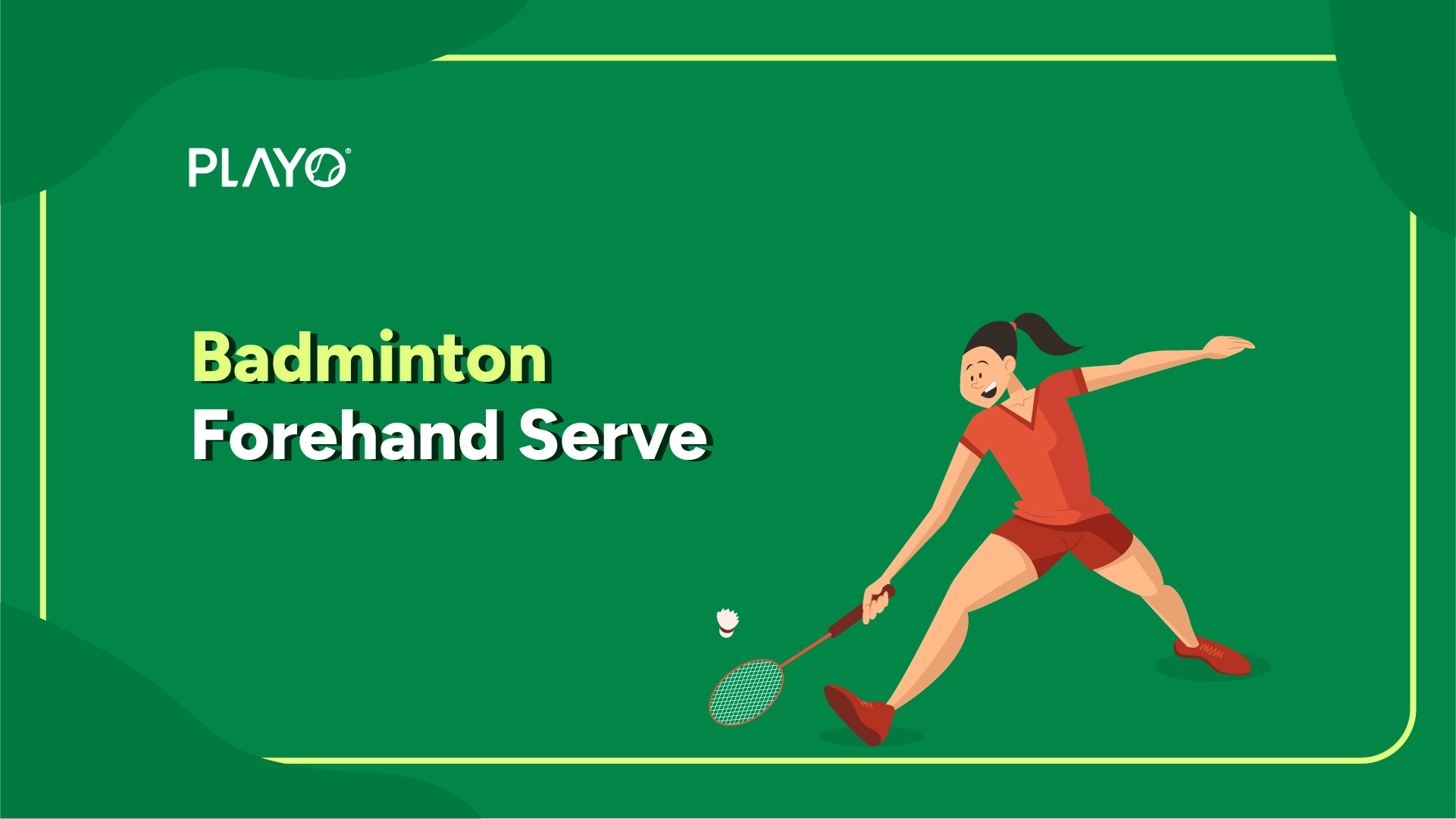


A badminton forehand serve is a serving technique in which a player strikes the shuttlecock using a forehand action to start a rally. It is commonly used to deliver high serves in singles and can also be used for low serves, depending on the player’s technique and tactical intention.
Learning the correct badminton forehand serve technique helps players control the shuttle’s trajectory, improve accuracy and make it harder for opponents to attack. However, a successful serve is not just about power. Players must follow the official service rules, maintain balance and direct the shuttle into the correct diagonal service court.
This guide explains how to perform a forehand serve in badminton, its main types, the official rules and common mistakes to avoid.
What is a Forehand Serve in Badminton?
A forehand serve is a serve performed using a forehand racket action, typically with the racket held in a forehand grip. The player swings the racket forward from below the shuttle to send it over the net and into the opponent’s service court.
The forehand serve is particularly useful in singles, where a high serve can push an opponent towards the back of the court. Depending on the intended trajectory, players can also use a forehand action to play a shorter serve.
Unlike the backhand serve, which is often used for low serves in doubles, the forehand serve generally allows a longer swinging action. Players must still control the racket movement and shuttle placement to avoid giving the receiver an easy attacking opportunity.
Types of Badminton Forehand Serves
Forehand serves can be played with different trajectories. The two main variations are the high forehand serve and the low forehand serve.
1. High Forehand Serve
A high forehand serve sends the shuttle high into the air so that it travels towards the back of the opponent’s service court before descending.
This serve is commonly used in singles to move the receiver away from the net and create more space for the server to defend the court. The shuttle is usually directed towards the rear service area, making the receiver move backwards to return it.
When to use it:
- In singles matches to push the opponent towards the rear court.
- When you want additional time to recover into a balanced position.
- When the opponent is standing close to the front of the court.
Key technique: Use a controlled underarm swing and sufficient racket acceleration to send the shuttle high and deep. Aim for the rear portion of the legal service court without hitting the shuttle long.
2. Low Forehand Serve
A low forehand serve travels close to the net and drops into the front area of the opponent’s service court.
The objective is to make the receiver lift the shuttle rather than attack it immediately. Although low serves are frequently associated with the backhand technique, they can also be performed using a forehand action.
When to use it:
- When you want to keep the shuttle close to the net.
- When the opponent is positioned deep in the court.
- When you want to vary the direction and trajectory of your serves.
Key technique: Use a gentle, controlled racket movement and focus on accuracy rather than power. The shuttle should cross the net and descend into the correct service court.
Read More: Badminton Backhand Serve
How to Perform a Badminton Forehand Serve
Follow these steps to develop a consistent forehand serve.
Step 1: Adopt the Correct Stance
Stand inside your service court without touching its boundary lines. Position your body slightly sideways to the net, with your non-racket shoulder generally facing towards the receiver.
Keep your knees slightly bent and distribute your weight comfortably. A balanced stance allows you to swing smoothly and recover quickly after serving.
Step 2: Hold the Racket Correctly
Use a comfortable forehand grip that allows you to control the racket without gripping it too tightly. Keep your wrist relaxed so that you can adjust the racket angle and generate the required swing.
Avoid holding the racket too rigidly, as excessive tension can reduce control and make the serve less consistent.
Step 3: Position and Release the Shuttle
Hold the shuttle by its feathers or cork in front of your body, depending on the serving style you are practising. Release it without deliberately adding spin.
Keep the shuttle in a position that allows you to make clean contact with the racket. Practise releasing it consistently so that your timing does not change with every attempt.
Step 4: Swing the Racket Forward
Bring the racket back slightly and swing it forward in a smooth underarm action. Coordinate your forearm, wrist and body movement to produce the required trajectory.
For a high forehand serve, accelerate the racket sufficiently to send the shuttle deep into the opponent’s court. For a low forehand serve, use a softer action to keep the trajectory low.
Under the standard Laws of Badminton, the racket movement must continue forwards from the start of the service until the shuttle is struck.
Step 5: Make Contact with the Shuttle
Strike the base of the shuttle first, ensuring the whole shuttle is below 1.15 metres from the court surface at the instant of contact under the standard BWF service-height rule.
Keep the contact controlled and direct the shuttle towards the diagonally opposite service court. Avoid attempting to generate excessive power at the expense of accuracy.
Step 6: Follow Through and Recover
Allow the racket to follow through naturally after contact. Return to a ready position with your knees slightly bent and your racket prepared for the receiver’s return.
A quick recovery is important because the opponent may respond with a smash, drop shot, drive or net shot, depending on the quality of the serve.
Official Badminton Forehand Serve Rules
The Badminton World Federation (BWF) Laws of Badminton set out the requirements for a legal serve. These rules apply to forehand and backhand serves alike.
1. Correct Service Court
The server and receiver must stand in diagonally opposite service courts. Neither player may touch the boundary lines of their respective service courts while delivering the serve.
In singles, the server uses the right service court when their score is even and the left service court when their score is odd. The same even-score and odd-score principle determines the serving side in doubles.
2. Service Height
Under the standard BWF service rule, the whole shuttle must be below 1.15 metres from the court surface when struck by the server’s racket. This is a fixed-height requirement. The older waist-height test should not be presented as the standard rule for ordinary play under the current Laws of Badminton.
3. Stationary Feet
Some part of both feet of the server and receiver must remain in contact with the court surface in a stationary position from the start of the service until it is delivered. Players must not drag, lift or move their feet in a way that violates this requirement during the service.
4. Correct Shuttle Contact
The racket must initially hit the base of the shuttle. The server must release the shuttle without adding spin and must not deliberately miss it when attempting to serve.
5. Forward Racket Movement
The first forward movement of the racket head marks the start of the service. From that point, the racket must continue moving forwards until the service is delivered.
The server must also wait until the receiver is ready. However, if the receiver attempts to return the serve, they are considered ready under the rules.
6. Shuttle Must Land in the Correct Service Court
The shuttle must travel upwards from the racket, pass over the net and, if not intercepted, land on or within the boundary lines of the receiver’s diagonally opposite service court. A serve that lands outside the correct service court is a fault.
Common Forehand Serve Mistakes
Even players with good racket skills can struggle with service consistency. Watch out for these common mistakes:
- Hitting the shuttle too low or too high: Practise making contact below the prescribed 1.15-metre limit while maintaining a controlled swing.
- Serving beyond the boundary lines: Reduce unnecessary power and focus on landing the shuttle inside the service court.
- Using excessive wrist tension: Keep your grip relaxed to improve touch and accuracy.
- Making the serve predictable: Practise both high and low forehand serves to vary the trajectory.
- Moving the feet illegally: Maintain the required stationary foot contact until the shuttle is struck.
- Recovering too slowly: Return to your ready position immediately after serving.
Tips to Improve Your Forehand Serve
- Practise high and low forehand serves in short sets, focusing on accuracy rather than power.
- Aim for specific targets near the front and rear of the service court to improve shuttle placement.
- Vary the shuttle’s trajectory while keeping your serving preparation consistent.
- Practise serving from both the right and left service courts to improve control and diagonal placement.
- Ask a coach or training partner to check your stance, shuttle release, contact point and recovery.
Conclusion
The badminton forehand serve is a useful technique for starting rallies with controlled placement and varied trajectories. High forehand serves can push opponents towards the back of the court, while low forehand serves can help keep them closer to the net.
To perform it effectively, focus on a balanced stance, a relaxed forehand grip, clean shuttle contact and accurate placement. Most importantly, follow the official service requirements, including the 1.15-metre contact-height limit, stationary foot contact and correct diagonal service-court placement.
With regular practice, players can develop a forehand serve that is accurate, consistent and suited to different match situations.
Download Playo on Android or iOS, or visit playo.co to start playing!
Frequently Asked Questions
A forehand serve is a way of starting a rally by striking the shuttle with a forehand racket action. It can be used to play high or low serves, depending on the intended trajectory.
Yes. Forehand serves are legal as long as they comply with the official service rules, including the correct service court, contact height, shuttle release and forward racket movement.
Under the standard BWF Laws of Badminton, the whole shuttle must be below 1.15 metres from the court surface when the racket strikes it.
Neither is universally better. A forehand serve is often useful for high serves in singles, while a backhand serve is widely used for short serves in doubles. The best option depends on the player’s skill, the match situation and the intended trajectory.
Yes. A forehand serve is legal in doubles if it meets all the service requirements and lands in the correct diagonal service court. However, players often favour the backhand technique for short doubles serves because it allows compact racket movement and precise control.