


The badminton service court is the marked area used for serving and receiving at the beginning of a rally. Its boundaries are determined by specific court lines, and these boundaries differ between singles and doubles. Understanding the service court makes it easier to identify where a serve should be delivered and whether the shuttle has landed in the correct area.
The Badminton World Federation (BWF) Laws of Badminton define the official court markings and dimensions used in the game. The court is rectangular, with lines that are 40 mm wide, and all court lines form part of the area they define.
What is a Badminton Service Court?
A service court is the area into which the shuttle must be served at the start of a rally. Each side of a badminton court is divided into two service courts by the centre line, creating a right service court and a left service court.
The service court is not simply a separate section of the badminton court. It is formed by several existing court markings, including the short service line, centre line, relevant sideline and the appropriate long service line. Which lines apply depends on whether the match is singles or doubles.
This distinction is important because the singles and doubles service courts have different shapes. The singles service court is narrower and extends farther towards the back of the court, while the doubles service court is wider but ends before the back boundary.
Badminton Service Court Dimensions
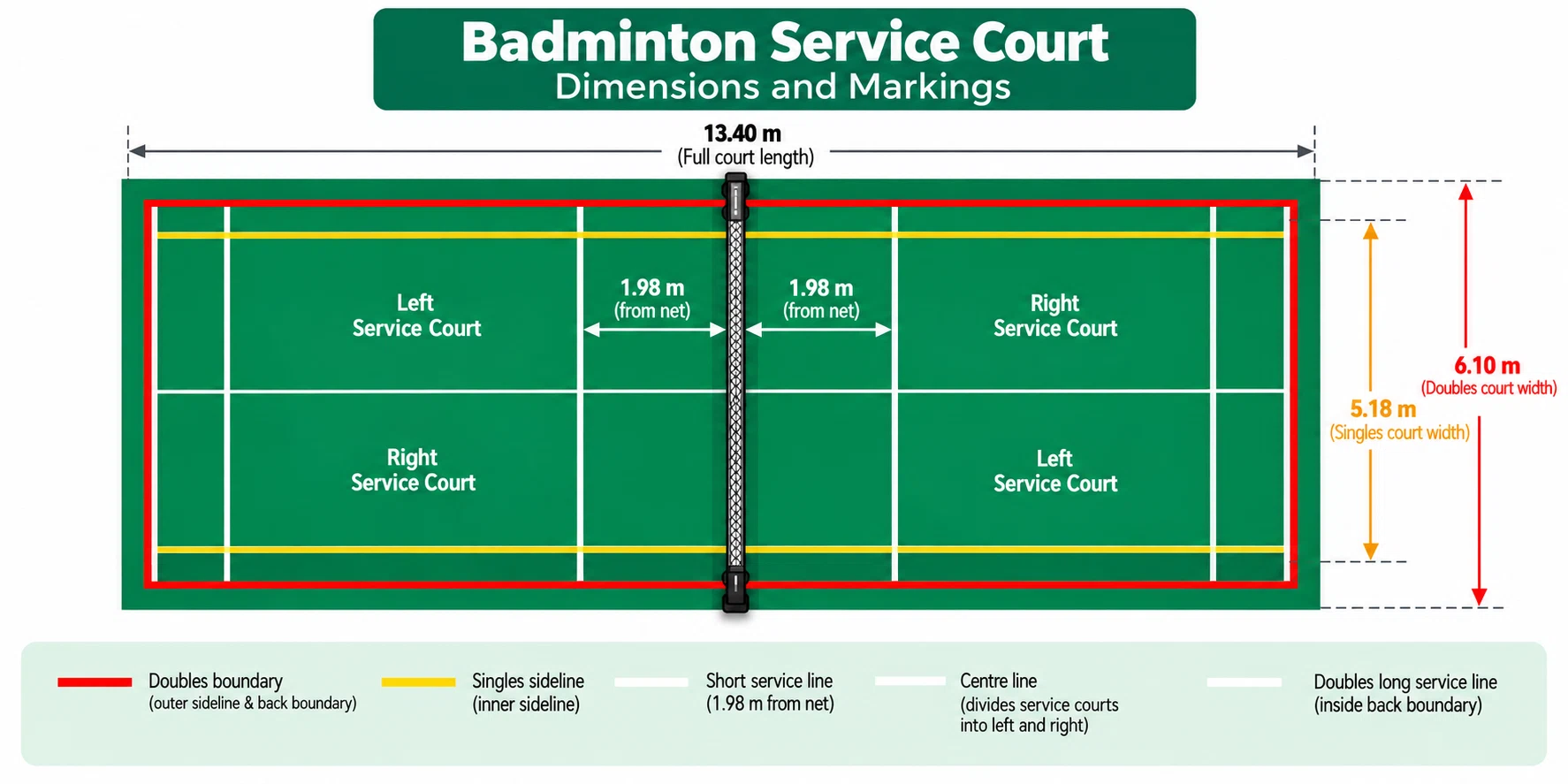
The service court dimensions depend on the format being played. A standard badminton court is 13.40 metres long. The full doubles court is 6.10 metres wide, while the singles court uses the inner sidelines and measures 5.18 metres wide.
The short service line is 1.98 metres from the net. The centre line divides the service area on each side into two service courts. Court lines are 40 mm wide, and the BWF states that the lines form part of the areas they define.
| Court measurement | Official measurement |
| Full court length | 13.40 m |
| Doubles court width | 6.10 m |
| Singles court width | 5.18 m |
| Short service line from net | 1.98 m |
| Court line width | 40 mm |
These measurements help explain why the service court cannot be treated as one identical area for singles and doubles. The same overall court is used, but different lines determine the boundaries of the service area in each format.
Read More: Badminton Service Rules
Badminton Service Court Lines
The service court is created by a combination of court markings. The centre line runs perpendicular to the net and divides each side into the right and left service courts. This is the line that separates the two possible service positions on each side.
The short service line runs parallel to the net and is 1.98 metres from it. It marks the front boundary of the service court. The shuttle must travel beyond this line to land inside the relevant service court.
The singles and doubles sidelines determine the width of the service court. The inner sidelines are used for singles, while the outer sidelines are used for doubles.
The final boundary is the relevant long service line. In singles, the back boundary line also serves as the long service line. In doubles, the doubles long service line is positioned inside the back boundary, making the doubles service court shorter.
Singles Badminton Service Court
The singles service court is narrower and longer than the doubles service court. Its side boundaries are the singles sidelines, which are the inner sidelines of the full badminton court. The front boundary is the short service line, while the rear boundary is the back boundary line. The centre line divides the area into right and left service courts.
This means that the singles service court extends farther towards the back of the court than the doubles service court. A serve can therefore land closer to the back boundary in singles, as long as it remains within the appropriate singles service court.
The overall singles court width is 5.18 metres, compared with the 6.10-metre width of the full doubles court.
Doubles Badminton Service Court
The doubles service court is wider but shorter than the singles service court. Its side boundaries are the outer doubles sidelines, while its front boundary remains the short service line.
The important difference is at the rear. The doubles service court ends at the doubles long service line, which is located inside the back boundary line. The area between the doubles long service line and the back boundary is therefore not part of the doubles service court.
This difference in the rear boundary is one of the easiest ways to distinguish a singles service court from a doubles service court when looking at a marked badminton court.
Singles vs Doubles Service Court
Although singles and doubles use the same court, their service areas differ based on the sidelines and rear boundary. Singles uses the inner sidelines and back boundary, while doubles uses the outer sidelines and doubles long service line.
| Feature | Singles service court | Doubles service court |
| Width | Narrower | Wider |
| Side boundary | Singles sideline | Doubles sideline |
| Front boundary | Short service line | Short service line |
| Rear boundary | Back boundary line | Doubles long service line |
| Shape | Narrow and long | Wide and shorter |
Badminton Service Court Layout
A standard badminton court can look complicated because several lines run parallel and perpendicular to the net. The easiest way to identify the service courts is to start with the net and work outward.
The short service line is the first important boundary, positioned 1.98 metres from the net. Behind it, the centre line divides the court into the right and left service courts. The relevant sideline determines the width, while the appropriate long service line determines how far the service court extends towards the back.
For singles, use the inner sideline and the back boundary line. For doubles, use the outer sideline and the doubles long service line. This simple distinction makes it easier to read the court without confusing the different lines.
Common Service Court Mistakes
- Confusing the singles and doubles sidelines: Singles uses the inner sideline, while doubles uses the outer sideline. Both are visible on a standard badminton court, which can lead to confusion.
- Using the back boundary for every serve: The back boundary is the rear limit of the singles service court. In doubles, the rear boundary is the doubles long service line, which is inside the back boundary.
- Confusing the short service line with the long service line: The short service line forms the front boundary of the service court and is 1.98 metres from the net. The relevant long service line determines the rear boundary.
Conclusion
The badminton service court is the designated area used for serving and receiving at the beginning of a rally. Its boundaries are defined by the centre line, short service line, sidelines and relevant long service line. Understanding these markings helps players position themselves correctly, recognise where the serve must land, and distinguish the service area from the rest of the court.
The service court differs between singles and doubles. Singles uses the inner sidelines and extends to the back boundary, making the service court narrower and longer, while doubles uses the outer sidelines and the doubles long service line, making it wider but shorter. Knowing these differences is also important when setting up or marking a badminton court, as using the correct measurements and lines ensures the court follows the official specifications.
Download Playo on Android or iOS, or visit playo.co to start playing!
Frequently Asked Questions
A service court is the designated area used for serving and receiving at the beginning of a badminton rally. Each side of the court has a right and left service court, separated by the centre line.
The dimensions depend on whether singles or doubles is being played. The standard court is 13.40 metres long, while the full doubles court is 6.10 metres wide and the singles court is 5.18 metres wide. The short service line is 1.98 metres from the net.
The service court is defined by the centre line, short service line, relevant sideline and relevant long service line. Singles uses the singles sideline and back boundary, while doubles uses the doubles sideline and doubles long service line.
The singles service court is narrower and longer, using the singles sideline and extending to the back boundary. The doubles service court is wider but shorter because it uses the doubles sideline and ends at the doubles long service line.
Yes. All court lines form part of the area they define, so a shuttle landing on a relevant service-court boundary line is considered in.