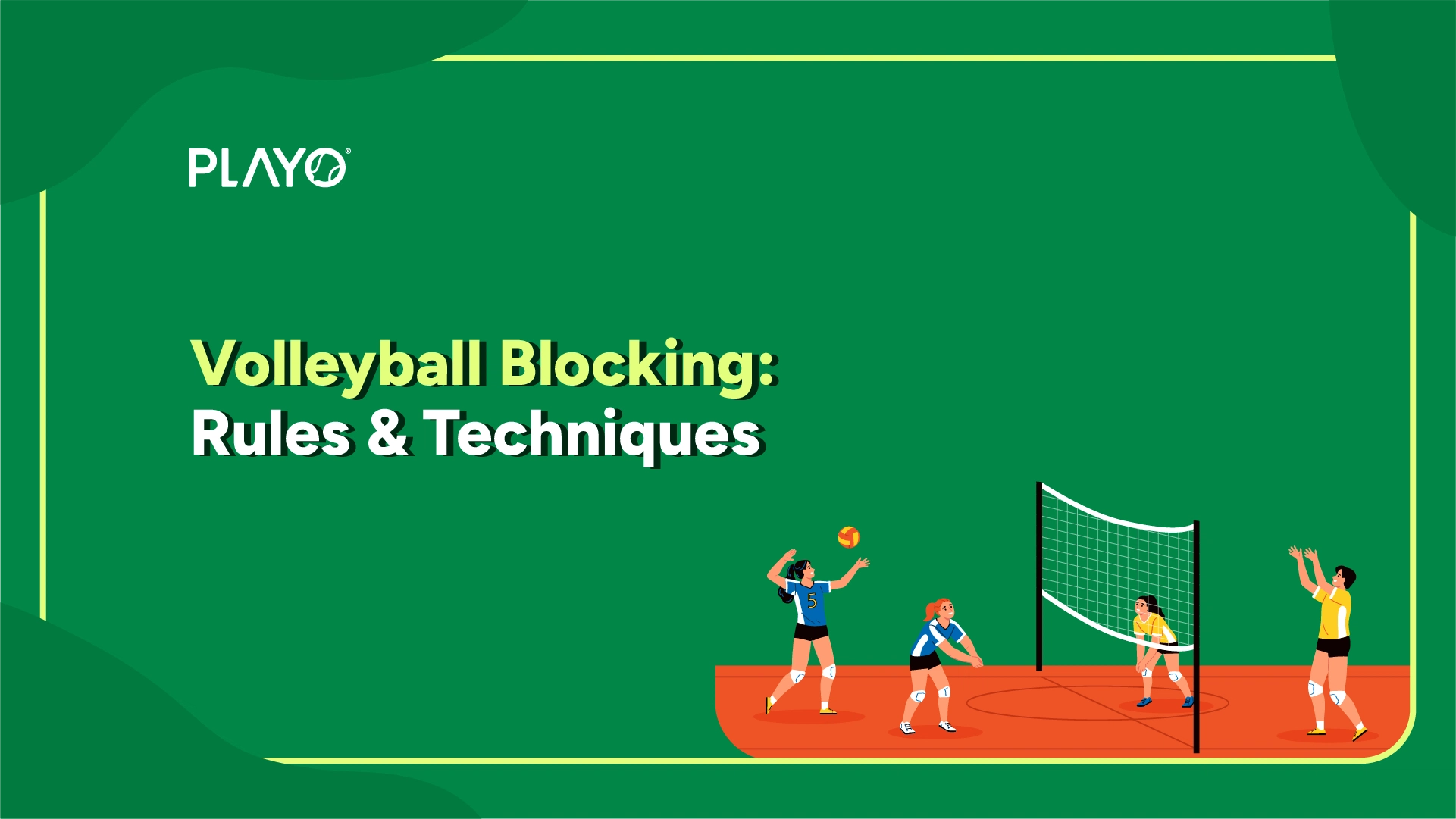


Blocking in volleyball is one of the most important defensive skills used to stop or slow down an opponent’s attack. A well-timed block can prevent a spike from crossing the net, force the ball into a predictable area of the court, or send the ball directly back into the opponent’s court.
Under the current FIVB Official Volleyball Rules 2025–2028, blocking is primarily performed by front-row players. A block contact does not count as one of the team’s three permitted hits, giving the team another three contacts to return the ball after the block.
What is Blocking in Volleyball?
Blocking in volleyball is a defensive action in which a player near the net reaches above or beyond the net to intercept an opponent’s attack. The main objective is to stop the ball from entering the team’s court or to control the direction of the opponent’s attack.
The three front-row players are the players who can participate in a completed block. A block can be performed by one player or by two or three players working together. The FIVB defines a collective block as one performed by two or three players close to each other. Blocking is considered the first line of defence because it allows a team to challenge an attacking player before the ball reaches the backcourt.
Types of Blocks in Volleyball
Blocking can be classified according to the number of players involved and the tactical approach used.
1. Single Block
A single block involves one player attempting to stop an opponent’s attack. It is commonly used when an attacker has been isolated or when there is not enough time for another blocker to join. The blocker needs to read the attacker quickly and position their hands to cover the likely direction of the attack.
2. Double Block
A double block involves two front-row players working together at the net. It provides greater coverage than a single block and is commonly used against strong outside or opposite-side attacks. The two blockers must coordinate their movements so that there is minimal space between their hands and arms.
3. Triple Block
A triple block involves three players forming a block together. It provides the greatest amount of coverage at the net but also leaves fewer players available to defend other areas of the court. A team may use a triple block when it expects a powerful attack from a particular area.
The FIVB rules recognise collective blocks involving two or three players, and the block is completed when one of the blockers touches the ball.
Read More: Volleyball Serving Rules
Volleyball Blocking Rules
Understanding the rules is essential for knowing when a block is legal.
A Block Does Not Count as a Team Hit
One of the most important volleyball blocking rules is that a block contact does not count as one of the team’s three hits. If a player blocks the ball and it comes back onto their side, the team still has three hits available to return it. The first contact after a block can be made by any player, including the player who made the block.
Players Can Reach Beyond the Net
A blocker is allowed to place their hands and arms beyond the net while blocking, as long as they do not interfere with the opponent’s play before the opponent executes an attack hit. A player cannot simply reach over the net and touch the ball before the opponent has completed an attack action if doing so interferes with the opponent’s play.
Blocking the Serve is Not Allowed
A player cannot block an opponent’s serve. Attempting to intercept a serve with a block is a blocking fault under the official rules.
Back-Row Players Cannot Complete a Block
Back-row players cannot complete a block. The same restriction applies to the libero. A back-row player or libero committing a completed block is considered a blocking fault. A libero also cannot attempt an individual or collective block.
What is a Completed Block?
A completed block occurs when a player participating in the block makes contact with the ball. When two or three players form a collective block, the block is considered completed as soon as any one of the blockers touches the ball. The contact does not have to stop the ball or send it back into the opponent’s court. A block can still be completed if the ball deflects off the blockers and continues into their own court.
During the same blocking action, one or more blockers may make quick, consecutive or continuous contacts with the ball. These contacts are treated as part of the same block action. Importantly, a completed block does not count as one of the team’s three permitted hits, so the team can still use up to three contacts after the block to return the ball to the opponent’s court.
Common Blocking Faults in Volleyball
A blocking fault occurs when a player violates one of the rules governing blocking. Common examples include:
- A blocker touches the ball in the opponent’s space before the opponent’s attack hit.
- A back-row player completes a block.
- A libero completes or attempts an individual or collective block.
- A player blocks the opponent’s service.
- The ball goes out after being touched by the block.
- A player blocks the ball in the opponent’s space from outside the antenna.
These faults can result in the opponent being awarded the rally.
How to Perform a Block in Volleyball
Good blocking requires coordination, timing and positioning. A basic blocking sequence can be broken down into the following steps.
1. Start in a Ready Position: Stand near the net with your knees slightly bent and your body balanced. Keep your hands up and stay prepared to move sideways.
2. Watch the Setter and Attacker: Do not focus only on the ball. Watch the setter’s movement and the attacking player’s approach to anticipate where the ball may be hit.
3. Move Into Position: Use quick lateral movements to get in front of the attacker. The goal is to close the gap between blockers when performing a double or triple block.
4. Jump at the Right Time: Timing is critical. Jump too early and the attacker may hit around or over the block. Jump too late and the ball may already be past the block.
5. Reach Over the Net: Extend your arms and hands upward and slightly over the net without interfering illegally with the opponent’s play. The FIVB identifies penetration over the net as an important part of effective blocking.
6. Land Under Control: After contacting or attempting to block the ball, land with control and prepare immediately for the next play.
Tips to Improve Blocking in Volleyball
1. Improve footwork: Practise quick lateral movements to get into position before the attacker makes contact.
2. Work on jump timing: Focus on timing your jump with the attacker’s approach instead of simply trying to jump as high as possible.
3. Keep your hands correctly positioned: Reach high and press your hands over the net while maintaining proper hand and arm positioning.
4. Close gaps between blockers: In a double or triple block, coordinate with teammates to reduce spaces between blockers.
5. Communicate with teammates: Call out attacking options and coordinate blocking assignments before and during the play.
6. Read the setter and hitter: Watch the setter’s movement and the attacker’s approach to anticipate the direction of the attack.
7. Practise different attacks: Train against quick attacks, outside hits and other attacking variations to improve reaction and positioning.
Blocking vs Digging in Volleyball
Blocking and digging are both defensive skills, but they happen at different stages of an attack. Together, blocking and digging create a team’s defensive structure. A block can reduce the attacker’s available angles, while defenders position themselves to cover the areas that remain open.
| Feature | Blocking | Digging |
| Location | Near the net | Usually in the backcourt |
| Main purpose | Stop or control an attack | Defend against an attack that gets past the block |
| Players involved | Primarily front-row players | Primarily back-row players |
| Timing | Before the ball crosses the net | After the ball crosses the net |
| Team hits | Block contact does not count | Defensive contact counts as a team hit |
Conclusion
Blocking in volleyball is more than simply jumping at the net. A successful block depends on reading the attack, moving into the right position, timing the jump and coordinating with teammates. Players can use single, double or triple blocks to challenge different attacking situations and limit the options available to the opponent.
Understanding the volleyball blocking rules is equally important. A block does not count as one of the team’s three hits, while back-row players and the libero cannot complete a block, and blocking an opponent’s serve is not allowed. With regular practice of footwork, timing, hand positioning and communication, players can develop more effective blocks and strengthen their team’s overall defence.
Download Playo on Android or iOS, or visit playo.co to start playing!
Frequently Asked Questions
Blocking is a defensive action in which a player near the net reaches above or beyond the net to intercept an opponent’s attack.
A block can involve one, two or three players. Two or three players performing a block together are considered a collective block under the FIVB rules.
No. A block contact does not count as one of the team’s three hits. The team gets three more hits after the block contact.
No. A back-row player cannot complete a block. A completed block by a back-row player is a blocking fault.
No. Blocking an opponent’s serve is prohibited under the official volleyball rules.