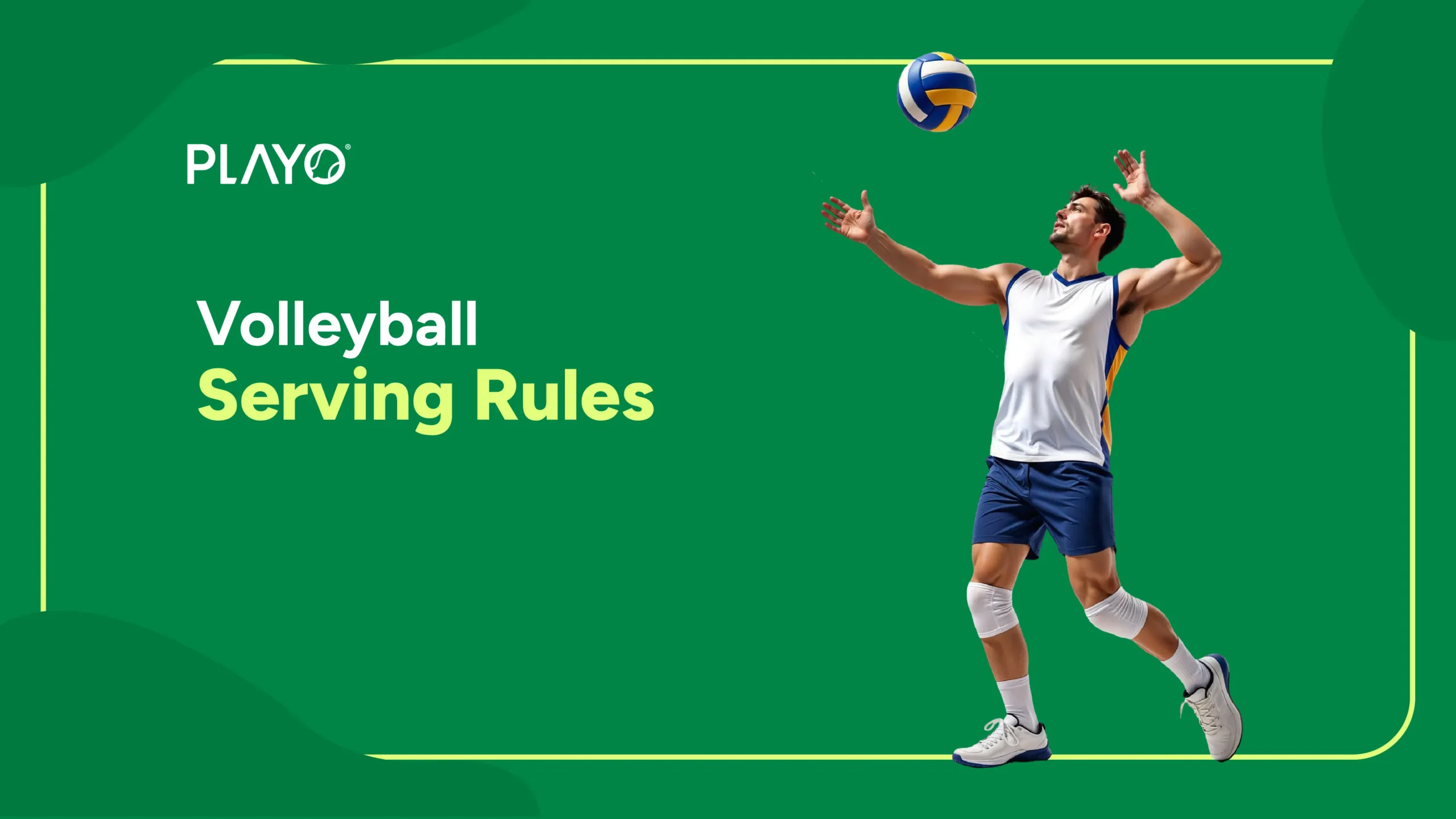


Serving is much more than just the way a volleyball rally begins. A well-executed serve can put the receiving team under immediate pressure, force errors, or even win a point outright with an ace. At the same time, a single mistake while serving can hand a point to the opposition.
Whether you’re playing recreationally, representing your school, or competing at a higher level, understanding the official volleyball serving rules is essential. These rules determine who serves, where they must stand, how long they have to serve, what constitutes a legal serve, and when a service fault is called.
This guide explains the latest FIVB Official Volleyball Rules (2025–2028). You’ll also learn about the service zone, rotation, common serving faults, different serving techniques, and practical tips to improve your consistency on the court.
What is a Serve in Volleyball?
A serve is the action that starts every rally in volleyball. It is the only skill performed entirely under the server’s control, making it one of the most important offensive skills in the game.
The primary objectives of a serve are to put the ball into play, apply pressure on the receiving team, and create scoring opportunities through aces or weak returns. Under the rally-point scoring system, every rally results in a point. If the serving team wins the rally, it continues serving. If the receiving team wins the rally, it earns the point, gains the right to serve, and rotates before the next serve.
Official Volleyball Serving Rules
The following are the official serving rules followed in FIVB indoor volleyball competitions.
1. Only the Correct Player Can Serve
At the beginning of each set, teams submit their rotational order. Throughout the set, players must serve according to that order. Only the player occupying Position 1 (back-right) is allowed to serve. If another player serves out of turn, the rally is awarded to the opponents, and the serving order is corrected.
2. The Server Must Serve from the Service Zone
The serve must be taken from behind the end line, within the designated service zone. At the instant of contacting the ball, the server:
- Must not touch the end line.
- Must not step inside the playing court.
- Must remain within the width of the service zone.
After striking the ball, the server is free to land inside the court or outside the service zone without committing a fault.
3. The Serve Must Be Hit Within 8 Seconds
Once the first referee whistles to authorise service, the server has 8 seconds to contact the ball. Exceeding this time limit results in an immediate service fault, and the opposing team wins the rally. If the server strikes the ball before the referee’s whistle, the serve is cancelled and replayed rather than penalised.
4. The Ball Must Be Contacted Correctly
The server begins by tossing or releasing the ball into the air. The serve becomes legal when the ball is struck with one hand or any part of one arm after the toss or release. There is no restriction on whether the ball spins, floats, or travels with topspin. Different serving techniques are permitted as long as the contact itself is legal.
5. The Ball Must Cross the Net Legally
A served ball is considered legal if it:
- Crosses the net through the crossing space.
- Lands inside the opponent’s playing court.
- Lands on a boundary line, which is considered in.
Unlike older rules, a serve may touch the net and still remain in play, provided it continues into the opponent’s court legally. These are commonly known as let serves.
6. Screening is Not Allowed
The receiving team must have a clear view of both the server and the ball during the service action. Players on the serving team commit a screening fault if they intentionally obstruct the opponents by:
- Waving their arms.
- Jumping collectively.
- Moving sideways together.
- Standing grouped so the server or the ball’s flight path is hidden.
The 2025–2028 FIVB rules also prohibit players from raising their hands above their heads in a way that creates a screen until the served ball has crossed the vertical plane of the net.
Read More: Volleyball Hand Signals
Volleyball Service Zone
Understanding the service zone helps prevent one of the most common serving errors- a foot fault. The service zone is the area behind each end line from which every serve must be taken.
According to the official FIVB court layout:
- The service zone extends across the full 9-metre width of the volleyball court behind the end line.
- It is bounded laterally by two short service lines positioned behind the end line.
- The service zone extends backwards to the end of the free zone, giving players flexibility to use different serving approaches, especially for jump serves.
One advantage of this rule is that players are not required to serve from the centre. Servers often choose positions near either sideline or the middle depending on their preferred angle and the opponent’s formation.
For example:
- A float server may stand closer to the middle to target specific passers.
- A jump server often begins several metres behind the end line to build momentum before take-off.
- Tactical servers may shift towards either sideline to create sharper serving angles.
As long as the server remains within the legal service zone at the moment of ball contact, the exact serving position is left to the player’s strategy.
Volleyball Rotation and Serving Order
Understanding the serving order is just as important as learning how to serve. In volleyball, players cannot choose who serves next- the order is determined by the team’s rotation.
How Does the Serving Order Work?
Before each set begins, every team submits its starting line-up to the scorer. This establishes the rotation order, which must be maintained throughout the set.
Only the player in Position 1 (back-right) is allowed to serve. After serving, players do not rotate if their team wins the rally. The same player continues serving until the opposing team wins a rally.
When the receiving team wins a rally, it:
- Scores one point.
- Gains the right to serve.
- Rotates one position clockwise.
- The player who moves into Position 1 becomes the next server.
This system ensures every player gets an opportunity to serve during a set.
Example: If Team A wins three consecutive rallies after serving, the same player continues serving. Once Team B wins a rally, it gains the point, rotates one position clockwise, and the player in Position 1 becomes the next server.
What Happens if a Team Serves Out of Rotation?
If a player serves before their turn:
- The opponents are awarded the rally and the point.
- Any points scored while the wrong player was serving may be cancelled if the fault is discovered in time, as specified in the FIVB rules.
- The serving order is corrected before play resumes.
For this reason, teams constantly communicate with the scorer and each other to avoid rotation errors.
Types of Volleyball Serves
Volleyball has several serving techniques, each offering different levels of control, speed, and difficulty. The most common types are:
- Underhand serve: A beginner-friendly serve in which the ball is struck from below the waist. It offers good control and is relatively easy to execute.
- Overhand serve: The ball is tossed into the air and struck above the shoulder. It allows players to generate more power and better control the direction of the serve.
- Float serve: The ball is contacted with little or no spin, causing it to move unpredictably through the air. It is commonly used to make reception more difficult.
- Jump float serve: A variation of the float serve performed while jumping. The higher contact point and increased speed can make it more challenging to receive.
- Topspin jump serve: An advanced serve performed with a jumping approach and topspin. The spin causes the ball to dip quickly, allowing players to serve with greater power while keeping the ball inside the court.
Common Volleyball Service Faults
A service fault occurs when the serve does not comply with the official rules, resulting in the serving team losing the rally. Most service faults are caused by positioning errors, incorrect timing, or serving the ball illegally. Knowing these faults can help players avoid giving away easy points.
Foot Fault
A foot fault occurs when the server touches the end line or the playing court before contacting the ball. This most commonly happens when players misjudge their approach during a jump serve. Once the ball has been struck, the server may step into the court, but any contact with the line or court before the serve is illegal and results in a loss of the rally.
Serving Out of Turn
Teams must maintain the same serving order throughout the set as recorded on the line-up sheet. If a player serves when it is not their turn in the rotation, it is considered a rotational fault. The opponents are awarded the rally, and the serving order is corrected according to the official rotation.
Exceeding the 8-Second Service Limit
After the referee authorises the serve with a whistle, the server has 8 seconds to contact the ball. Failing to serve within this time results in a service fault, and the opposing team is awarded the rally. This rule keeps the game flowing and prevents unnecessary delays.
Ball Fails to Cross the Net
For a serve to be legal, the ball must cross the net through the crossing space and enter the opponent’s court. If the ball hits the net and falls back onto the server’s side, or otherwise fails to cross the net, the serve is ruled a fault.
Ball Lands Out of Bounds
A served ball must land inside the opponent’s court or touch one of the boundary lines, which are considered part of the playing area. If the ball lands completely outside these lines without touching them, the serve is out, and the rally is awarded to the receiving team.
Ball Crosses Outside the Crossing Space
The served ball must pass over the net within the legal crossing space, which is the area between the antennas. If the ball crosses outside the antennas or touches an antenna during flight, it is immediately ruled out, regardless of where it lands.
Illegal Screening
Players on the serving team must not intentionally obstruct the receiving team’s view of the server or the ball during service. Screening may occur when teammates stand too close together, move collectively, or raise their arms in a way that hides the server or the ball’s flight path. If the referee determines that the receiving team was unfairly obstructed, a screening fault is called.
Serving Before the Referee’s Whistle
If the server contacts the ball before the referee signals for service, play is stopped, and the serve is retaken. Since the rally has not officially begun, this action is not recorded as a service fault and does not result in a point for either team.
Indoor vs Beach Volleyball Serving Rules
Although indoor and beach volleyball share the same objective of serving the ball legally into the opponent’s court, there are a few key differences in serving rules due to the number of players and the rotation system.
| Rule | Indoor Volleyball | Beach Volleyball |
| Players per team | 6 | 2 |
| Rotation | Players rotate clockwise after winning the right to serve | Both players alternate serving whenever their team regains service |
| Serving order | Must follow the rotation submitted before the set | Each team follows a serving order established at the start of the set |
| Screening | Screening rules apply because six teammates can obstruct the server | Screening is generally not an issue due to only two players being on court |
| Service zone | Behind the end line within the service zone | Behind the end line across the width of the court |
Tips to Improve Your Volleyball Serve
Learning the rules is only the first step. Consistent serving comes from practising good technique and making smart decisions during a match.
- Develop a consistent pre-serve routine: Following the same routine before every serve, such as taking a deep breath or focusing on your target, can improve concentration and reduce unforced errors.
- Prioritise accuracy over power: A well-placed serve is often more effective than a powerful one. Aim for deep corners, gaps between passers, or weaker receivers instead of simply hitting the ball as hard as possible.
- Maintain a consistent ball toss: Keep your toss at a comfortable height and slightly in front of your hitting shoulder. A consistent toss leads to cleaner contact and better control.
- Choose a serve that matches your skill level: Beginners should first master the underhand and overhand serve before progressing to the float serve, jump float serve, and topspin jump serve.
- Practise serving to different areas of the court: Alternate between deep, short, and wide serves during practice to improve placement and make your serves less predictable.
- Reduce service errors: Keep your foot behind the end line until you contact the ball, maintain good balance, and focus on consistent execution instead of attempting difficult serves every time.
Conclusions
Understanding the official volleyball serving rules helps you avoid unnecessary faults and play with greater confidence. From following the correct serving order to serving from the legal service zone, every rule plays a role in ensuring fair play. Combine this knowledge with regular practice and proper technique to develop a more consistent and effective serve, whether you’re playing recreationally or competitively.
Download Playo on Android or iOS, or visit playo.co to start playing!
Frequently Asked Questions
A player must serve from behind the end line within 8 seconds of the referee’s whistle and follow the team’s serving order. The ball must be struck with one hand or any part of one arm, cross the net through the crossing space, and land inside the opponent’s court to be considered a legal serve.
Illegal serves include stepping on or over the end line before contact, serving out of turn, exceeding the 8-second limit, serving the ball out of bounds, or failing to send it over the net legally.
The main types of volleyball serves are the underhand serve, overhand serve, float serve, jump float serve, and topspin jump serve.
The topspin jump serve is considered the hardest serve because it combines speed, power, and topspin, making it difficult for opponents to receive.
Only the player in Position 1 (back-right) is allowed to serve. Any player serving out of the team’s established rotation order cannot legally serve. Under official rules, a libero may also serve, but only in one designated rotation position.
Yes. Under current FIVB rules, a serve that touches the net is legal as long as it passes through the crossing space and lands inside the opponent’s court.
An ace is a serve that results directly in a point because the receiving team either fails to touch the ball or cannot return it legally.
Yes, depending on the competition rules. Under FIVB rules, a libero may serve in one rotation position in the serving order. This allows teams to use the libero as a server for a specific player without affecting the team’s rotational sequence.