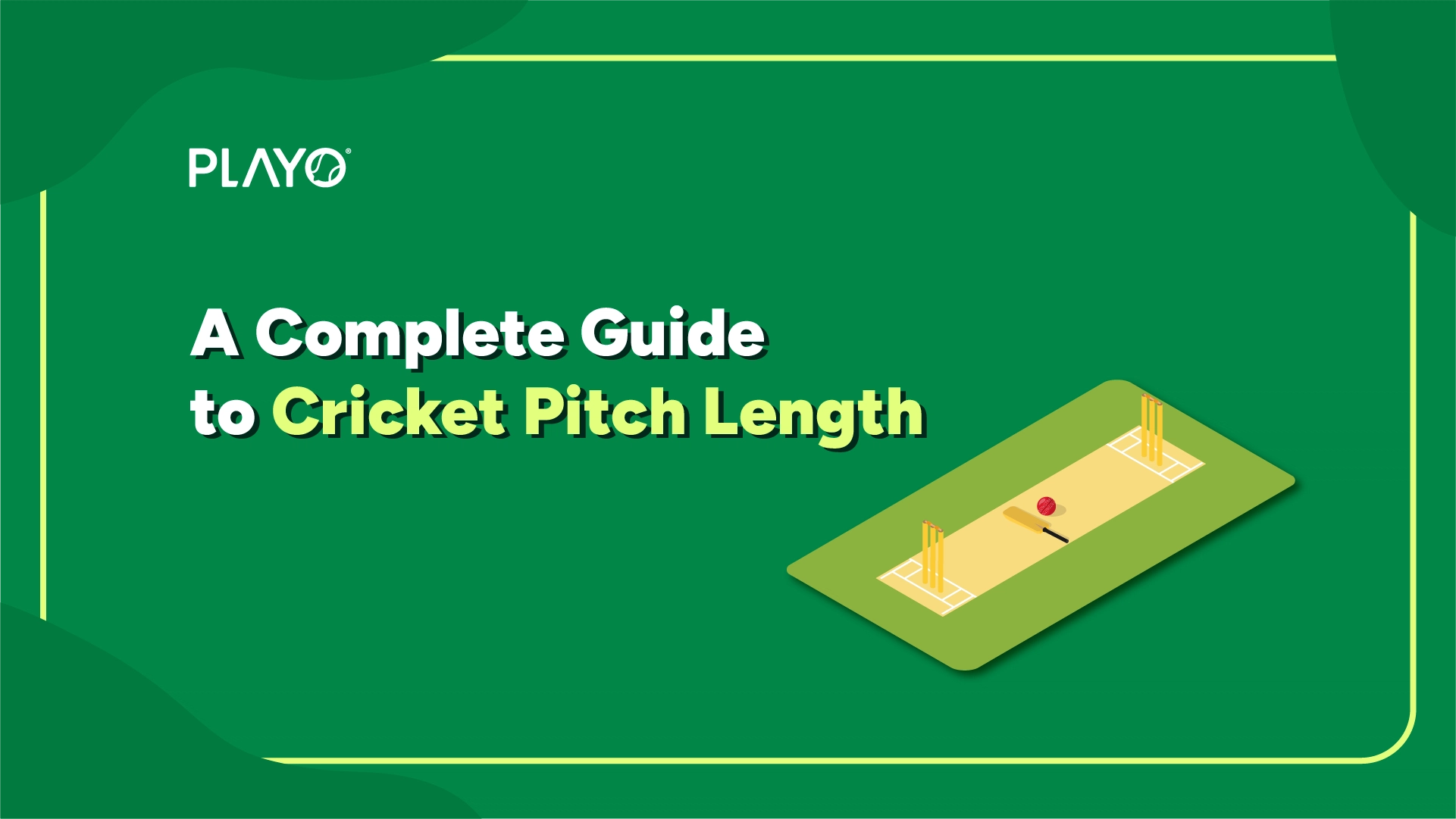


Cricket may be played across massive stadiums and watched by millions, but its entire structure revolves around a small, precisely measured strip called the pitch. At the heart of this lies one constant that has defined the game for centuries, the 22-yard pitch length. Whether it is a fast bowler running in, a batter judging a delivery, or players sprinting between wickets, everything is based on this distance.
But there is more to it than just a number. From crease markings and junior pitch variations to how different pitch surfaces behave, this 22-yard strip influences every aspect of the game. Understanding cricket pitch length helps you appreciate not just the rules, but also the strategy and skill that make cricket so unique.
What Is the Standard Cricket Pitch Length?
According to Law 6.1 of the Marylebone Cricket Club (MCC) Laws of Cricket, the official length of a cricket pitch is fixed at:
- 22 yards (imperial)
- 20.12 meters (metric)
- 66 feet (alternative imperial)
The pitch width is also standardised at:
- 10 feet (3.05 meters or 3.33 yards)
This rectangular strip connects the two sets of stumps and forms the core playing area of the game. When measuring the pitch, the 22-yard distance is taken from the back edge of one popping crease to the back edge of the opposite popping crease.
It is important to note that the MCC defines these dimensions, while the International Cricket Council (ICC) adopts and enforces them in international cricket. As a result, every professional match, whether it is Test cricket, ODIs, or T20s, is played on the same 22-yard pitch.
This consistency ensures fairness and allows players across the world to compete under identical conditions, preserving the integrity of the sport.
Why Does Cricket Pitch Length Matter?
The pitch length directly influences gameplay dynamics:
- Bowling Strategy: Fast bowlers rely on the 22-yard distance to generate pace and bounce, while spinners use the surface texture over this distance to extract turn.
- Batting Technique: Batters calibrate their footwork, shot selection, and running between wickets based on the fixed pitch length.
- Umpiring Decisions: Crease markings determine run-outs, stumpings, and no-ball calls, all dependent on precise pitch measurements.
- Ground Preparation: Groundskeepers must maintain consistent pitch dimensions to avoid unfair advantages or safety hazards.
Even minor deviations can alter ball behaviour, affect player performance, and potentially lead to match disputes. That’s why official competitions enforce strict measurement protocols.
Read More: Cricket Fielding Positions
Junior Cricket Pitch Lengths
Young cricketers don’t start on full-size pitches. To support skill development, safety, and enjoyment, junior cricket uses progressively longer pitches as players mature. The England and Wales Cricket Board (ECB) and regional bodies like Wiltshire Cricket have standardised these measurements.
Here’s the official junior cricket pitch length chart (effective from 2019):
| Age Group | Pitch Length (Yards) | Pitch Length (Meters) | Pitch Length (Feet) |
| Under 9 | 15 yards | 13.72m | 45ft |
| Under 10 & 11 | 17 yards | 15.54m | 51ft |
| Under 12 | 18 yards | 16.46m | 54ft |
| Under 13 | 19 yards | 17.37m | 57ft |
| Under 14 | 21 yards (boys) / 20 yards (girls) | 19.20m / 18.29m | 63ft / 60ft |
| Under 15 & 16 | 22 yards (boys) / 20 yards (girls) | 20.12m / 18.29m | 66ft / 60ft |
| Under 17+ | 22 yards | 20.12m | 66ft |
Cricket Pitch Markings
A regulation pitch is not just about length. It includes specific markings that control how the game is played. Here is what each line means and how it is measured.
1. Bowling Crease
- Length: 2.64 meters (8 ft 8 in)
- Position: The stumps are centred on this line
- Purpose: Defines the wicket area. Bowlers deliver the ball in relation to this line, and it acts as the reference for other crease markings
2. Popping Crease (Batting Crease)
- Length: 3.66 meters (12 ft)
- Distance from stumps: 1.22 meters (4 ft) in front of the stumps
- Purpose: Batters must have their bat or body grounded behind this line to stay safe from run-outs or stumpings. Bowlers must land part of their front foot behind this line to avoid a no-ball
3. Return Creases
- Length: Extend 2.44 meters (8 ft) perpendicular to the popping crease
- Position: Located on both sides of the wicket
- Purpose: Restrict the bowler’s delivery stride. If the back foot lands on or outside this line, it results in a no-ball
4. Wide Guidelines (Limited-Overs Cricket Only)
- Position: 43.18 cm (17 inches) from the inside edge of the return crease
- Purpose: In T20 and ODI cricket, deliveries passing outside these lines are called wides, awarding an extra run to the batting side
5. Protected Area Indicators
- Dimensions: 7.62 cm (3 inches) long markers
- Position: 1.53 meters (5 ft) in front of the popping creases and 30.48 cm (12 inches) from the middle stump
- Purpose: Indicate the central area of the pitch that must be preserved. Bowlers are not allowed to run through this area during their follow-through
Bowlers who repeatedly enter the protected area receive warnings and can eventually be suspended from bowling in that innings under Law 41.
When setting up or marking a pitch, the standard 22-yard distance should always be measured from the back edge of one popping crease to the back edge of the opposite popping crease to ensure accuracy and compliance with official laws.
Cricket Stumps and Bail Specifications
While pitch length gets most attention, stumps and bails complete the wicket setup:
- Stump Height: 28 inches (71.12cm) above the playing surface
- Stump Placement: Two sets positioned centrally on each bowling crease, parallel to each other
- Bail Length: 4.375 inches (111.1mm) each
- Bail Projection: Should not extend more than 0.5 inches (1.27cm) above stumps when seated
These dimensions ensure consistent wicket-breaking criteria across all levels of play.
Pitch Conditions and Their Impact on Play
While the length of a cricket pitch remains fixed at 22 yards, its surface condition can vary significantly and play a huge role in how a match unfolds. Even subtle changes in the pitch can influence bounce, pace, and movement.
Common Types of Pitch Conditions
Green Pitch
- Covered with a layer of grass and retains moisture
- Assists fast bowlers with seam movement and extra bounce
- Common in countries like England and New Zealand
Dry or Dusty Pitch
- Hard and cracked surface, often seen in the subcontinent
- Favours spin bowlers as the ball grips and turns sharply
- Becomes more challenging for batters as the game progresses
Sticky Wicket
- Occurs when a damp pitch begins to dry under the sun
- Produces uneven and unpredictable bounce
- Rare in modern cricket due to advanced pitch covers
Flat Track
- Even, hard surface with consistent bounce
- Ideal for batting and high-scoring games
- Offers very little assistance to bowlers
How Captains Use Pitch Conditions
Pitch conditions are a key factor during the toss. Captains assess the surface before deciding whether to bat or bowl first. For example:
- A team with strong spin bowlers may choose to bowl first on a dry pitch, expecting it to deteriorate and turn later
- A pace-heavy attack may prefer early moisture on a green pitch to exploit movement with the new ball
Understanding pitch conditions helps teams plan strategies more effectively, making the 22-yard strip far more influential than it appears.
Conclusion
Cricket pitch length is more than just a measurement; it is a fundamental element that shapes how the game is played. The standard 22-yard distance, along with precise crease markings, defined dimensions, and junior pitch variations, ensures consistency across all levels of cricket. As covered in this guide, these specifications are governed by official laws to maintain fairness and accuracy in every match. Understanding pitch length, markings, and surface conditions provides valuable insight into gameplay, helping players, coaches, and enthusiasts better interpret strategies and on-field decisions.
Download Playo on Android or iOS, or visit playo.co to start playing!
Frequently Asked Questions
The standard cricket pitch length is 22 yards (20.12 meters or 66 feet), as defined by the Marylebone Cricket Club.
Yes, the pitch length remains 22 yards in Test cricket, ODIs, and T20s. It does not change across formats.
A cricket pitch is measured as 22 yards between the back edges of the two popping creases, not just stump to stump.
The standard width of a cricket pitch is 10 feet (3.05 meters).
A cricket pitch includes three key markings- the bowling crease, popping crease, and return creases. These lines define batting safety zones, bowling legality, and fielding decisions during play.