

Football is a simple game at first glance: two teams, one ball, and a goal at either end. But behind every successful team lies a carefully balanced system of football positions, with each player performing a unique role that contributes to the bigger picture.
From commanding goalkeepers and rock-solid defenders to creative midfielders and clinical strikers, every position on the pitch serves a distinct purpose. Some players protect their team’s goal, some control the rhythm of the match, while others carry the responsibility of creating and scoring chances.
Over the decades, football positions have evolved alongside tactics and formations. Traditional roles such as the sweeper have almost disappeared, while modern concepts like inverted wingers and false nines have transformed the way teams attack. Despite these changes, the fundamental structure of the game still revolves around three key units: defence, midfield, and attack.
Whether you’re new to the sport or simply want to understand how your favourite team functions on the field, this guide covers all football positions and their roles in detail.
Understanding Football Positions
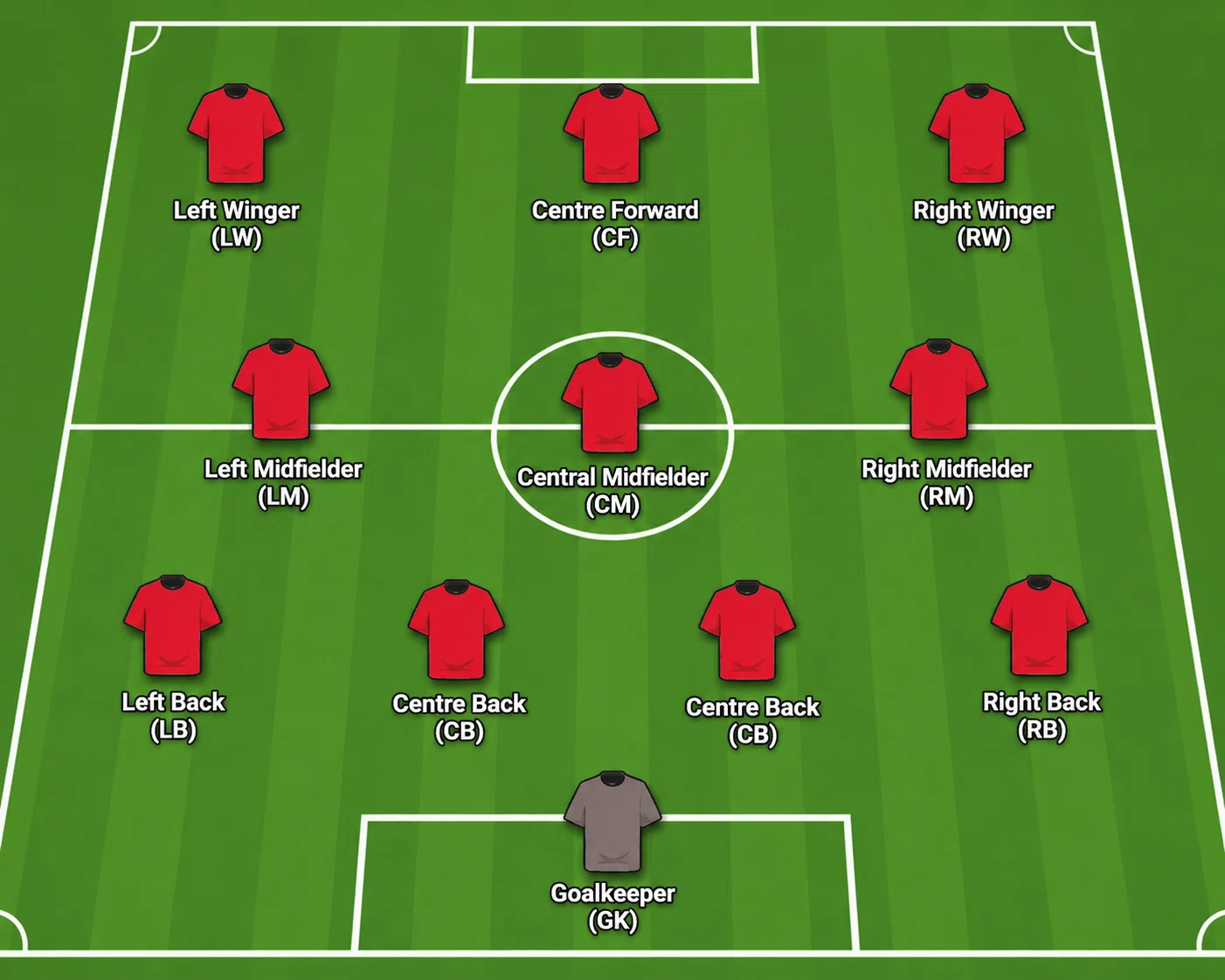
The image above shows some of the most common football positions and where players are typically located on the pitch. While teams use different formations and tactical systems, the core responsibilities of these roles remain largely the same.
Football positions can be broadly divided into four groups: goalkeepers, defenders, midfielders, and forwards. Goalkeepers protect the net and organise the defence, defenders stop opposition attacks, midfielders connect defence with attack, and forwards focus on creating and scoring goals. Together, these positions form the foundation of every football team, regardless of the formation being used.
Modern football is far more fluid than traditional systems suggest. Full-backs often join attacks, wingers drift into central areas, and strikers drop deeper to build play. As tactics continue to evolve, players are expected to perform multiple functions depending on their team’s style of play. Understanding these core positions is the best way to appreciate how football works and how each player influences the game.
Read More: 5 Different types of kicks in Football
Goalkeeper (GK)
The goalkeeper is the only player allowed to use their hands inside the penalty area and serves as the team’s last line of defence. Their primary responsibilities include stopping shots, claiming crosses, organising the back line, and remaining composed in high-pressure situations. Great goalkeepers rely on quick reflexes, positioning, anticipation, and strong decision-making to protect their goal.
Modern goalkeeping extends beyond traditional shot-stopping. Players in this role are expected to communicate with defenders, initiate attacks with accurate distribution, and operate as sweepers when their team plays a high defensive line. This evolution has made the goalkeeper an integral part of both defensive organisation and build-up play.
Centre-Back (CB)
Centre-backs form the foundation of every defensive system. Positioned in the middle of the back line, they are responsible for stopping attackers, winning aerial duels, protecting the penalty area, and organising the defence. Physical strength, intelligent positioning, strong tackling, and good decision-making are essential qualities for players in this role.
While traditional centre-backs focused mainly on defending, modern football demands much more. Many teams rely on ball-playing defenders who can break opposition lines with accurate passes, carry the ball forward under pressure, and help build attacks from the back. Whether playing in a two-man partnership or a three-man defence, centre-backs remain the backbone of every successful team.
Full-Backs (LB and RB)
The role of full-backs has changed dramatically in modern football. Traditionally, left-backs and right-backs focused on marking wingers, preventing crosses, and maintaining defensive shape. Today, they are expected to contribute heavily in attack while still fulfilling their defensive responsibilities.
Modern full-backs make overlapping runs, deliver crosses, create numerical advantages on the flanks, and often operate as additional midfielders during possession. This requires exceptional stamina, technical ability, and tactical awareness to move seamlessly between defence and attack. Without effective full-backs, many teams would struggle to create width and penetration in the final third.
Wing-Backs (LWB and RWB)
Wing-backs share many similarities with full-backs but operate higher up the pitch and enjoy greater attacking freedom. They are commonly used in formations with three central defenders, such as 3-5-2 or 3-4-3, where the extra centre-back provides additional defensive cover.
Their responsibilities include stretching the opposition, delivering crosses, creating chances, and supporting attacks in advanced areas while recovering quickly when possession is lost. As a result, wing-backs are among the most physically demanding positions in football, combining the defensive awareness of a full-back with the creativity and attacking instincts of a winger.
The Sweeper: A Historical Football Position
Although rarely seen in modern football, the sweeper remains an important part of the game’s tactical history. Positioned behind the centre-backs, the sweeper acted as a free defender, clearing danger, covering spaces left by teammates, and stepping into midfield to initiate attacks.
Changes to the offside rule and evolving tactical systems gradually reduced the need for dedicated sweepers, with high defensive lines and coordinated pressing structures becoming the norm. However, the role’s influence persists, as modern ball-playing centre-backs and sweeper-keepers continue to perform many of the same responsibilities.
Defensive Midfielder (CDM)
The defensive midfielder acts as the shield in front of the defence and plays a crucial role in maintaining the team’s balance. Their responsibilities include breaking up opposition attacks, recovering possession, protecting central areas, and providing stability during transitions.
There are different types of defensive midfielders. Some operate as destroyers, relying on tackles, interceptions, and physical presence to protect the back line. Others function as deep-lying playmakers, using intelligent passing and positional awareness to control the tempo and initiate attacks. The most effective players combine both qualities, knowing when to press, when to hold their position, and when to move the ball forward to keep the team organised.
Central Midfielder (CM)
Central midfielders connect every phase of play. They receive possession from defenders, circulate the ball across the pitch, support attacking moves, and contribute defensively when required. Their ability to control the tempo, link different areas of the team, and maintain possession makes them one of the most influential positions on the field.
Versatility is essential to this role. Some central midfielders rely on creativity and passing range, while others bring energy, work rate, and tactical discipline. The position also includes specialised roles such as box-to-box midfielders, who contribute in both penalty areas, and deep-lying playmakers, who operate from deeper positions to dictate possession and initiate attacks.
Attacking Midfielder (CAM)
The attacking midfielder operates in the space between midfield and attack, positioned behind the striker. Traditionally known as the number 10, this player is responsible for creating scoring opportunities through vision, intelligent movement, and precise passing while finding pockets of space to influence the game.
Some attacking midfielders function as classic playmakers, dictating attacks with through balls and intricate combinations, while others are more direct, making late runs into the penalty area and contributing with goals. Modern tactical systems also require them to press opponents, contribute defensively, and maintain positional discipline without sacrificing creativity.
Wide Midfielder (LM and RM)
Wide midfielders operate along either side of the pitch and contribute to both attack and defence. Unlike modern wingers, who focus primarily on attacking responsibilities, traditional wide midfielders maintain a balanced role by supporting full-backs, helping central midfielders retain possession, and providing width in attacking phases.
The position demands exceptional stamina and tactical awareness, as players must transition quickly between defending deep and joining attacks. Classic 4-4-2 systems relied heavily on wide midfielders for structure, crossing, and maintaining numerical superiority in wide areas. Although less common in modern football, the role remains important in formations that emphasise balance and collective discipline.
Wingers (LW and RW)
Wingers operate high and wide on the pitch, providing pace, creativity, and unpredictability in attack. Their primary responsibilities include stretching defensive lines, beating opponents in one-on-one situations, and creating chances for teammates.
Modern football has transformed this role. While traditional wingers relied heavily on crosses from the byline, many now play as inverted wingers, operating on the opposite side of their stronger foot to cut inside and shoot. This evolution has increased the goalscoring influence of wide players without diminishing their creative responsibilities.
Technical ability, acceleration, dribbling skills, and quick decision-making remain essential qualities for wingers. Modern systems also require them to press opponents, track back when needed, and support their full-backs, making them both key creators and goalscorers in contemporary football.
The False Nine (F9)
A false nine is a forward who drops deeper into midfield instead of remaining close to the opposition’s penalty area. This movement confuses defenders, creates space for wingers to attack centrally, and provides an extra passing option during build-up play.
The role requires exceptional technical ability, vision, and tactical intelligence, combining the creativity of an attacking midfielder with the finishing instincts of a centre-forward. Although not every team uses a false nine, the concept continues to influence modern attacking systems and positional play.
Second Striker (SS)
The second striker occupies the space between midfield and the main forward. Unlike an attacking midfielder, whose primary responsibility is creating chances, the second striker focuses more on scoring goals while still contributing to build-up play.
These players thrive on intelligent movement, exploiting spaces created by the central striker and arriving in dangerous positions at the right moment. They often operate with greater freedom than traditional forwards, drifting into channels and combining with midfielders.
The role flourished in 4-4-2 systems, where the second striker played off a target man, linking play and capitalising on opportunities. Although less common in modern football, it remains an important role in teams that prioritise fluid attacking movement.
Centre-Forward (CF) vs Striker (ST)
The terms centre-forward and striker are often used interchangeably, but subtle differences exist between the two roles. A striker primarily focuses on scoring goals, exploiting defensive spaces, running behind opponents, and finishing chances inside the penalty area. Speed, anticipation, and composure are among the key qualities required for this position.
A centre-forward contributes more to the team’s overall play by holding up the ball, bringing teammates into attacking moves, winning aerial duels, and acting as a focal point in possession. Traditional target men typically fit this role, using their physical presence to help build attacks.
Modern football often blurs these distinctions, with many forwards combining the qualities of both positions while carrying the responsibility of leading the team’s attack and finding the back of the net.
How Formations Influence Football Positions
Football positions never exist in isolation. Their responsibilities change depending on the tactical system a team employs. In a 4-4-2 formation, wide midfielders support two strikers and contribute significantly in defence, while a 4-3-3 places greater emphasis on wingers, full-backs, and midfield control through central areas.
Formations such as 3-5-2 rely heavily on wing-backs to provide width and contribute at both ends of the pitch. Modern coaches also encourage positional flexibility, with players adapting to different phases of play and performing multiple roles within the same match. Understanding football positions, therefore, means understanding how players work together rather than simply where they start on the team sheet.
Conclusion
Understanding football positions provides a deeper appreciation of the world’s most popular sport. Every player on the pitch contributes to a larger tactical framework, and success depends upon how effectively these individual roles function together.
From goalkeepers organising their defence to strikers leading the attack, each position carries unique responsibilities and demands specific skills. While tactics continue to evolve and new interpretations emerge, the essential structure of defence, midfield, and attack remains at the heart of football.
Whether you are a beginner learning the game or a passionate fan seeking deeper tactical insight, recognising the roles each player performs offers a richer understanding of every match you watch.
Download Playo on Android or iOS, or visit playo.co to start playing!
Frequently Asked Questions
The main football positions are goalkeeper, defenders, midfielders, and forwards. These broad categories include specialised roles such as centre-backs, full-backs, defensive midfielders, attacking midfielders, wingers, and strikers.
There is no fixed number of football positions because tactics continue to evolve. However, the most commonly recognised roles include goalkeeper, centre-back, full-back, wing-back, defensive midfielder, central midfielder, attacking midfielder, winger, second striker, centre-forward, and striker.
Every position plays an important role, but many consider central midfielders to be among the most influential because they connect defence and attack while controlling the tempo of the game.
A striker primarily focuses on scoring goals and exploiting spaces behind defenders, while a centre-forward often acts as a focal point in attack by holding up the ball, linking play, and bringing teammates into dangerous areas.
A false nine is a forward who drops deeper into midfield rather than staying near the penalty area. This movement creates space for teammates and adds an extra creative presence in central areas.