
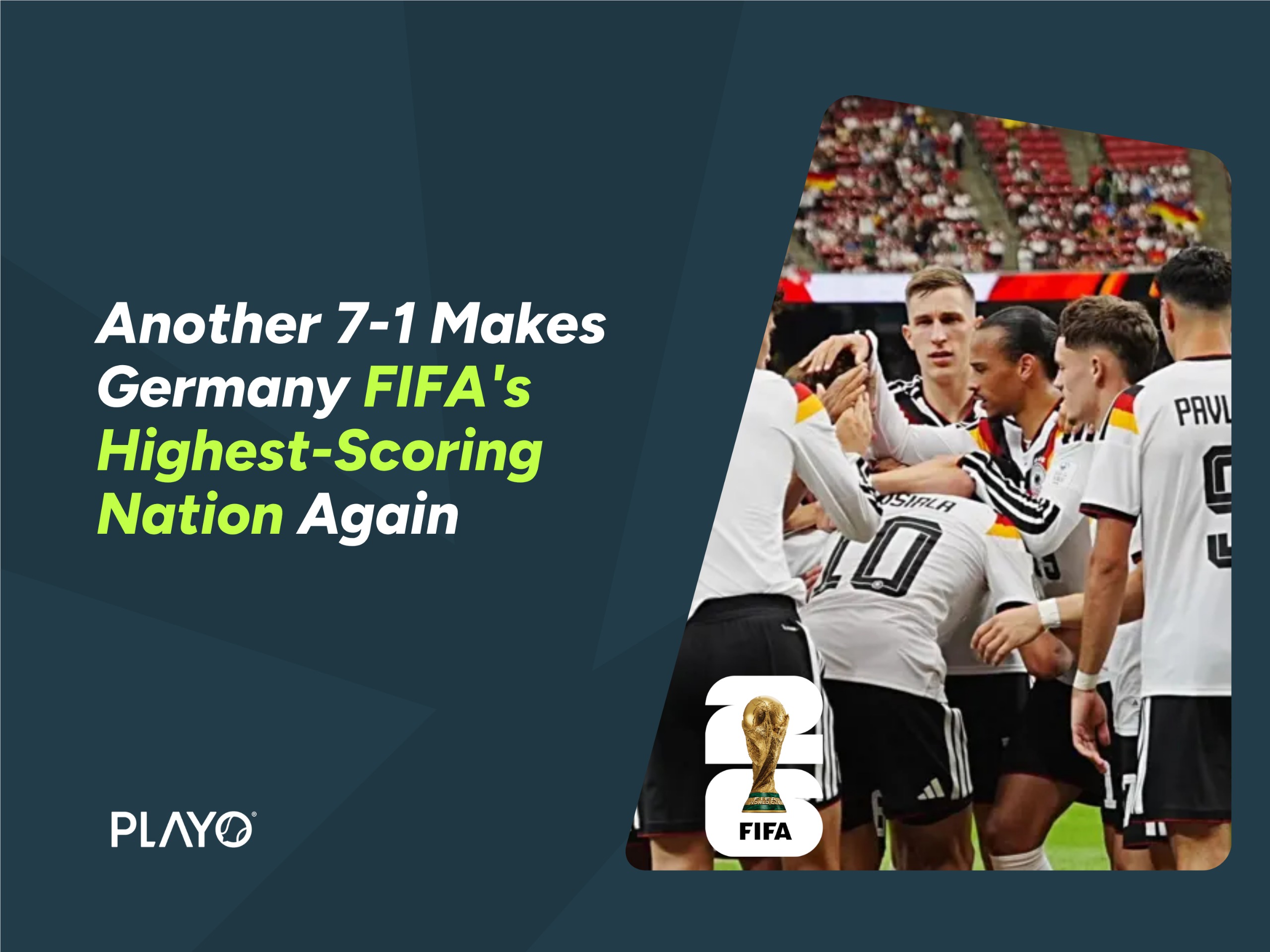


Twelve years after a 7-1 victory over Brazil first propelled Germany to the top of the FIFA World Cup scoring charts, another 7-1 triumph has done exactly the same. Germany’s emphatic 7-1 victory over Curaçao on June 14, 2026, took Die Mannschaft to 239 World Cup goals and restored them as the highest-scoring nation in tournament history.
The significance of the result lies beyond the scoreline itself. Germany’s latest triumph did not set a record for the biggest win in World Cup history, nor was it their highest-scoring match. Instead, it marked the second occasion in 12 years that a 7-1 victory has coincided with Germany overtaking Brazil and climbing to the summit of the all-time scoring charts.
How Germany Reclaimed the Record
Germany first became the World Cup’s highest-scoring nation on July 8, 2014, when Joachim Löw’s side stunned hosts Brazil 7-1 in the semi-finals in Belo Horizonte. Aside from securing a place in the final, the famous victory took Germany’s all-time tally to 223 goals, allowing them to edge past Brazil and claim top spot for the first time.
Their reign proved temporary. At the 2018 World Cup in Russia, Brazil reclaimed the lead after defeating Mexico 2-0 in the Round of 16. That result moved the Seleção to 228 goals, while Germany’s shock group-stage exit left them stranded on 226.
Brazil entered the 2026 FIFA World Cup with a narrow advantage, leading Germany 237 goals to 232. A 1-1 draw against Morocco on June 13 increased Brazil’s tally to 238, seemingly strengthening their grip on the record.
Less than 24 hours later, Germany responded in emphatic fashion. Julian Nagelsmann’s side dismantled World Cup debutants Curaçao in Houston, scoring seven times to move from 232 goals to 239 and reclaim a record they had first captured twelve years earlier.
Read More: FIFA World Cup Winners List (1930–2022)
Why the 7-1 Scoreline Is So Significant
Germany’s victory over Curaçao was not their biggest World Cup win. They famously defeated Saudi Arabia 8-0 at the 2002 tournament, while several matches in World Cup history have produced even more goals.
What makes the latest result remarkable is the context surrounding it. On both occasions that Germany has overtaken Brazil to become the tournament’s highest-scoring nation, they have done so immediately after a 7-1 victory.
The first came in 2014 against Brazil in one of the most iconic matches in football history. The second arrived in 2026 against Curaçao. In both cases, Brazil entered with the lead in the all-time scoring race, and Germany’s seven-goal haul proved enough to move them into first place.
Although the opponents and circumstances were different, the outcome was strikingly similar. Few statistical quirks from the tournament’s nearly century-long history are as unusual.
The Numbers Behind the Rivalry
The battle between Germany and Brazil extends far beyond trophies. The two footballing giants have combined for nine World Cup titles and have occupied the top two positions on the all-time scoring charts for decades.
Germany’s latest victory means they now sit alone at the top with 239 goals from 113 matches, narrowly ahead of Brazil’s 238 goals in 115 matches. What makes the achievement even more impressive is Germany’s efficiency. Their 239 goals have come in two fewer matches, giving them an average of 2.12 goals per game compared to Brazil’s 2.07.
The lead atop the all-time scoring charts has changed hands only three times over the last 12 years. Germany first moved ahead in 2014, Brazil reclaimed top spot in 2018, and Germany returned to the summit in 2026.
| Year | Key Match | Germany Total Goals | Brazil Total Goals | Leader |
| 2014 | Germany 7-1 Brazil | 223 | 222 | Germany |
| 2018 | Brazil 2-0 Mexico | 226 | 228 | Brazil |
| 2026 | Brazil 1-1 Morocco | 232 | 238 | Brazil |
| 2026 | Germany 7-1 Curaçao | 239 | 238 | Germany |
The gap between Germany and Brazil and the rest of the field also highlights their dominance. Argentina are third on the all-time list with 152 goals, followed by France with 136 and Italy with 128, leaving the top two nations comfortably ahead of the chasing pack.
More Than Just Seven Goals
Germany’s victory over Curaçao strengthened its position in Group E and further highlighted the country’s remarkable scoring tradition. The latest result marked the fourth time Germany has scored seven or more goals in a World Cup match, following a 7-0 win over Yugoslavia in 1974, an 8-0 victory over Saudi Arabia in 2002 and the famous 7-1 triumph over Brazil in 2014.
The battle with Brazil for top spot on the all-time scoring charts has been remarkably close. Germany first moved ahead in 2014, Brazil reclaimed the lead at the 2018 World Cup, and Germany returned to the summit in 2026. With 239 goals in 113 matches, Die Mannschaft have edged past Brazil’s tally of 238 goals in 115 games while maintaining a superior scoring average.
For Germany, the 7-1 scoreline has now become synonymous with taking over the World Cup scoring crown. Twelve years ago, seven goals against Brazil helped them rise to the top for the first time. Twelve years later, seven goals against Curaçao have restored them to that position, adding another chapter to one of football’s most enduring statistical rivalries.
Download Playo on Android or iOS, or visit playo.co to start playing!
Frequently Asked Questions
Germany’s 7-1 victory over Curaçao at the 2026 FIFA World Cup helped them reclaim the title of the tournament’s highest-scoring nation. The result took Germany to 239 goals in 113 World Cup matches, moving them ahead of Brazil, who have scored 238 goals in 115 matches. Interestingly, this is the second time a 7-1 victory has helped Germany overtake Brazil on the all-time scoring charts.
Following their 7-1 win over Curaçao on June 14, 2026, Germany has scored 239 goals in 113 FIFA World Cup matches. This is the highest tally by any nation in the history of the tournament.
Germany first became the highest-scoring nation in FIFA World Cup history on July 8, 2014, after defeating Brazil 7-1 in the semi-finals. That victory took Germany’s all-time tally to 223 goals, allowing them to surpass Brazil for the first time.