

The Indian women’s national cricket team achieved a landmark milestone on November 2, 2025, defeating the South African women’s national cricket team by 52 runs in the final of the ICC Women’s Cricket World Cup at DY Patil Stadium. The victory marked India’s first Women’s World Cup title after earlier runner-up finishes in 2005 and 2017. The result reflected disciplined batting, effective bowling execution, and strong fielding under pressure in a high-stakes final.
The triumph was the outcome of sustained structural growth in Indian women’s cricket. Expanded domestic competitions, central contracts from the BCCI, improved access to sports science, and competitive exposure through franchise leagues strengthened the talent pipeline. Increased media visibility and investment over the past decade also contributed to higher performance standards. The 2025 World Cup win stands as evidence of long-term planning, consistent development, and India’s emergence as a dominant force in women’s international cricket.
The Rise of Women’s Cricket in India
Women’s cricket in India did not always receive the attention it enjoys today. For many years, the team operated with limited financial support, lower media coverage, and fewer playing opportunities compared to the men’s side. Before 2006, women’s cricket in India was governed by the Women’s Cricket Association of India (WCAI). In 2006, the Board of Control for Cricket in India (BCCI) took over its administration, which gradually improved funding, facilities, and structure.
A major turning point came during the ICC Women’s Cricket World Cup in England. Although India finished as runners-up after losing the final to England, the team’s performance significantly boosted the sport’s popularity at home. Players such as Mithali Raj, Harmanpreet Kaur, and Smriti Mandhana gained nationwide recognition.
In 2022, the BCCI announced equal match fees for centrally contracted men and women cricketers in international matches, marking a historic step toward pay parity and greater recognition of women’s cricket in India.
The Historic 2025 World Cup Victory
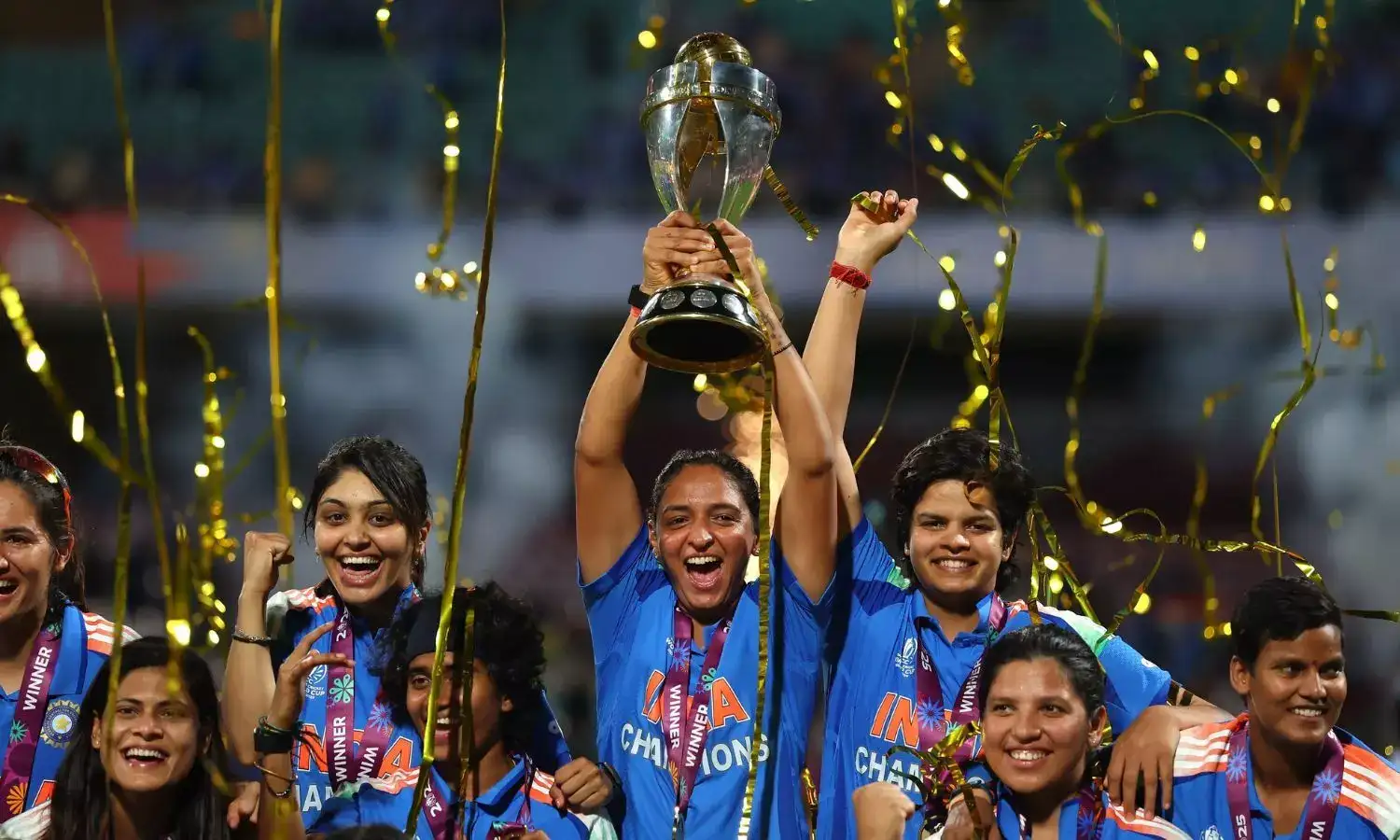
November 2, 2025, marked a defining moment in Indian sport as the Indian women’s national cricket team won their first ICC Women’s Cricket World Cup title. In the final of the ICC Women’s Cricket World Cup at the DY Patil Stadium, India defeated the South Africa women’s national cricket team by 52 runs. Batting first, India scored 298 for 7 in 50 overs. Shafali Verma led the innings with 87 and was named Player of the Match. Deepti Sharma remained unbeaten on 58, while Smriti Mandhana added 45 to strengthen the total.
South Africa fought hard in the chase. Captain Laura Wolvaardt scored 101, keeping her side in contention. However, disciplined bowling from Deepti Sharma and timely breakthroughs from Shafali Verma ensured steady pressure. South Africa was eventually bowled out for 246 in 45.3 overs, confirming India’s maiden Women’s World Cup triumph and a landmark achievement in the team’s history.
Read More: India Women’s Cricket Team in Australia
Key Players of Women’s Cricket World Cup 2025
India’s World Cup triumph rested on standout individual performances backed by verified tournament data. Below are the confirmed statistics from official ICC and ESPNcricinfo records.
Smriti Mandhana
- Tournament Runs: 434 runs in 9 innings
- Average: 54.25 | Strike Rate: 99.08
- High Score: 109* (vs New Zealand) – the highest individual score by an Indian woman in a single World Cup edition
- Milestone: Surpassed Mithali Raj’s 2017 record (409 runs) for most runs by an Indian in a single Women’s World Cup
- Final Contribution: 45 runs off 58 balls (8 fours)
Deepti Sharma
- Tournament Wickets: 22 wickets in 9 innings (Leading wicket-taker)
- Bowling Average: 20.40 | Best Figures: 5/39 (vs South Africa, Final)
- Tournament Runs: 215 runs
- Historic Feat: First player ever (men’s or women’s) to score 200+ runs AND take 20+ wickets in a single World Cup edition
- Final Performance: 5/39 with the ball + 58* off 58 balls with the bat – a match-defining all-round display
Shafali Verma
- Final Innings: 87 runs off 78 balls (Strike Rate: 111.53), 7 fours, 2 sixes
- Final Bowling: 2 wickets for 36 runs in 7 overs (dismissed Suné Luus and Marizanne Kapp)
- Tournament Context: Joined India’s squad as an injury replacement for Pratika Rawal ahead of the semi-finals after Rawal sustained an ankle fracture
- Note: Full tournament batting aggregates for Verma are not consistently published across official sources, as she entered the squad during the knockout stage; her impact was most visible in high-pressure knockout matches.
Harmanpreet Kaur
- Final Contribution: 20 runs off 29 balls (2 fours) before being bowled by Nonkululeko Mlaba
- Leadership Impact: As captain, Harmanpreet managed bowling rotations strategically throughout the tournament; India’s bowlers maintained disciplined economy rates in the middle overs during her tactical interventions
- Career Context: The 2025 World Cup marked Harmanpreet’s first ICC trophy as captain, cementing her legacy as a transformative leader for Indian women’s cricket
Key Milestones in Indian Women’s Cricket
The growth of Indian women’s cricket has not been sudden but the result of consistent structural reforms, landmark performances, and progressive policy decisions. Each milestone over the past two decades has contributed to building a stronger domestic system and a more competitive national side.
| Year | Milestone | Captain |
| 2006 | BCCI takes control of women’s cricket | Mithali Raj |
| 2017 | ICC Women’s World Cup Runners-up | Mithali Raj |
| 2022 | Equal match fees announced | Harmanpreet Kaur |
| 2023 | Women’s Premier League launched | Harmanpreet Kaur (National Team Captain) |
| 2025 | ICC Women’s Cricket World Cup Champions | Harmanpreet Kaur |
Impact of the Women’s Premier League on Indian Women’s Cricket
The launch of the Women’s Premier League (WPL) in 2023 represented a structural turning point in Indian women’s cricket. Unlike earlier domestic tournaments, the WPL introduced a franchise-based professional model with centralised broadcasting, player auctions, sports science integration, and global participation. Its long-term influence became evident during India’s 2025 ICC Women’s Cricket World Cup victory.
Professionalisation of the Domestic Ecosystem
Before WPL, the pathway from domestic cricket to international representation lacked sustained competitive intensity. The WPL created a high-performance environment where Indian players competed in pressure situations similar to global ICC tournaments. Exposure to televised matches, large crowds, and result-driven franchise expectations improved mental resilience and match temperament.
Technical and Tactical Advancement
Playing alongside and against international players elevated tactical awareness. Batters adapted to higher strike rates, power-hitting strategies, and improved strike rotation. Bowlers refined variations for death overs and middle-over containment. Fielding standards improved significantly due to professional conditioning programs embedded within franchise setups.
The tactical aggression visible in India’s 2025 World Cup campaign, particularly in middle-overs acceleration and disciplined death bowling, reflected habits developed in the WPL environment.
Financial Stability and Career Sustainability
The WPL auction system ensured substantial contracts for domestic and national players. Financial security allowed athletes to focus exclusively on cricket, nutrition, recovery, and strength training. This marked a transition from semi-professional participation to full-time athletic commitment.
Combined with central contracts from the BCCI and equal match fee announcements in 2022, the WPL strengthened long-term career viability in women’s cricket.
Expansion of Talent Pool and Bench Strength
The league functioned as a scouting platform. Consistent domestic performers gained visibility and opportunities in national camps. As a result, India entered the 2025 World Cup with improved squad depth and role clarity, reducing over-reliance on senior players.
Commercial and Cultural Impact
The WPL enhanced broadcast revenues, sponsorship investments, and digital engagement metrics for women’s cricket in India. Increased visibility reshaped public perception and encouraged grassroots participation. Cricket academies across states reported a rise in enrollment among young girls following the league’s inaugural season.
Future of Indian Women’s Cricket
India’s 2025 ICC Women’s Cricket World Cup victory has laid the foundation for a sustained era of growth and competitiveness. Increased grassroots participation, stronger state-level tournaments, and structured age-group pathways are expanding the talent pipeline across the country. Cricket academies have reported a noticeable rise in enrollment among young girls, reflecting the inspirational impact of recent international success. With clearer career pathways and improved visibility, women’s cricket is now positioned as a viable professional option rather than a developmental sport.
The continued expansion of the Women’s Premier League is expected to further deepen domestic competition and bench strength. Alongside franchise exposure, the Board of Control for Cricket in India has increased investment in high-performance infrastructure, sports science, analytics, and workload management. These systemic improvements are crucial for maintaining consistency across formats and sustaining success in future ICC tournaments.
Looking ahead, India’s challenge will be transitioning from breakthrough champions to consistent global leaders. With a blend of experienced players and emerging talent, a professional league ecosystem, and institutional backing, Indian women’s cricket appears well-equipped to compete at the highest level for years to come.
Conclusion
The rise of the Indian women’s cricket team to World Champions in 2025 was the outcome of long-term structural reform rather than a standalone triumph. Since the Board of Control for Cricket in India assumed control in 2006, consistent investments in domestic structure, central contracts, sports science, and competitive exposure have strengthened the national framework. The launch of the Women’s Premier League further professionalised the ecosystem, enhancing player development and squad depth.
India’s victory at the ICC Women’s Cricket World Cup reflects tactical maturity, financial stability, and sustained high-performance planning. It marks the country’s transition from emerging contender to established global leader in women’s cricket.
Download Playo on Android or iOS, or visit playo.co to start playing!
Frequently Asked Questions
The Indian women’s cricket team won their first ICC Women’s Cricket World Cup title on 2 November 2025, defeating South Africa by 52 runs in the final at DY Patil Stadium, Navi Mumbai.
Shafali Verma led the batting with 87 runs, while Deepti Sharma contributed with both bat and ball. Their performances were crucial in securing India’s 52-run victory.
Harmanpreet Kaur is the captain of the Indian women’s cricket team in limited-overs formats. She is known for aggressive batting, strong leadership skills, and guiding India in major ICC tournaments.
Amol Muzumdar is the head coach of the Indian women’s cricket team. He focuses on tactical planning, performance analytics, fitness standards, and strengthening squad depth across international formats.
There is no single official “best,” but Mithali Raj is widely regarded as India’s greatest female cricketer due to her records, leadership, and long-standing impact on women’s cricket.