


Football formations play a vital role in shaping match outcomes, and this importance carries over strongly into the five-a-side game. While 11-a-side football is defined by systems like 4-4-2, 4-3-3, or defensive blocks, 5-a-side football formations must adapt to faster play, limited space, and constant transitions. In five-a-side football, structure helps teams balance attack and defence without restricting movement.
Due to the smaller pitch, teams often drift into unplanned, free-flowing play, with players rotating positions instinctively. While this may resemble a “Total Football” approach, it often leads to poor spacing and defensive gaps that organised teams can exploit. Most formations are built around three core roles- the goalkeeper, a defensive organiser, and a striker, around which teams can adopt attacking or defensive setups based on their strengths. Let’s check out the six most strategic 5-a-side football formations in this blog.
Types of 5-a-Side Football Formations
1. The Square (2-0-2)
The most common formation used in 5-a-side football. Because it’s obvious, and most inexperienced teams tend to use this. It provides a balanced attack and defense. Both are supported by 2 players. This formation could really work if things are flexible but also with the clarity of who will support both attacking and defending roles during the play.
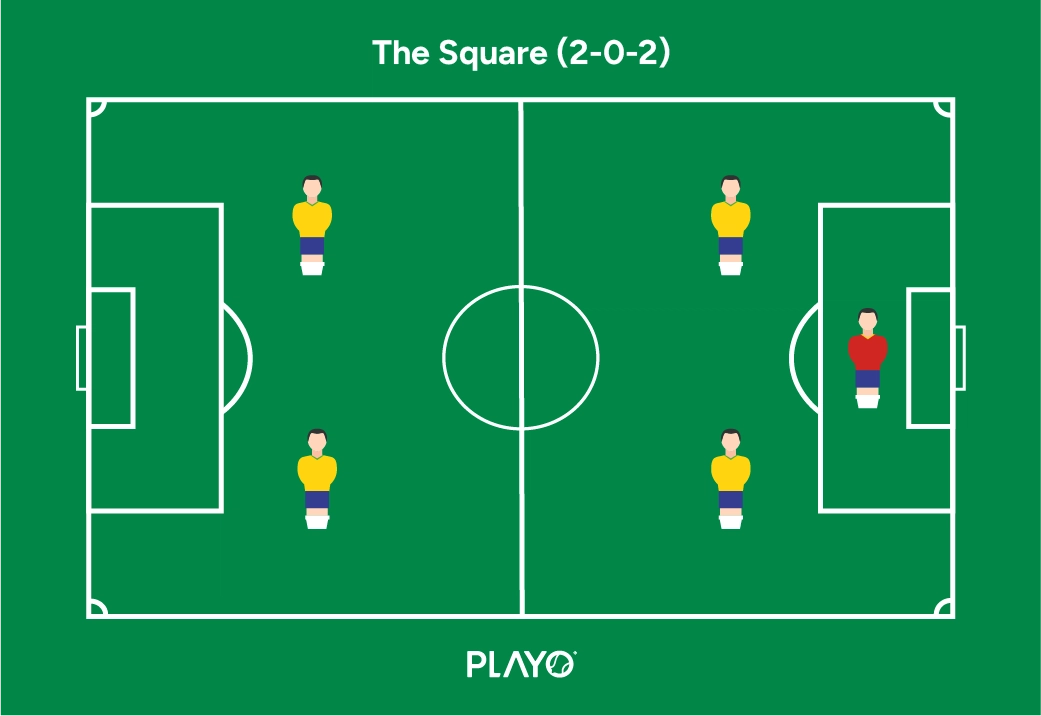
As the name suggests, this formation includes 2 defenders and 2 forwards who have clearly defined roles of defense and attack.
One of the best football formations, this is an excellent choice when you are just starting with a team of players with varied experience levels. However, in this 5v5 soccer formation, while 2 players each are required to stay back and push forward respectively, this formation requires some flexibility in terms of attackers supporting the defenders and vice versa.
Pros:
- Involves everyone in the play irrespective of their experience.
- Balanced and kept the player’s roles simple.
- Flexible approach.
Cons:
- Predictable and easy to read by the opponents.
- Roles may get mixed up due to lack of communication and the player’s inexperience.
- It can weaken the game if the defenders and attackers are all inexperienced players.
2. The Wall (3-0-1)
Playing against a strong team, or you are one up in the game, and don’t want to get too greedy? Use THE WALL. The Wall, as the name suggests, is a super defensive strategy which should be adopted for a certain period in the game, rather than the team’s default formation. This 5-a-side formation involves creating a wall of sorts with 3 defenders and 1 striker in preventive positions.
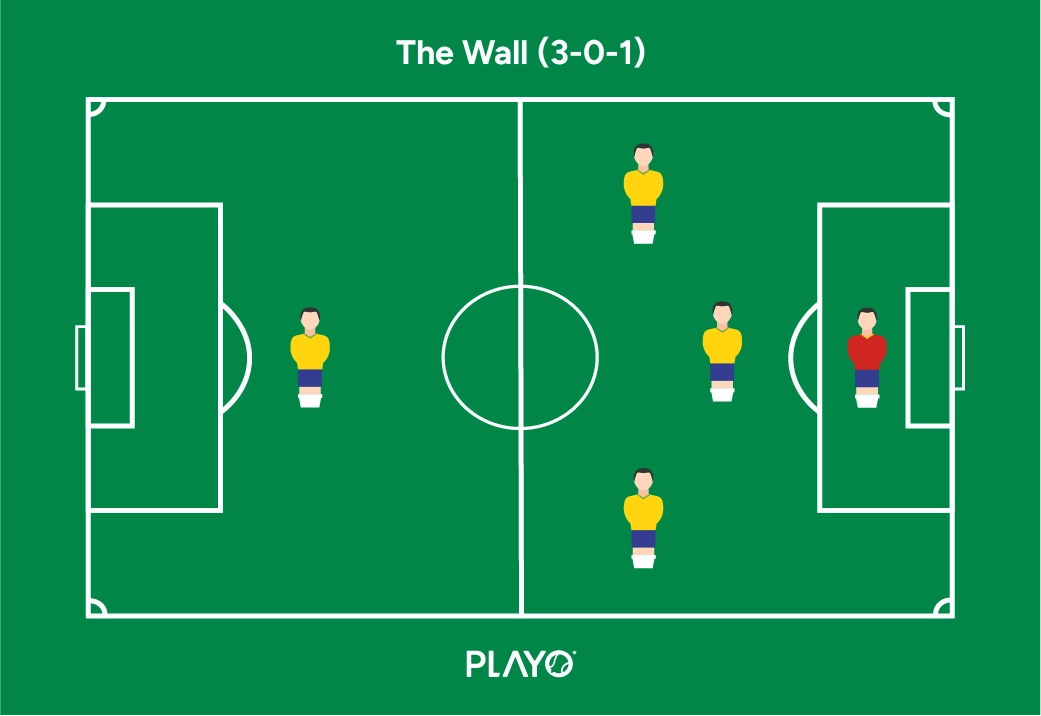
In this five aside football formation, the defenders try to stop the incoming goals while passing on the ball to the striker to attempt counter goals.
Pros:
- Gives your team an excellent defense.
- Quicker players in a Wall formation can deliver outstanding counterattacks.
Cons:
- May not result in too many goals.
- If the attackers are unwilling to think independently, it may weaken the game.
- This formation cannot be a team’s default position.
3. The Diamond (1-2-1)
You think you have the perfect team with the right people for the right job, then this formation is something you should adopt. The key to this formation is the midfielders who need to be fast on their feet, literally and figuratively. They are going to be doing most of the running, so make sure to have a couple of equally good subs on the bench.
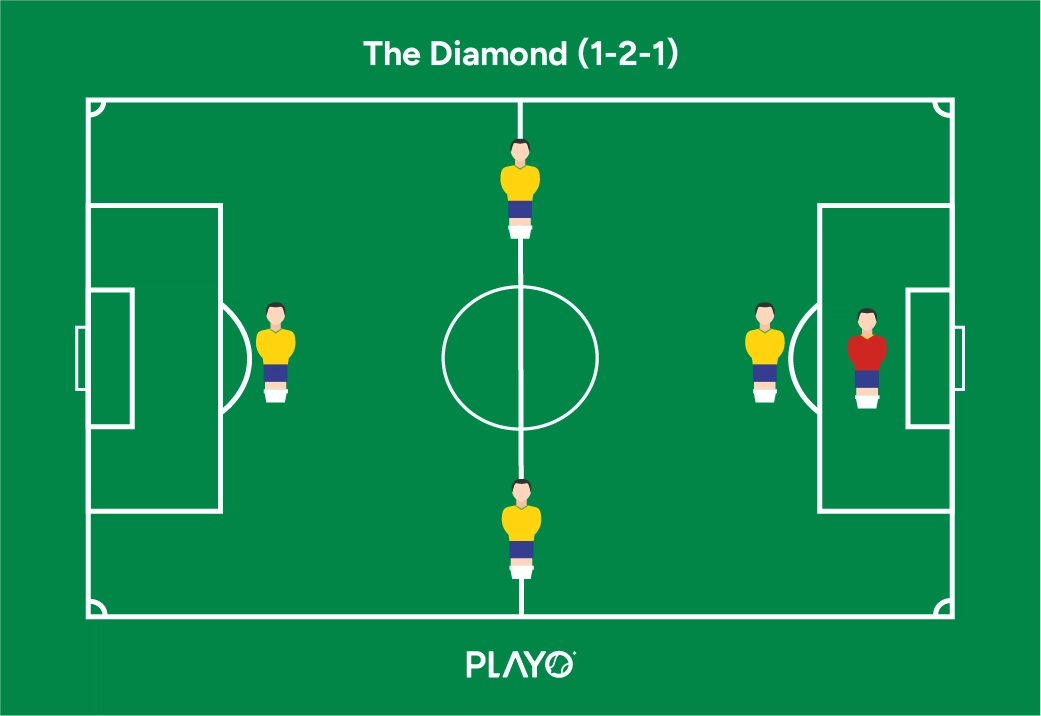
Known as the best 5-a-side football formation, particularly for its flexibility, the diamond allows balancing the defence and the attack extremely well. This balance is maintained while having two midfielders linking both their games. This formation is especially used when a team has a lot of substitutes to keep refreshing their midfield positions.
Pros:
- The best football formation when the opposing team is of similar capability.
- This formation allows your team to utilise the rival team’s weaknesses and score goals.
- Allows players to assume responsibility while being disciplined.
- This football formation is extremely adaptable and flexible.
Cons:
- It doesn’t work well when players focus too much on attack and ignore the defense positions leaving it open for the opposition to exploit.
- This 5v5 soccer formation may fall flat if the defender is unskilled or inexperienced.
Read More: Who is the Captain of the Indian Football Team?
4. The Y (1-1-2)
Do you see the opposing team using the “THE WALL”? Shift to the “Y”, which is a very attacking formation. The key idea of this formation is to get possession of the ball as high up on the pitch as possible and try to maximise that. The Y is one of the most offensive 5-aside football formations, known for creating a lot of pressure on the opposing side’s defence. This 5-a-side formation has one player behind the two at the front to cover more space. It also allows the players to block the passing lanes. The midfielder, however, will be required to play a supporting role with the defence when your opposition has the ball.
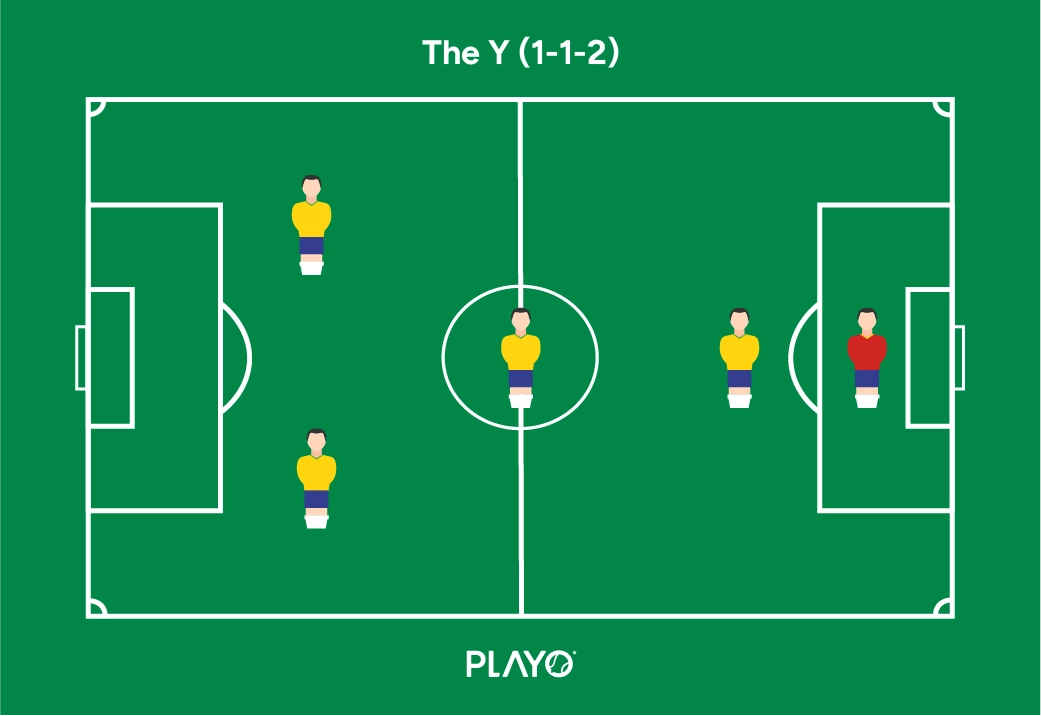
This attacking position often ensures that your team scores many goals, especially when played against a weaker team.
Pros:
- An excellent five-a-side football formation, which helps in scoring goals.
- The defender’s position is usually free of confusion since this 5-a-side formation has one player as the ‘last man’ at the back.
- Extremely useful while playing a high-pressing game.
Cons:
- The players must be experienced in this formation to utilise their strengths fully.
- This football formation may expose the entire line of defence if the attacking players are not committed to playing a pressing game.
- This formation must be practised for a long to help you score goals.
5. The Counter (2-1-1)
This is often considered one of the most effective 5-a-side formations. Also known as the “Pyramid”, it consists of two defenders, one striker, and one midfielder. Among the more defensive five-a-side football formations, this setup focuses on staying compact and scoring primarily through counter-attacks.
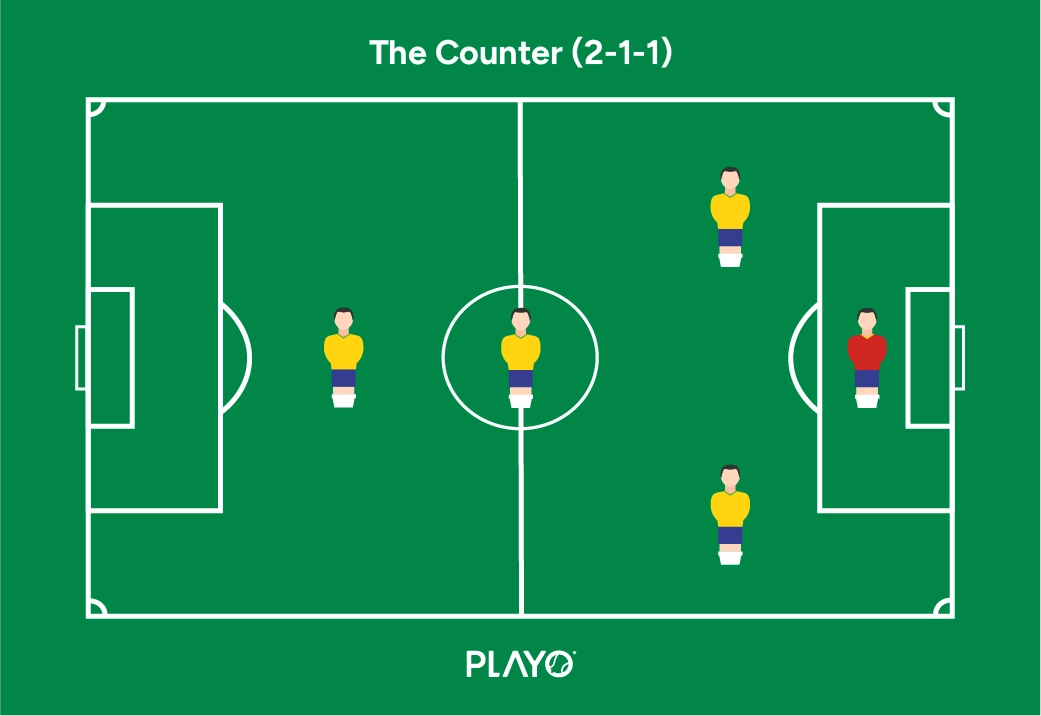
This formation works best when your fastest and fittest player operates as the attacking outlet. Along with strong, reliable defenders, the striker must be clinical when chances arise. A floating midfielder plays a crucial role by linking defence and attack, providing support on transitions and maintaining team balance.
Pros:
- One of the few 5v5 soccer formations that frees up the pivot, the outright striker,to concentrate on attacking.
- This formation utilises the defence better without exposing it from behind.
- The defenders get better support from the midfielders than most other 5-a-side football formations.
Cons:
- The midfielder needs top-notch stamina to continue supporting both the attack and defence throughout the game.
- The defenders must also be experienced, without relying on the midfielder to do all the attacking.
6. The Hail Mary (1-0-3)
Also known as the ‘All or nothing’ football formation, the Hail Mary is among the most intense and exciting formations in a 5-a-side football game. In this formation, 1 defender and 3 attackers are involved in an extremely structured play.
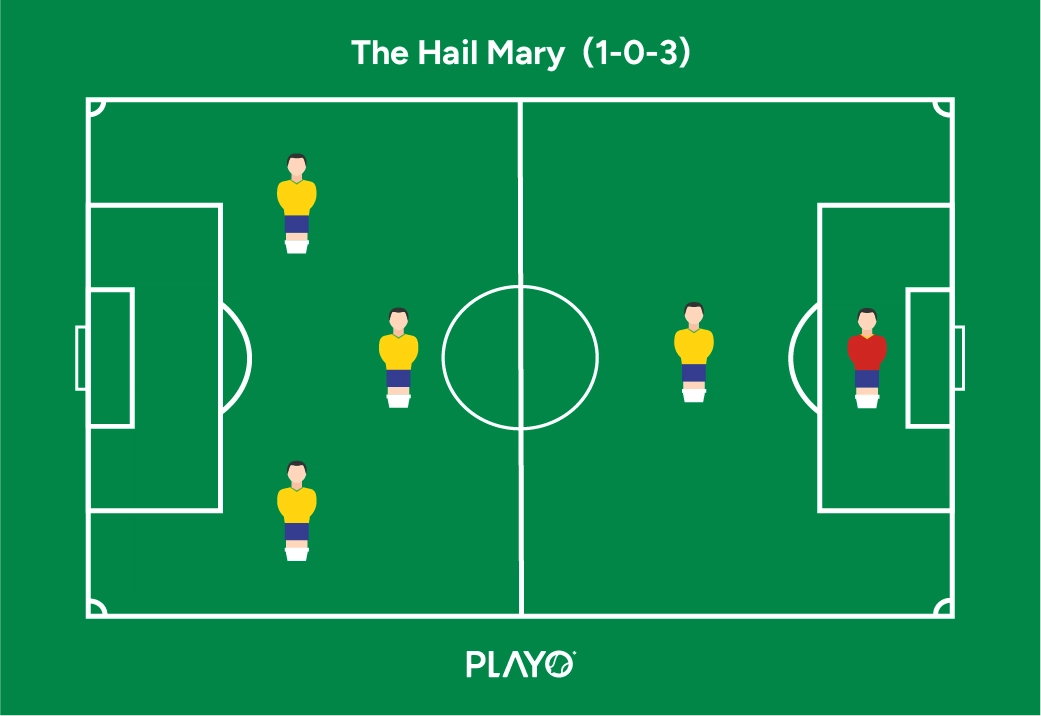
This is the best football formation when your team is more experienced than the opposition. Another situation where this formation is important is when your team hasn’t been able to score till almost the end of the game and is willing to take a risk.
In this formation, the players on the right and left sides of the football pitch should assist the defender in case of an attack by the opposition. Since this five-a-side football formation requires constant attacking, defending, and pressuring, you need the toughest, most versatile players as your attackers.
Pros:
- If strategised well, this is one of the top 5-a-side formations to help you get goals even if you are late into the game.
- This is a perfect formation to utilise your team’s experience and turn the game in your favour.
Cons:
- This is one of those few football formations in which the defender may be left exposed.
- This formation is not intended to be utilised for the entire game duration. It is more suitable in a ‘do or die’ situation.
Conclusion
Formations in 5-a-side football are not about copying what other teams do or choosing a setup that simply looks good on paper. They are about understanding your team’s strengths, recognising weaknesses, and assigning roles that maximise efficiency on a small, fast-paced pitch.
When selecting a formation, factors such as player experience, fitness, and tactical awareness should guide the decision. Flexibility is equally important, as five-a-side football demands quick transitions and shared responsibility across positions. Ultimately, the most organised team, not necessarily the most talented one, is often the team that controls the game and gets results.
Download Playo on Android or iOS, or visit playo.co to start playing!
Frequently Asked Questions
There is no single best formation for 5-a-side football. The most effective setup depends on the player’s ability, fitness, and match situation. Balanced teams often use 2-0-2 or 1-2-1, while defensive or counter-attacking teams may prefer 3-0-1 or 2-1-1.
A typical 5-a-side team includes a goalkeeper, a defensive player or sweeper, midfield support, and an attacking pivot or striker. Players frequently rotate roles due to the fast pace and limited space.
5-a-side football is harder in terms of intensity and decision-making. Players have less time and space, must defend and attack constantly, and are involved in play more frequently than in 11-a-side matches.
The main weakness of a 4-3-3 formation is exposure in midfield and defence if wingers do not track back. It also requires high fitness levels and strong positional discipline to prevent counterattacks.
Weaker players are usually positioned where they face less direct pressure, such as wide areas or deeper defensive roles with support. In small-sided games, roles should still allow cover and simple responsibilities.
Shorter players often excel in midfield, winger, and attacking roles that rely on agility, balance, quick turns, and close control rather than aerial strength.